How AI-Powered Tools Transform Preconstruction Estimation
Picture this: your team is gearing up for a big bid. The deadline is tight, and your estimators are buried in drawings, highlighters in hand, spending countless hours just to calculate quantities. Sound familiar? For decades, manual takeoffs have been the bottleneck in preconstruction—slow, error-prone, and frustrating.
But what if much of that grind could be automated? That’s where AI-powered takeoff tools come in.
The Problem: Manual Takeoffs Are a Productivity Sinkhole
Let’s break it down. A typical manual takeoff involves:
- Printing PDF plans or opening them in tools like Bluebeam.
- Manually measuring areas, lengths, and counts.
- Transcribing those quantities into a spreadsheet.
- Double-checking (and triple-checking) for errors.
This process is time-consuming and prone to mistakes. Miss a line on the drawing? You could underbid and eat the cost later. Overestimate? You risk pricing yourself out of the competition.
In short, manual takeoffs are slow, costly, and ripe for disruption.
The AI Solution: Vision AI for Automated Takeoffs
Here’s how AI-powered takeoffs change the game:
1. Upload Your Drawings
You start by uploading your PDF or CAD files into the software. The platform begins analyzing the drawings immediately.
2. AI Extraction
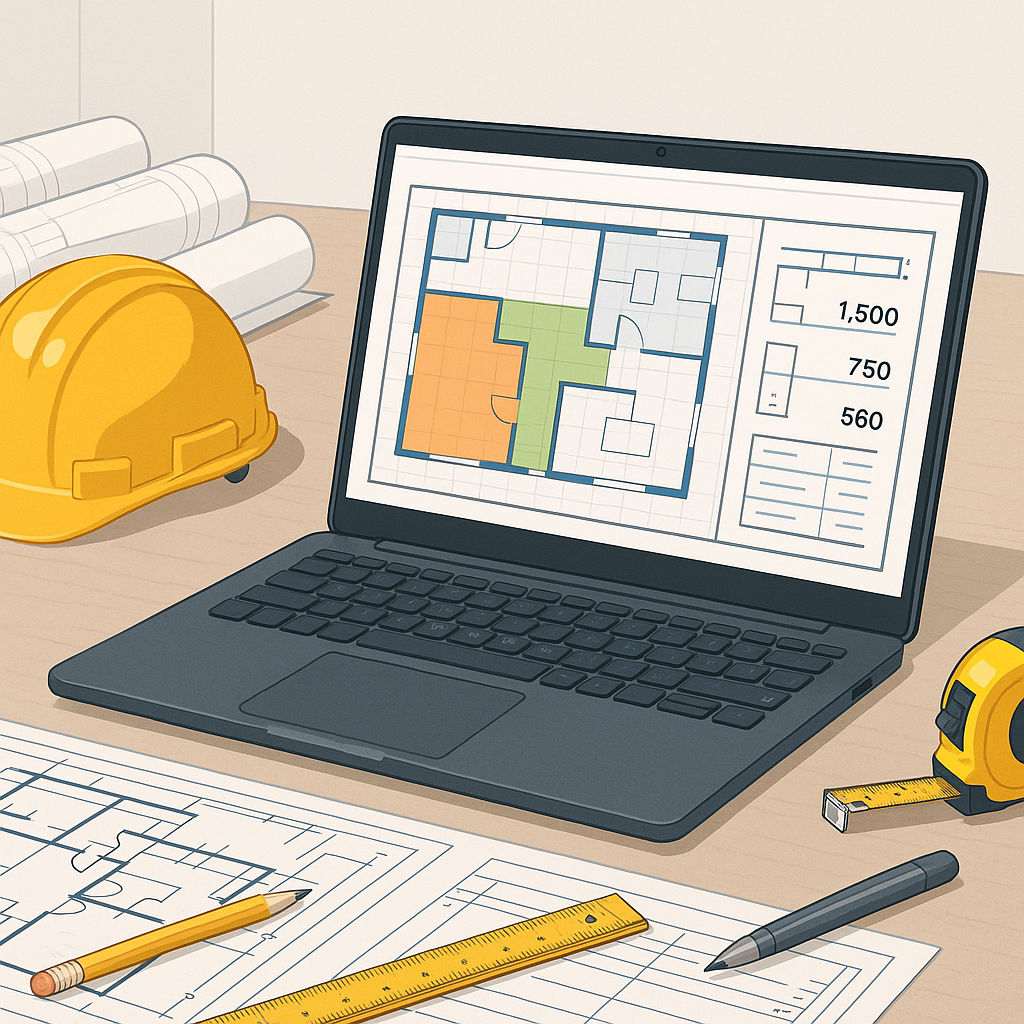
Using Vision AI, the tool identifies and extracts quantities—room areas, wall lengths, door counts, and more. It’s not just reading PDFs; it’s interpreting them. Think of it like having a junior estimator who works at lightning speed.
3. Flagging for Review
No AI is perfect, and that’s okay. Tools often flag low-confidence measurements for manual review, ensuring you stay in control while automating repetitive tasks.
4. Real-Time Updates
Got a revised drawing? Upload it, and the AI recalculates quantities instantly. No starting from scratch.
Illustrative example — A contractor using AI-powered tools could reduce takeoff time significantly, freeing up hours for higher-value tasks like bid strategy and subcontractor negotiations.
Why It’s Not Just About Speed
Speed is great, but accuracy and reliability are just as critical. AI-powered tools excel here too:
- Fewer Errors: AI doesn’t skip lines or misread dimensions.
- Consistency: Every takeoff follows the same logic, reducing variability.
- Audit Trails: Many tools provide a full breakdown of how quantities were calculated, so you can defend your numbers in meetings.
The Obvious Objection: “AI Can’t Think Like an Estimator”
It’s true—AI doesn’t understand construction the way you do. It won’t decide whether to round up quantities or factor in site-specific complexities. But that’s not the point.
AI isn’t here to replace you; it’s here to handle the repetitive tasks so you can focus on what you do best—applying judgment, negotiating, and winning bids.
Common Mistakes When Adopting AI Takeoff Tools
If you’re considering making the switch, avoid these pitfalls:
- Relying on Defaults: Customize the tool to your project’s needs. AI is only as good as the inputs you provide.
- Skipping Training: Even intuitive tools require some onboarding. Invest time upfront.
- Ignoring Low-Confidence Flags: Always review flagged items. AI is fast, but it’s not infallible.
The Bottom Line
Manual takeoffs are the past. AI-powered tools are the future—not just for speed, but for accuracy, consistency, and scalability. If your team is still spending excessive hours on takeoffs, it’s time to rethink your process.
AI-powered tools streamline preconstruction estimation, allowing you to focus on higher-value tasks and improving your chances of winning bids.


