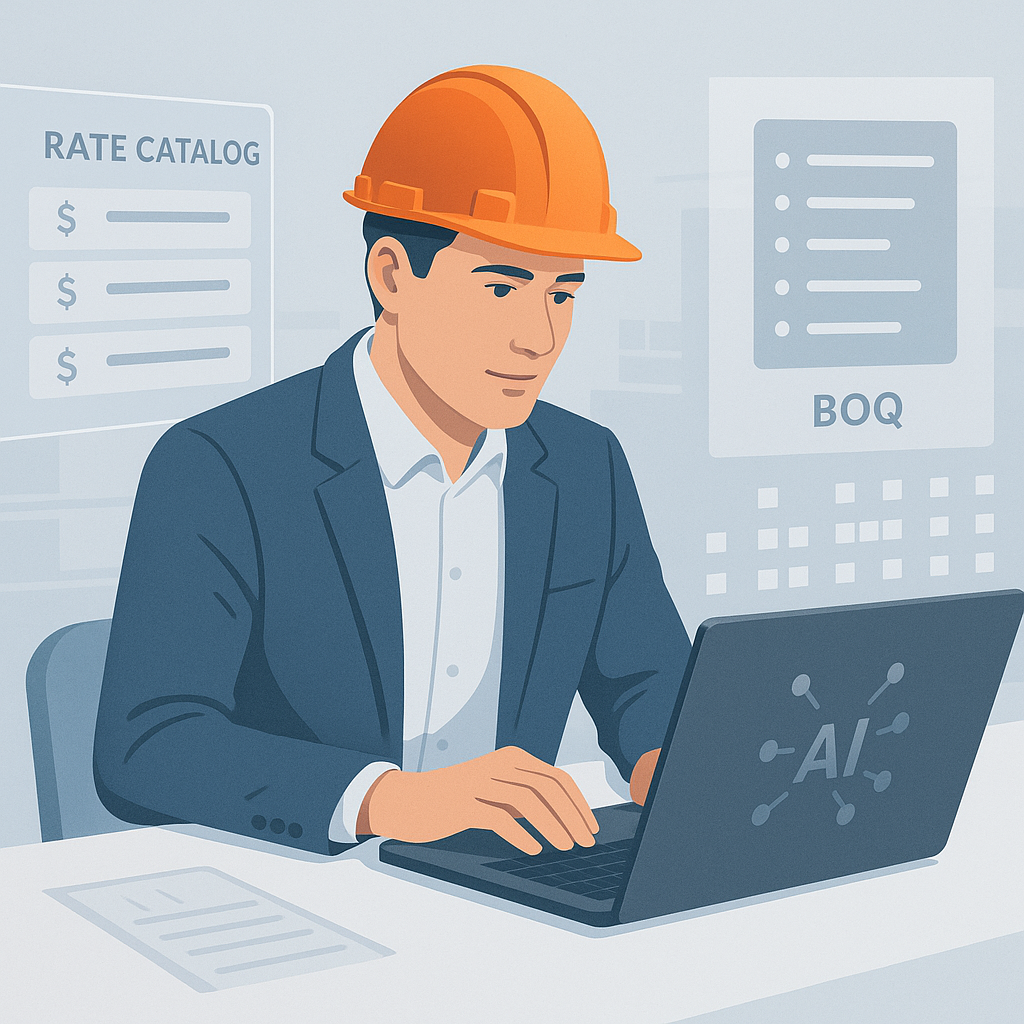
The Hidden Time Sink in Preconstruction Estimation
Every estimator has been there. You’re under the gun to get a bid out, and you’re staring at a BOQ (Bill of Quantities) with hundreds of line items. Each one requires an accurate rate pulled from a 2,000-page rate book, multiple online databases, or—worst case—your own spreadsheets. It’s time-consuming, tedious, and prone to errors. And yet, getting those rates right is critical. Get it wrong, and you’re either overbidding (and losing the job) or underbidding (and losing money).
This is where AI-powered rate matching can save the day. Many teams spend significant time on rate lookup for a single BOQ. That’s time that could’ve been spent reviewing takeoffs, negotiating with subs, or refining the bid strategy.
What Is AI Rate Matching?
Let’s break it down. Rate matching is the process of finding the most accurate, applicable rate for each line item in a BOQ. It involves pulling rates from a mix of sources—RSMeans, CPWD DSR, state-specific SORs, or even your company’s historical projects. The problem? Most of these sources aren’t searchable. Instead, you’re scrolling through PDFs or manually cross-referencing spreadsheets.
AI rate matching changes that. Instead of searching manually, you upload your BOQ to a platform like EstimateNext. The AI uses semantic search to understand what you’re asking for and instantly pulls the most relevant rates from its database. For example, if your BOQ has a line item for "12mm TMT bars," the AI scans its database of thousands of items and returns the most relevant matches—complete with material, labor, and equipment breakdowns. It even considers historical adjustments and regional variations.
Why Does It Matter?
Here’s why this is a game-changer:
-
Speed: Instead of spending hours hunting for rates, you get matches in seconds. Multiply that time savings across multiple estimates, and you’re freeing up significant labor hours every year.
-
Accuracy: Humans get tired. AI doesn’t. Manual rate lookup is error-prone, especially when you’re rushing to meet a deadline. A typo or a missed rate can cost you the job—or worse, the project’s profitability. AI minimizes that risk by providing precise matches based on your input.
-
Learning Over Time: Here’s where it gets interesting. AI tools like EstimateNext improve with use. Every time you accept or reject a rate match, the system learns. By the time you’re on your third project, it’s not just fast—it’s personalized to your preferences.
Simplifying CPWD DSR Rates
If you’ve ever handled government projects in India, you know the pain of dealing with CPWD DSR. These rate books are massive, hard to navigate, and updating rates for inflation adds another layer of complexity.
AI-powered tools can simplify this process by matching BOQ line items to the appropriate CPWD DSR rates, flagging items for manual review when needed, and even suggesting inflation adjustments based on relevant indices. This reduces the manual effort required and ensures greater consistency in rate application.
The Obvious Objection: "But AI Can’t Think Like an Estimator!"
You’re right—it can’t. AI doesn’t replace your expertise; it amplifies it. You’re still the one making judgment calls, negotiating with subs, and deciding on markup. The AI just handles the grunt work—like rate matching and what-if recalculations—so you can focus on the high-value tasks.
Common Mistakes to Avoid
- Over-reliance on AI: AI is a tool, not a magic wand. Always review low-confidence matches and edge cases.
- Ignoring Custom Rates: If your project uses custom materials or finishes, make sure to upload those to the system. Most AI platforms, including EstimateNext, allow this.
- Skipping Feedback Loops: The AI gets smarter with use. If you don’t provide feedback on matches, you’re leaving efficiency gains on the table.
The Bottom Line
If you’re still spending hours flipping through rate books, it’s time to rethink your workflow. AI-powered rate matching isn’t a luxury anymore—it’s a necessity for staying competitive in today’s construction market.


