The Challenge in Estimation: Manual Rate Lookups
Every estimator knows the pain. You’re halfway through an estimate when you hit a snag: you need a specific rate for a custom material or labor task. So, you crack open a 2,000-page rate book (like RSMeans or CPWD DSR) or sift through your company’s outdated Excel sheets. Hours pass. Your frustration climbs. And you still don’t feel confident that the rate you found is the right one.
It’s not just a headache—it’s a margin killer. A mismatched rate can mean underbidding (and losing money) or overbidding (and losing the job). Worse, the time you spent hunting down that rate could’ve been spent refining the bid or strategizing with your team.
Here’s the good news: AI-powered rate matching tools make this problem easier to manage. Let’s break down how.
What Is AI Rate Matching (and Why Does It Matter)?
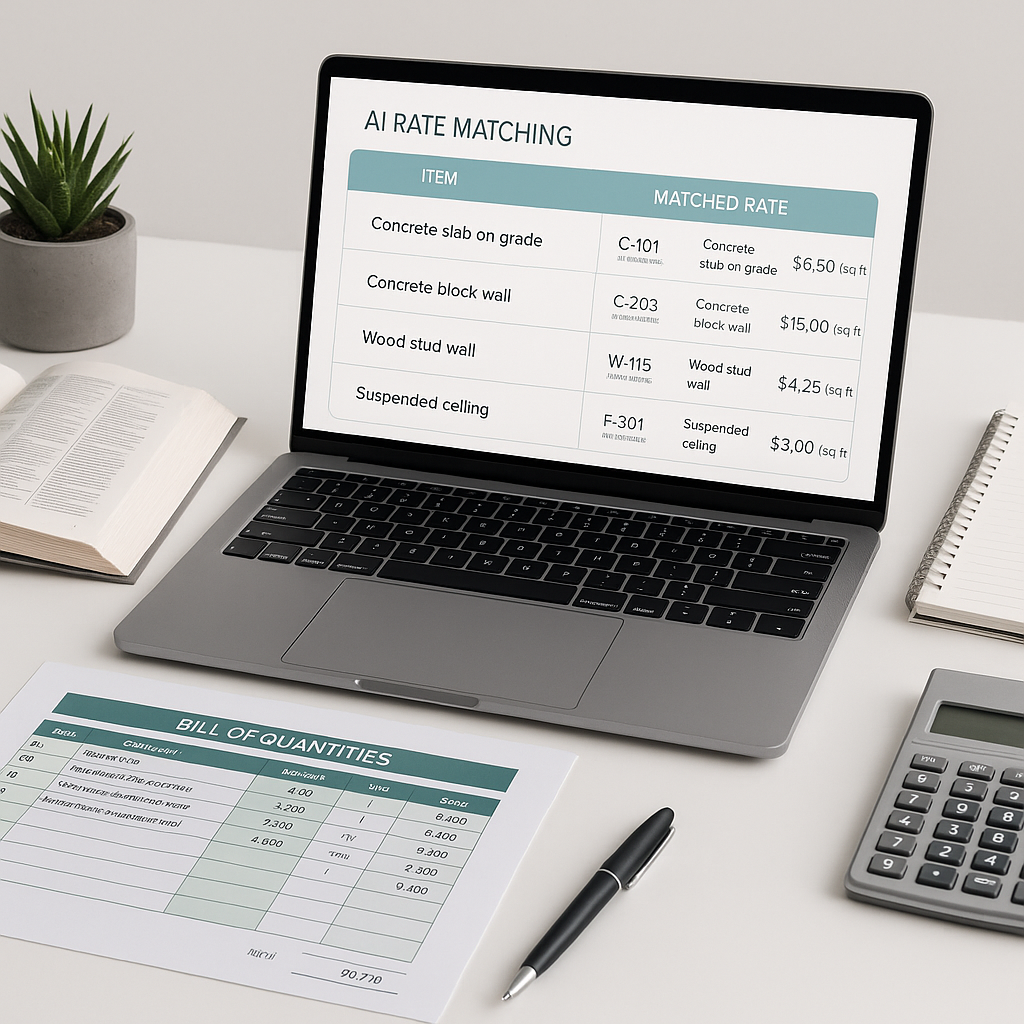
AI rate matching is exactly what it sounds like: using artificial intelligence to find the right rate for a specific task, material, or service. Instead of flipping through rate books or guessing, you upload your BOQ (Bill of Quantities), and the software matches each line item to the most relevant rate in its database.
For example, AI tools can scan thousands of SOR (Schedule of Rates) items across catalogs like CPWD DSR, RSMeans, and others. Need the installation cost for a specific material? Just type it in. Done in seconds. No manual cross-checking. No second-guessing.
How It Works: General Overview
Let’s say you’re estimating a mid-rise residential building project. You upload the BOQ into an AI-powered estimation platform. Here’s what happens next:
- Smart BOQ Parsing: The AI reads your BOQ—whether it’s a neatly formatted Excel sheet or a messy CSV file with merged cells—and breaks it down into individual line items.
- Semantic Search: For each item, the AI searches its database of rates using natural language processing. It doesn’t just look for exact matches; it understands context. For example, if your BOQ says “plastering walls,” the AI knows to look for rates under “wall finishes” instead of “flooring.”
- Rate Matching: The AI suggests the best-matching rates, ranked by relevance. It might offer options from multiple catalogs so you can choose the one that fits your project.
- Feedback Loop: If a rate doesn’t feel right, you can override it. The system learns from this feedback for future estimates.
The result? What used to take hours now takes minutes. And you can trust the rates because they’re pulled from verified, up-to-date sources.
Benefits: Time Saved, Errors Reduced
Manual rate lookup can take significant time per estimate. AI-powered tools reduce this drastically, allowing teams to focus on refining bids and improving strategy.
But it’s not just about time. Rate mismatches are a hidden cost that most teams don’t track. Underpricing a task can eat into your profit margins. Overpricing can make your bid uncompetitive. AI helps mitigate these risks by ensuring every rate is accurate and consistent.
Common Objections (and How to Address Them)
“AI can’t handle my custom rates.”
Many AI tools allow you to upload your own rate catalogs. Once they’re in the system, the AI treats them like any other source. You can even set project-specific rates for unique tasks or materials.
“What if the AI gets it wrong?”
No system is perfect, but AI tools include safeguards like manual overrides. If a rate looks off, you can flag it and adjust. Plus, the AI learns from your corrections, so it gets smarter with every project.
“This sounds complicated to set up.”
Most platforms are designed for ease of use. Training typically takes a short amount of time, and the interface is as intuitive as using Excel. If you can upload a file, you can use AI rate matching.
What to Watch Out For
- Outdated Catalogs: If the AI pulls from an old SOR, you might still end up with inaccurate rates. Make sure your tool uses current data.
- Garbage In, Garbage Out: The AI is only as good as the BOQ you feed it. Double-check your input for errors or missing details.
- Over-Reliance: AI is a tool, not a replacement for human judgment. Always review the final estimate before submitting your bid.
Final Thoughts
Manual rate lookups are a relic of the past. They waste time, drain resources, and introduce unnecessary risks into your estimates. AI-powered rate matching simplifies the process, making it faster and more efficient.
If you’re tired of losing hours to rate books and spreadsheets, it’s time to explore better solutions.


