The Estimation Bottleneck Every GC Knows Too Well
If you run a general contracting firm, you already know the drill. A new tender lands on your desk — maybe a 200-bed hospital, a mixed-use tower, or a government infrastructure project. Your chief estimator opens a blank spreadsheet, starts hunting for rate books, and begins the slow, manual grind of pricing every line.
Forty hours later, the estimate is done. Maybe. If nobody made a copy-paste error. If the rates are current. If the sub quotes actually got levelled properly.
This is how most GCs still operate. And it is costing them bids.
What 80% Faster Actually Looks Like
The firms that have moved past spreadsheets are not just saving time — they are winning more work. Here is what changes when estimation becomes a structured, intelligent process:
- Drawing takeoff in minutes, not days. Upload architectural or structural drawings, and measurements flow directly into your BOQ. No more scaling off paper prints or toggling between PDF viewers and spreadsheets.
- Rate matching against 78,000+ items. Instead of manually searching through CPWD, SOR, or CSI MasterFormat schedules, the system matches your BOQ lines to the closest rate items from 135+ catalogues. A hospital BOQ with 2,000 lines that used to take a week gets matched in under an hour.
- GMP pricing with built-in contingency logic. Guaranteed Maximum Price contracts need careful layering — direct costs, general conditions, contingency, fee. With a structured GMP workflow, you build the price once and adjust scenarios in real time.
Sub Levelling: The Hidden Time Sink
Most GCs spend almost as much time levelling sub bids as they do on their own estimate. You receive quotes from six MEP subs, but each one has priced the scope differently. One includes commissioning, another excludes it. One prices by system, another by floor.
A proper bid levelling tool normalises these quotes into a common structure so you can compare like-for-like in 30 minutes instead of three days. You spot the gaps, the exclusions, the outliers — before they become change orders.
Real Numbers from Real Projects
Consider a mid-size GC handling 15-20 tenders per quarter. Their estimation team of four was spending roughly 600 hours per quarter on pricing — that is nearly four person-months. After adopting a structured estimation platform:
- Time per estimate dropped from 40 hours to 8 hours on average
- Bid submission rate increased by 35% because the team could handle more tenders
- Win rate improved by 12% because estimates were more accurate and competitive
- Rework on awarded projects dropped by 20% because the original scope was priced correctly
These are not hypothetical numbers. They reflect what happens when you replace manual processes with structured workflows.
What About Your Existing Processes?
The biggest concern GCs have is disruption. You have rate libraries you have built over years. You have estimators who know their spreadsheets inside out. You have workflows that, however slow, actually work.
The right platform does not ask you to throw all of that away. EstimateNext, for example, lets you import your existing rate libraries and historical project data. Your estimators still make the decisions — they just make them faster because the data is organised, searchable, and matched automatically.
The Preconstruction Advantage
Here is the real competitive edge: when you can estimate faster, you can estimate earlier. You can give your clients rough-order-of-magnitude pricing at the concept stage. You can run what-if scenarios during design development. You can show a client that switching from curtain wall to precast saves 18% on the facade — before the drawings are finalised.
This is preconstruction done right. Not just a cost check at tender stage, but an ongoing conversation about value, cost, and time.
Five Questions to Ask Your Team This Week
- How many hours does your average tender estimate take from start to submission?
- How many tenders did you decline last quarter because you did not have capacity?
- When was the last time you updated your rate library with current market prices?
- How long does it take to level sub bids on a multi-trade package?
- Can you run a what-if scenario on a live estimate in under five minutes?
If the answers to these questions make you uncomfortable, it might be time to rethink your estimation workflow.
Getting Started
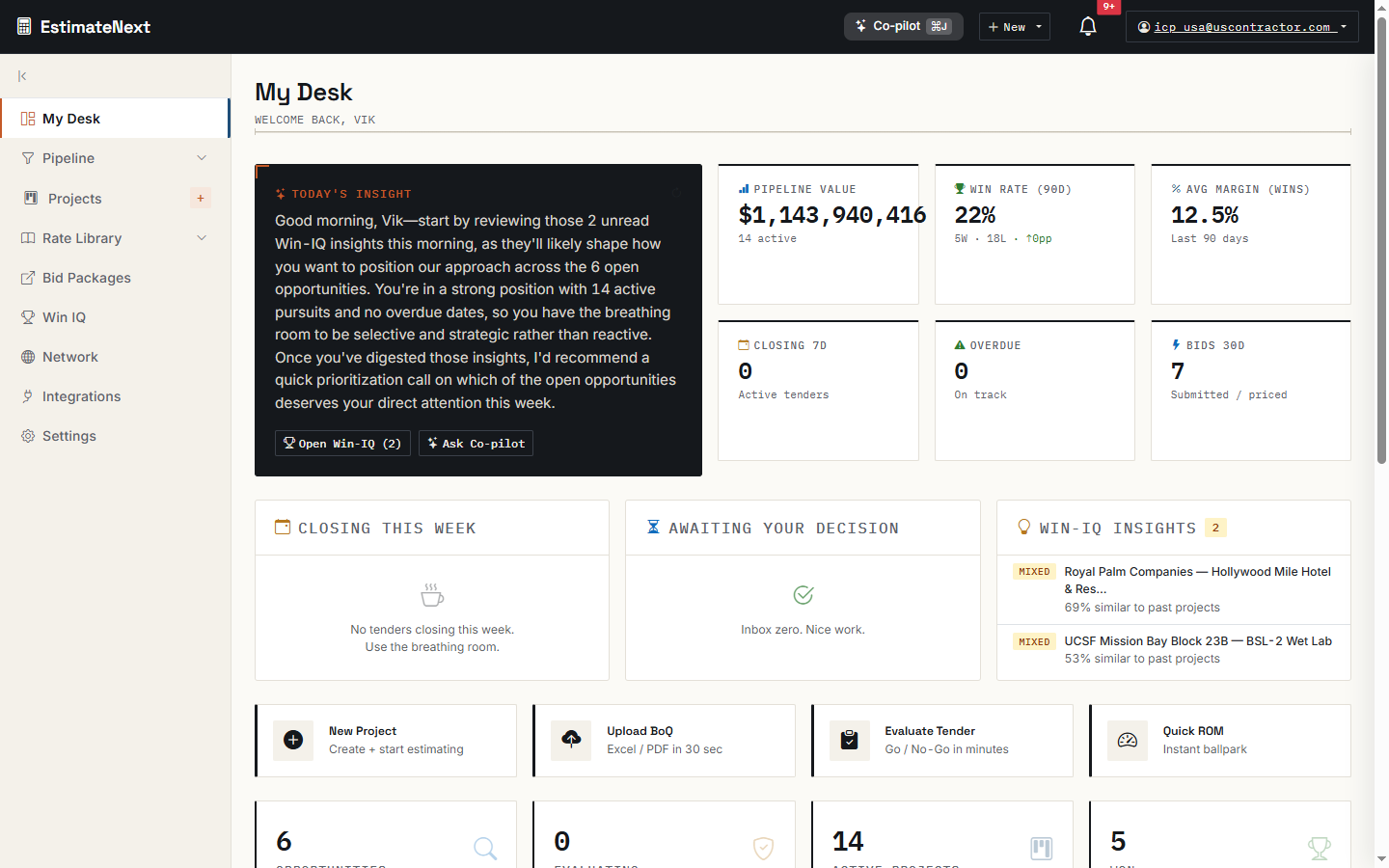
The shift does not have to be dramatic. Start with one project. Upload a BOQ, match it against a standard catalogue, and see how the numbers compare to your manual estimate. Most teams find that the platform pays for itself on the first tender — not in subscription fees saved, but in hours recovered and bids won.
Ready to see how EstimateNext can accelerate your next tender? Request a demo and bring a real project BOQ — we will price it together.
Ready to see EstimateNext in action?
AI-powered preconstruction estimation platform — from BOQ upload to priced bid package in minutes. 78K+ SOR items, 7 specialist trade tools, bid intelligence, and a procurement network.
Get Started Free →

