The PMC Estimation Challenge
Project Management Consultancies operate across geographies, and that creates a unique estimation challenge. Your Dubai office prices in AED using UAE municipality rates. Your London office uses NRM2 with BCIS benchmarks. Your Mumbai office follows CPWD schedules. And your New York team works in CSI MasterFormat divisions.
Same company, same clients, completely different estimation frameworks. The result? No two offices estimate the same way. Comparison across projects is nearly impossible. And when a client asks "How does this project compare to the one you did in Dubai?" — the answer requires a manual, painful reconciliation.
Why Standardisation Matters More Than You Think
PMCs live and die by benchmarking. Your value to clients is not just project management — it is the accumulated knowledge of what things cost across markets and project types. But that knowledge is trapped in spreadsheets, personal rate libraries, and the heads of individual estimators who move to competitors every few years.
Standardised estimation does not mean forcing every office to use the same rate catalogue. It means establishing a common structure that allows meaningful comparison:
- Common work breakdown structure that maps to local frameworks
- Normalised cost metrics (cost per square metre, cost per bed for hospitals, cost per student for schools)
- Currency-adjusted benchmarks with purchasing power parity corrections
- Consistent contingency and escalation methodology
Multi-Market Rate Intelligence
The real power of a unified estimation platform for PMCs is cross-market rate intelligence. When your London QS is estimating a hospital and can see what similar items cost on your Mumbai hospital project (adjusted for purchasing power), they have a sanity check that no published rate book can provide.
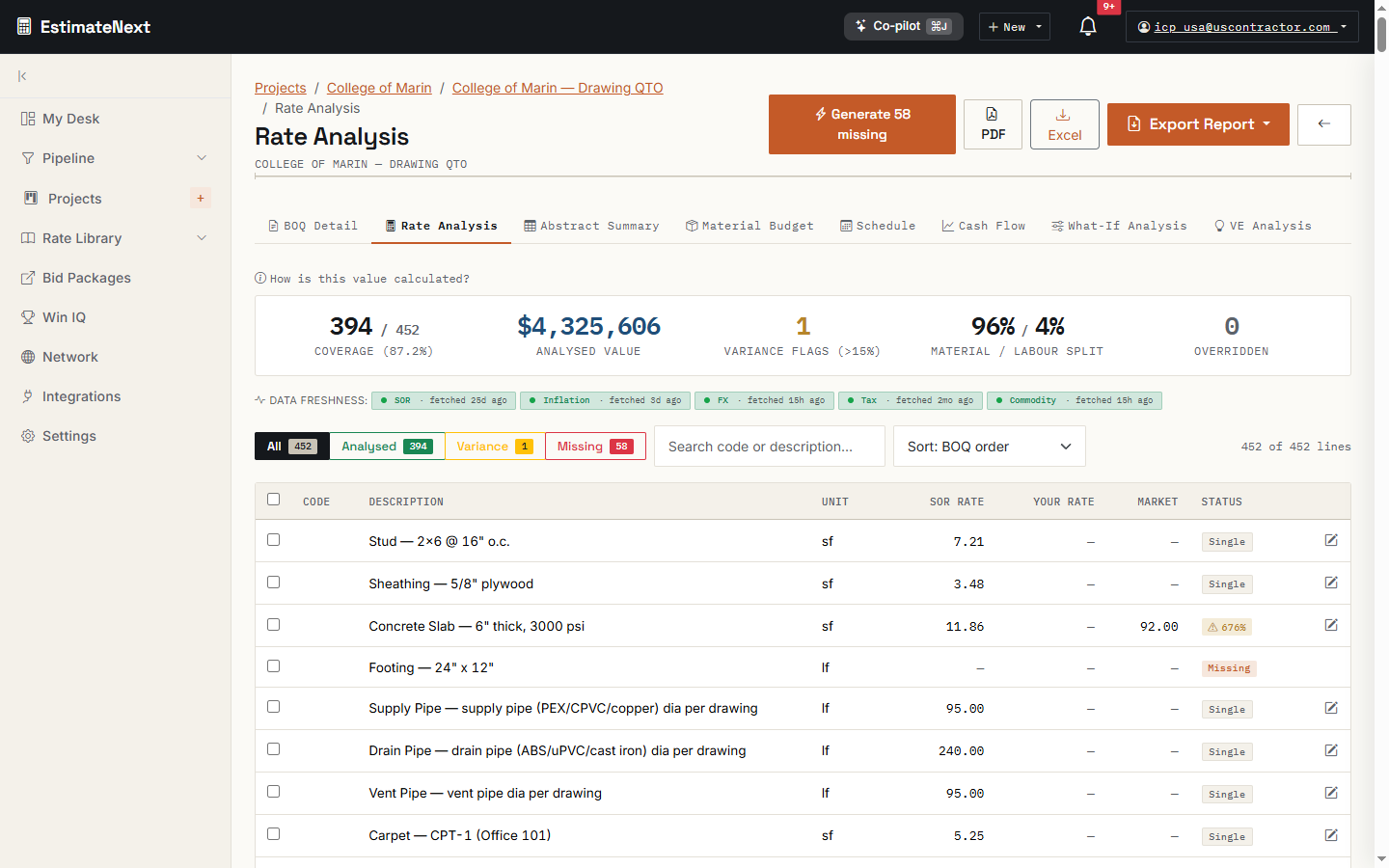
EstimateNext maintains rate catalogues for multiple markets — CPWD and state SORs for India, NRM2 elements for the UK, CSI divisions for North America, and regional rates for the Middle East. When you work across markets, you can:
- Apply the correct local framework for each project
- Compare normalised costs across geographies
- Identify items where local market conditions create outliers
- Build project-type benchmarks (hospitals, offices, schools) that work globally
Practical Multi-Office Workflows
Here is how a PMC with four offices might structure their estimation workflow:
Project Setup
The lead office creates the project in the platform with the correct measurement framework, currency, and rate catalogue. A 200-bed hospital in Abu Dhabi gets UAE municipality codes and AED rates. The same scope in Hyderabad gets CPWD rates in INR.
Rate Library Management
Each office maintains its own rate library, supplemented by the platform's built-in catalogues. A global rate committee reviews and approves updates quarterly. This ensures local knowledge is captured without losing consistency.
Cross-Project Benchmarking
When a new tender comes in, the estimator can pull benchmarks from similar completed projects across all offices. A school in Dubai benefits from cost data on schools in Mumbai and London — not as direct rates, but as sanity checks on overall cost per square metre.
Reporting to Clients
Clients get reports in their preferred format — NRM2 elements, CSI divisions, or a custom structure. But internally, the data is mapped to a common structure for the PMC's own analysis.
The Data Advantage
Over time, a PMC using a unified estimation platform builds an asset that competitors cannot easily replicate: a cross-market cost database. After 50 projects across four markets, you have:
- Benchmark costs per square metre for 12 building types
- Rate trends by trade over 18 months
- Contingency usage patterns by project type and market
- Subcontractor pricing patterns by geography
This data powers better client advisory, more accurate budgets at concept stage, and defensible cost opinions when disputes arise.
Real Scenario: International School Programme
A PMC is appointed to manage the design and construction of five international schools across three countries — UAE, India, and the UK. Each school is 15,000-20,000 sq metres with similar functional requirements but different local standards, procurement methods, and market conditions.
Without a unified platform, each country team estimates independently. The PMC cannot easily compare costs across the programme or identify procurement efficiencies.
With a unified platform:
- All five schools share a common work breakdown structure
- Local rates are applied in each market
- The PMC can report a normalised cost per student across the programme
- Design changes in one school can be impact-assessed across all five instantly
Getting Started for PMCs
If your consultancy operates across more than one market, start by mapping your current estimation frameworks. Identify the common work breakdown structure that could unify your offices. Then pilot the platform on a real multi-market programme.
Ready to standardise estimation across your offices? Talk to our team about multi-market implementation for PMCs.
Ready to see EstimateNext in action?
AI-powered preconstruction estimation platform — from BOQ upload to priced bid package in minutes. 78K+ SOR items, 7 specialist trade tools, bid intelligence, and a procurement network.
Get Started Free →

