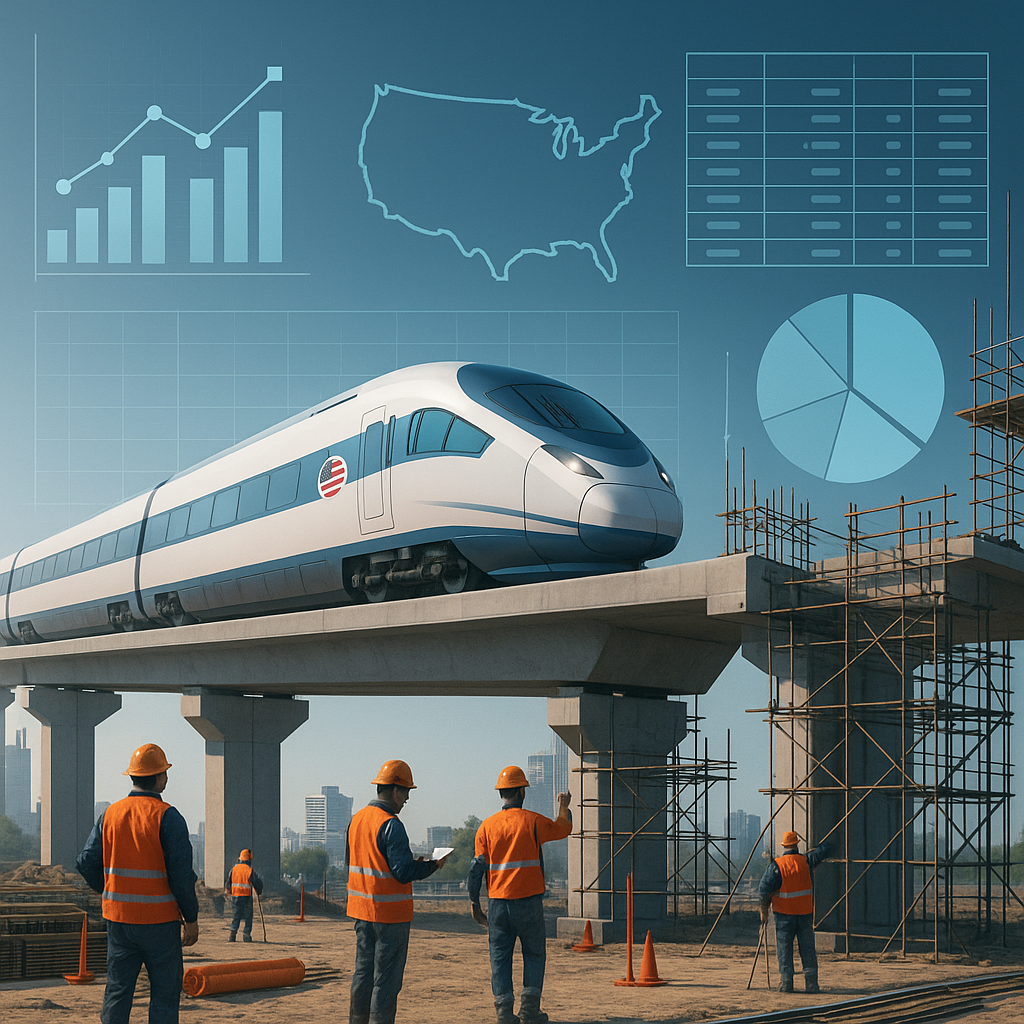
The US Rail Renaissance: Opportunity Meets Challenge
The US is finally getting serious about rail. From Amtrak’s expansion under the Biden administration to various state-level initiatives, rail infrastructure is making a comeback. These projects promise reduced traffic congestion, lower emissions, and better connectivity. But they also come with significant challenges—particularly when it comes to preconstruction estimation.
Let’s face it: estimating for rail projects is complex. The scope often includes everything from structural steel to utility relocation, all spread across hundreds of drawings and BOQ lines. If you’ve ever worked on a rail project, you know the drill:
- Measure track lengths and gradients manually from sprawling PDFs.
- Account for station platforms, staircases, elevators, and utilities.
- Flip between RSMeans, DOT rate books, and custom vendor quotes to piece together costs.
It’s tedious, error-prone, and slow. And on large projects, those errors can add up to significant overruns. So, what’s the fix?
The Estimation Bottleneck: A Real Problem
The biggest bottleneck for rail projects isn’t labor or materials—it’s estimation. Here’s why:
-
Manual Takeoffs Are a Time Sink
For a rail extension, you might spend weeks manually measuring track lengths, station areas, and utility runs. Each revision means starting over, which is a nightmare when deadlines are tight. -
Rate Lookup Is a Mess
Rail projects involve fragmented rate sources: DOT schedules for civil works, union agreements for labor, and niche vendor quotes for specialized equipment like rail switches. Juggling these in Excel is clunky and error-prone. -
What-If Scenarios Are Painful
What happens if inflation jumps mid-project? Or if a material substitution is required? Rebuilding your estimate in Excel is a manual grind. For projects with hundreds of line items, it’s nearly impossible to do this quickly or accurately.
How AI Tools Are Changing the Game
AI-powered estimation tools are designed to address these exact issues. Let’s break it down:
1. Takeoff Automation with Vision AI
Instead of manually measuring from PDFs, AI tools can extract quantities in minutes. Upload a drawing set, and the AI identifies track lengths, wall areas, and even utility counts. This can save significant time on large projects.
2. Semantic Rate Matching
Rate lookup doesn’t have to mean flipping through DOT books or RSMeans PDFs. AI-powered semantic search engines can scan thousands of SOR items and match them to your BOQ in seconds. For rail projects, they can even prioritize state-specific rates or apply inflation adjustments for multi-year projects.
3. Real-Time What-If Scenarios
Need to see how a price increase affects your bid? Or test the impact of a material substitution? AI-powered platforms allow you to make these changes in real time, with every BOQ line recalculated instantly.
4. Bid Intelligence
For GCs, deciding whether to bid on a rail project is often a gut call. AI tools can analyze tender documents against structured criteria to flag potential risks or highlight mismatched scopes before you commit.
Trends Driving Rail Expansion
Why now? A few key trends are fueling the rail boom:
- Federal Funding: The Infrastructure Investment and Jobs Act (IIJA) has unlocked billions for rail projects, including upgrades and new routes.
- Climate Goals: Rail is more sustainable than road or air travel, aligning with state and federal emissions targets.
- Urban Congestion: Cities like Chicago and Los Angeles are betting on rail to ease gridlock and improve public transit.
But these trends also mean tighter timelines and more scrutiny. If estimators can’t keep up, projects risk cost overruns, delays, or outright cancellations.
Common Questions
Q: How accurate are AI-powered takeoffs for rail projects?
A: Tools achieve high accuracy by combining Vision AI with manual review. For critical items like track lengths, you can remeasure low-confidence lines directly within the platform.
Q: Can AI tools handle multi-market rates?
A: Yes. Platforms apply location-specific rates, tax regimes, and labor rules automatically. This is critical for projects spanning multiple states or countries.
Q: What about compliance with DOT or union standards?
A: AI tools integrate datasets like RSMeans, DOT schedules, and Davis-Bacon wage rates to ensure compliance. You can also upload custom rate books for niche requirements.
Q: Do these tools replace human estimators?
A: No. They enhance human workflows by automating repetitive tasks, allowing estimators to focus on strategy and risk mitigation.
What’s Next for Rail Projects?
Rail infrastructure is gaining momentum, but the pressure on estimators is only going to increase. As projects grow in size and complexity, outdated workflows simply won’t cut it. AI-powered tools offer a way to work smarter—not harder—and avoid costly mistakes.


