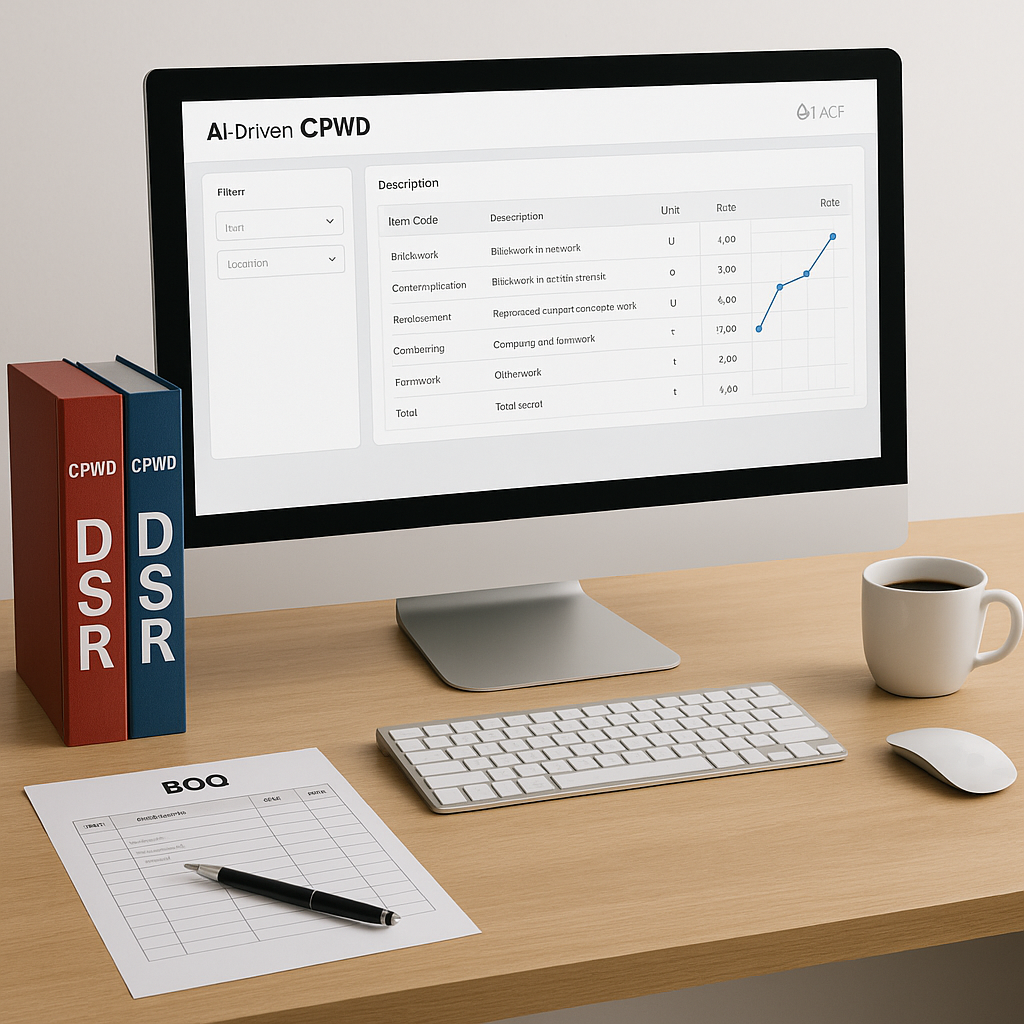
The Problem with CPWD Rate Analysis
If you've ever bid on a CPWD project, you know the drill. The Central Public Works Department (CPWD) updates its Schedule of Rates (DSR) periodically to reflect changes in labor, materials, and equipment costs. Staying compliant with these updates is critical, especially for government tenders. But let’s be honest: the process is a headache.
When bidding on a project, the tender often requires an updated BOQ (Bill of Quantities) that aligns with the latest Cost Index. Here’s what you’d typically do:
- Scour the CPWD website for the latest circular.
- Identify which of the catalogues applies to your project.
- Manually apply the percentage adjustments from the circular to every line item in your BOQ.
- Recalculate rates for your estimate, ensuring compliance with the updated schedule.
This process can take significant time for even a mid-sized project. And that’s assuming you don’t make a single error. One wrong calculation or missed update could mean underpricing your bid—or worse, disqualification for non-compliance.
The Good News: Streamlining the Process
Technology is changing the game. Tools and platforms now exist to help automate parts of the CPWD rate analysis process. Here’s how they typically work:
-
Smart BOQ Parsing
- Upload your BOQ in formats like Excel or CSV. Advanced tools can auto-detect merged cells, section headers, and hierarchies, reducing the need for manual cleanup.
- For example, if your BOQ has a section labeled “Earthwork” with sub-items like excavation and backfilling, the parser organizes it automatically.
-
SOR Matching
- The system searches across CPWD SOR items to find matches based on descriptions, user-defined catalogs, and fallback logic.
- For instance, if your BOQ includes “Concrete M20 mix,” the tool identifies the corresponding CPWD item, including the latest rate adjustments.
-
Cost Index Adjustments
- When CPWD releases a new circular, the system applies the percentage uplift across all relevant items instantly, eliminating manual recalculations.
-
Output Compliant Reports
- The final estimate can be generated in CPWD-compliant formats, complete with rate analyses and supporting schedules, ensuring tender requirements are met.
Why This Matters
For contractors bidding on public projects, time is money. Missing a tender deadline because you were stuck updating rates? That’s a lost opportunity. Submitting an estimate with outdated rates? That could cost you the bid—or your margins.
Illustrative example — Automating rate analysis for a mid-sized contractor handling multiple CPWD tenders annually could save significant time, which can then be redirected toward refining strategies or pursuing additional bids.
Common Questions About CPWD Rate Analysis
Q: How often does CPWD update the Cost Index?
A: Once or twice a year, although it varies. Updates reflect inflation and market changes, so staying current is crucial.
Q: Can tools handle regional SORs?
A: Yes, many platforms include state-specific SORs alongside CPWD DSR, ensuring compliance across regions.
Q: What if my BOQ items don’t match exactly?
A: Advanced tools often suggest the closest match, and manual overrides are typically allowed for fine-tuning.
Common Mistakes to Avoid
-
Ignoring Circular Updates
- Even small inflation adjustments can skew your bid. Always check the latest Cost Index.
-
Manual Recalculations
- Human error is inevitable when reworking hundreds of rates by hand. Automate wherever possible.
-
Submitting Non-Compliant Formats
- Some tenders specify CPWD-compliant formats. Double-check before submission.
The Bottom Line
CPWD rate analysis doesn’t have to be a time sink. By leveraging technology to handle the heavy lifting, you can focus on what really matters: winning bids and protecting margins.


