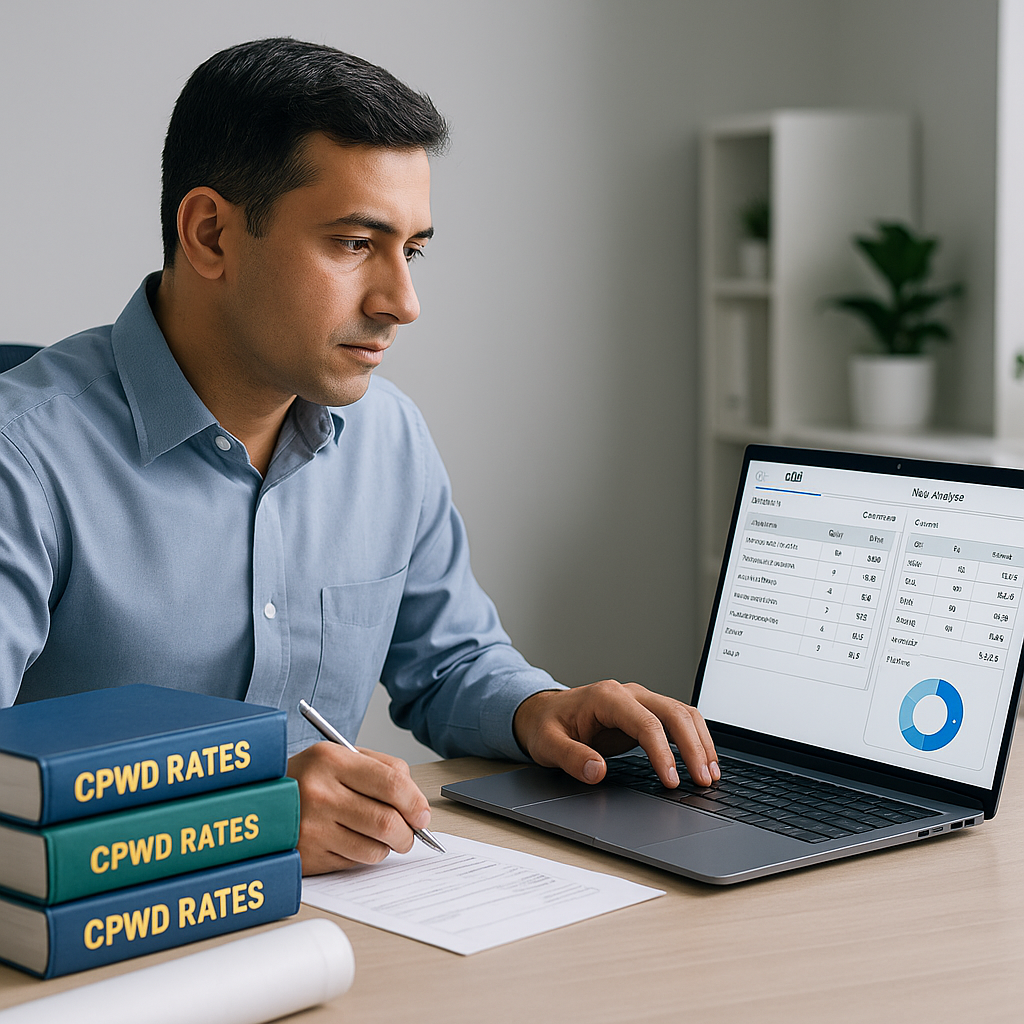
How to Use the Latest CPWD Schedule of Rates for Accurate Construction Estimates
If you've ever worked on government tenders in India, you know the importance of the CPWD (Central Public Works Department) Schedule of Rates (DSR). It’s the cornerstone of public construction pricing. However, keeping up with updates and applying them correctly can be a time-consuming and error-prone process.
Every year—or sometimes more often—CPWD releases updates to account for inflation, new materials, and regional adjustments. These updates require careful interpretation and application to your Bill of Quantities (BOQ). Missing a detail can result in non-compliance or unprofitable bids.
Here’s how you can use the latest CPWD Schedule of Rates effectively and efficiently.
The Old Way: CPWD DSR Updates by Hand
When bidding on a CPWD project, the tender often requires you to use the latest DSR to justify your pricing. Here’s the traditional process:
- Finding the latest circular: CPWD updates are often scattered across PDFs on their website, requiring time to locate the correct one.
- Applying the cost index: Circulars include percentage adjustments for labor, materials, and equipment, which must be manually calculated for each item in your BOQ.
- Reanalyzing rates: After applying adjustments, you need to factor in overhead, profit margins, and specific project conditions.
- Updating the BOQ: Finally, you manually update your BOQ in Excel or another tool with the revised rates.
This manual process is time-intensive and prone to errors, especially for mid-sized or large projects.
The Problem with Manual Updates
Manual updates to CPWD rates are challenging due to:
- Volume of data: The CPWD DSR contains thousands of items across multiple categories, making it difficult to track changes.
- Risk of errors: Manual calculations increase the likelihood of mistakes, which can affect the accuracy of your estimates.
- Time constraints: With multiple bids to manage, dedicating significant time to rate updates is not always feasible.
The result is often either rushed, inaccurate estimates or missed deadlines.
A Better Way: Streamlining CPWD Rate Updates
To simplify the process, consider using tools or methods that automate parts of the workflow. Here’s how you can streamline the process:
1. Efficient BOQ Parsing
Instead of manually cleaning up BOQ files, use tools or techniques that can automatically detect and organize data such as merged cells, section headers, and hierarchies. This ensures your BOQ is ready for processing without extensive manual effort.
Illustrative example —
| Item Description | Unit | Qty | Rate (₹) | Amount (₹) |
|---|---|---|---|---|
| Cement Concrete 1:2:4 | Cum | 150 | 7,500 | 11,25,000 |
| Brickwork in CM 1:6 | Cum | 200 | 6,200 | 12,40,000 |
| Plastering 12 mm thick | Sqm | 500 | 150 | 75,000 |
2. Automated Cost Index Application
Instead of manually applying cost index adjustments, use tools or methods that automatically integrate the latest updates for labor, materials, and equipment into your rates.
3. Rate Analysis at Scale
Access to a comprehensive database of SOR items ensures you’re using accurate rates. Breaking down costs into material, labor, and equipment components can provide greater transparency and accuracy.
4. Real-Time Updates
If a new circular is released during your estimation process, having a system that allows for quick recalculations can save significant time and effort.
Why This Matters
Using the latest CPWD rates is critical for:
- Accurate Bids: Ensuring your estimates are neither underpriced nor overpriced keeps you competitive.
- Time Savings: Streamlining the process frees up time for strategic tasks.
- Audit Confidence: Accurate and transparent rate analysis reduces the risk of disputes during audits.
Common Questions About CPWD DSR Updates
1. How often does CPWD update the Schedule of Rates?
Typically once or twice a year, but updates can vary depending on market conditions. Regularly checking for updates is essential.
2. Can automation tools handle regional SORs?
Yes, many tools are designed to cover multiple catalogs, including state-specific SORs, ensuring compliance across regions.
3. Do these tools include non-civil items like plumbing or electrical?
Yes, the CPWD DSR covers a wide range of trades, and tools can match items across all categories.
4. What happens if a rate isn’t in the catalog?
Some systems can suggest the closest match or flag it for manual review, reducing the risk of missing critical items.
Pro Tips for Using CPWD Rates Effectively
- Always cross-check: Even with automation, review high-value or high-risk items manually.
- Stay updated: Monitor CPWD circulars for policy changes that might impact your projects.
- Leverage tools: Use platforms that offer insights like margin analysis to enhance your estimates.
By adopting efficient methods or tools, you can save time, reduce errors, and ensure compliance with the latest CPWD Schedule of Rates.