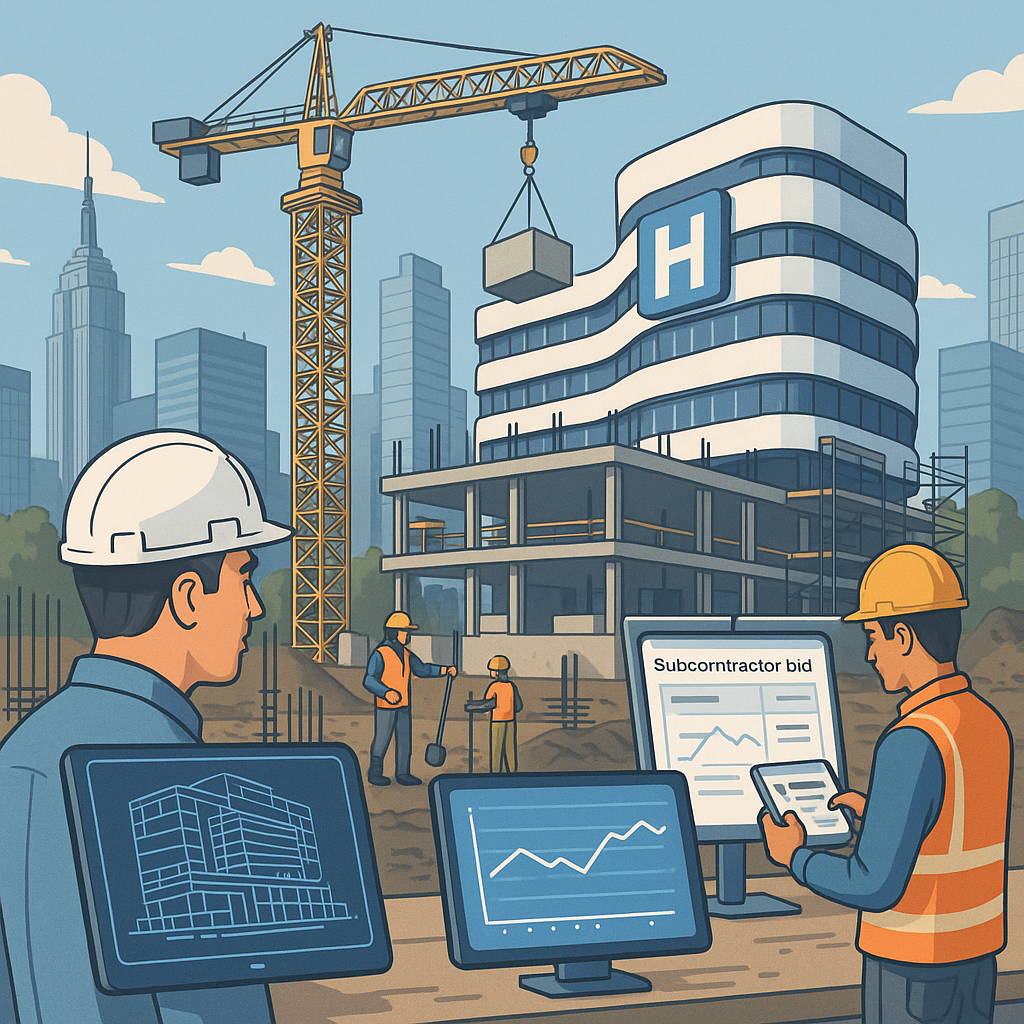
The $2.3B Challenge: Estimation at Scale
Turner-Consigli’s joint venture to build NYC’s state-of-the-art cancer center is the kind of project that makes estimators sweat. A $2.3B budget, sky-high stakeholder expectations, and razor-thin margins for error. It’s not just about building; it’s about nailing the numbers before a single shovel hits the dirt.
And here’s the kicker: manual workflows won’t cut it. You can’t flip through 2,000-page RSMeans rate books or rebuild Excel sheets for every what-if scenario. Not when you’re estimating for a project that’ll span years and involve hundreds of trades.
So how do you handle it? The short answer: smarter tools. Specifically, AI-powered platforms like EstimateNext that tackle the most painful parts of preconstruction.
Brutal Bottleneck #1: Rate Lookups
Let’s talk rate matching for a second. For a project like Turner-Consigli’s cancer center, estimators need accurate rates across dozens of trades—plumbing, HVAC, electrical, structural steel, you name it. And the rates? They’re buried in catalogs like RSMeans or state-specific SORs.
This process usually takes hours. Why? Because you’re flipping pages, scanning for matches, and second-guessing if the rate you’ve picked is even the right fit. Mistakes creep in. Margins shrink. Everyone gets frustrated.
Here’s where AI makes a difference. Tools like EstimateNext’s 4-step SOR matcher can process 78,000+ rate items across 135 catalogs. Instead of spending six hours hunting for rates, the system surfaces matches in seconds. It even cross-checks historical data from past projects to give you the most relevant rates.
A Concrete Example
Say you’re pricing the HVAC system for a 200,000-square-foot facility. Instead of guessing ductwork labor costs or flipping through ASHRAE tables, the platform pulls rates from SMACNA standards and adjusts for NYC-specific labor rates. Done in minutes.
Actionable Steps
- Consolidate Data Sources: Ensure your AI platform integrates with all relevant rate catalogs (RSMeans, SORs, trade-specific standards).
- Leverage Historical Data: Use AI tools that incorporate data from past projects to refine accuracy.
- Automate Adjustments: Look for tools that auto-adjust rates for regional labor costs and inflation trends.
Brutal Bottleneck #2: Sub Bid Leveling
Now let’s move to subs. For a project of this size, you’re dealing with bids from at least half a dozen subcontractors per trade. Each bid comes in a different format, with wildly varying scopes. Normalizing these by hand? That’s six hours per trade, minimum.
Turner-Consigli’s team likely has a dedicated cost engineer just for this task. But smaller GCs? They don’t have that luxury. This is where AI-powered sub bid leveling saves the day. Tools like EstimateNext can normalize bids, rank subs by price and scope, and flag gaps in coverage—all in 30 minutes flat.
Real-World Impact
I’ve seen teams spend days arguing over which sub’s bid to pick because no one trusts the numbers. With tools like this, you get an audit trail for every adjustment. The transparency alone is worth it.
Actionable Steps
- Centralize Bids: Upload all sub bids into a single platform that can handle multiple formats.
- Automate Comparisons: Use AI tools to highlight discrepancies in scope and flag incomplete bids.
- Rank Subs: Prioritize subcontractors based on price, scope completeness, and historical performance metrics.
Brutal Bottleneck #3: Drawing Revisions
Projects like the NYC cancer center don’t stay static. Revisions are constant—new layouts, updated specs, shifted timelines. Every change forces estimators to redo takeoffs.
Manual takeoff workflows are a nightmare here. You’re re-measuring PDFs, recalibrating tools, and manually updating quantities. On a project with 1,000+ drawings, this can easily eat up 40 hours a week.
AI-powered drawing intelligence flips this script. Platforms like EstimateNext use Vision AI to extract quantities in 10 minutes. Upload your revised drawings, and the system highlights what’s changed—wall lengths, room areas, doors, you name it.
Case Study: A Mid-Sized Hospital Project
One estimating team reported saving over 30 hours per week when transitioning to AI-powered drawing tools. For a $200M hospital project, they reduced their bid preparation time by 40%, helping them meet a tight submission deadline.
Actionable Steps
- Digitize Drawing Management: Use cloud platforms to store and version-control all project drawings.
- Adopt Vision AI: Transition to tools that can auto-detect changes in updated drawings.
- Validate Outputs: Cross-check AI-generated takeoffs with manual measurements during the initial setup phase.
Why This Matters for GCs
Turner-Consigli’s project is a high-stakes example, but the lessons apply to any GC estimating large-scale builds. The bottlenecks we’ve covered—rate lookups, bid leveling, drawing revisions—aren’t unique to NYC. They’re universal pain points.
The takeaway? If your team is still relying on manual workflows, you’re leaving money (and sanity) on the table. Tools like EstimateNext aren’t just about saving time—they’re about making your estimates defensible. When you can back up every rate, every adjustment, and every bid recommendation with data, you win trust. Trust wins projects.
Decision Framework: Manual vs. AI-Powered Estimation
| Feature | Manual Approach | AI-Powered Approach |
|---|---|---|
| Rate Lookups | Hours per trade | Seconds with historical insights |
| Sub Bid Leveling | Days to normalize | 30 minutes with audit trails |
| Drawing Revisions | 40+ hours per week | 10 minutes with Vision AI |
| Accuracy | Prone to human error | 99% accuracy with data validation |
| Scalability | Limited by manpower | Easily handles large-scale projects |
The Bottom Line
Turner-Consigli’s $2.3B cancer center project highlights just how critical cost engineering is in mega-builds. Whether you’re chasing a $100M bid or a billion-dollar JV, the principles are the same. Speed, precision, and transparency win the day.
If your team is battling bottlenecks like manual rate lookups or sub bid leveling, it’s time to upgrade your stack. EstimateNext offers AI-powered solutions that cut through the chaos. Get started free →


