Why Manual PDF Takeoffs Are a Nightmare
Let’s not sugarcoat it—manual takeoffs are an absolute grind. You spend hours flipping through drawings, measuring every wall, room, and window with a highlighter and ruler (or worse, clunky software that barely helps). A single detailed project can easily take 40 hours. That’s a full workweek gone, and for what? A process riddled with human error and burnout risks.
I’ve seen estimators miss deadlines because they were stuck remeasuring the same drawing revisions for the third time. Not ideal. And the stakes are high—one bad takeoff can blow a budget or lose a bid entirely.
But what if you could get those takeoffs done in 10 minutes instead of 40 hours? That’s where AI tools like EstimateNext’s Vision AI come in. It’s not magic—it’s just smarter tech. Here’s how it works and why it matters.
How AI-Powered PDF Tools Handle Takeoffs
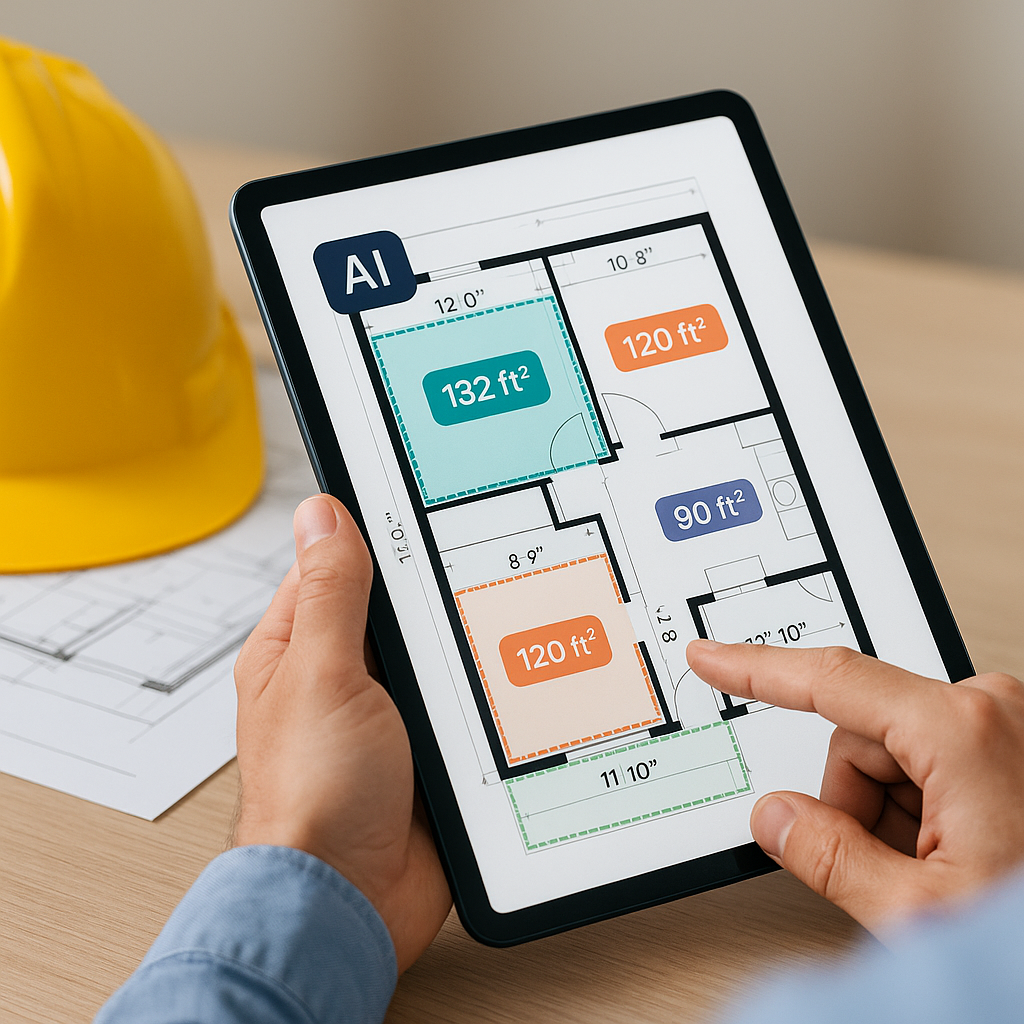
AI-powered tools don’t just speed up takeoffs—they make them smarter. With Vision AI, for example, you can upload any PDF drawing set, and the software extracts quantities like room areas, wall lengths, and door/window counts automatically.
Here’s the kicker: it doesn’t stop at basic measurements. It flags low-confidence areas where manual rechecks might be needed. So, you’re not just getting speed—you’re getting accuracy with an audit trail.
Real-World Example: $108M Dallas Water Project
On a recent $108M water infrastructure project, a GC team used AI-powered takeoff tools and saved over 90 hours of manual work. Vision AI extracted room dimensions and wall lengths in under 10 minutes, which would’ve taken an estimator team 3-4 days to complete manually. The time saved allowed them to focus on refining bid strategies instead of drowning in PDFs.
Case Study: MEP Subcontractor Handling 60+ Bids
An MEP subcontractor based in Phoenix adopted Vision AI to streamline its estimation workflow. Before the switch, their estimators struggled to respond to the sheer volume of bids—often missing deadlines or submitting subpar proposals rushed due to time constraints. After implementing AI-powered takeoff tools, they were able to process drawings for 60+ bids annually without adding staff. Their win-rate improved by 18% in the first year, boosting annual revenue by over $400,000.
The Math Behind the Savings
Let’s break it down. Say your team charges out estimators at $130/hour. A typical manual takeoff eats 40 hours—that’s $5,200 in labor costs per project. With AI tools, you’re cutting that down to just 10 minutes. Even factoring in software costs (let’s say $99/month), the ROI is insane. You’re saving thousands per bid.
And it’s not just about dollars. Faster takeoffs mean you can respond to more bids, increasing your win-rate potential. For MEP subcontractors, who might respond to 60+ bids a year, this can be a game-changer.
Additional Example: Regional Contractor Savings
A regional contractor in Florida specializing in mid-sized housing developments shared their numbers after adopting AI-powered tools. On average, they saved $52,000 annually in labor costs while boosting bid capacity by 30%. This allowed them to secure three additional projects in one fiscal year, worth over $4.5M in combined revenue.
What About Accuracy?
You might be thinking: “Speed is great, but what if the AI misses something?” Fair question. AI tools aren’t infallible. But they’re designed to minimize errors with self-learning algorithms. Every estimator correction feeds back into the system, making future matches more precise.
For example, if a room’s dimensions look off, the software flags it for a manual recheck. You still have control. But instead of wasting hours, you’re only focusing on the 5% of measurements that need human oversight.
Accuracy in Complex Projects
Consider multi-phase commercial projects with hundreds of revisions. AI-powered software like Vision AI can compare revisions side-by-side, automatically detecting changes in dimensions, materials needed, or layouts. This eliminates tedious rework and ensures consistency across versions. Manual methods simply can’t match this level of precision.
Why PDF Integration Matters
Most construction teams already work with PDFs—drawings, specifications, RFIs. The beauty of AI-powered tools is that they integrate directly into your existing workflows. No need to learn a new platform from scratch. Tools like Vision AI even allow you to measure directly within the PDF, with calibration options for linear, area, and angle measurements.
This isn’t just about convenience. It’s about eliminating the friction points that slow down your process. You’re not exporting data into five different tools or manually re-entering numbers into Excel. Everything stays connected.
Practical Example: Streamlined Workflows
An electrical contractor in California switched to Vision AI specifically because of its PDF integration. Before adopting the tool, they spent 20 hours per week manually transferring takeoff data into spreadsheets. Post-integration, they cut that time down to 1 hour per week, freeing up their estimators to focus on bid strategy.
The Real Competitive Edge
Speed and accuracy are obvious benefits. But the real edge comes from scalability. If you’re a regional contractor bidding on mid-sized projects, you probably don’t have the luxury of a massive estimating team. AI tools let you punch above your weight.
Take GCC contractors, for instance. Many of them use outdated tools or manual methods because they can’t justify the $15K/year price tag of a platform like CostX. AI-powered solutions like EstimateNext offer similar capabilities for a fraction of the cost (AED 130/month). That’s not just cost-effective—it’s democratizing access to modern estimation workflows.
Comparison Table: Manual vs. AI-Powered Takeoffs
| Feature | Manual Takeoffs | AI-Powered Takeoffs |
|---|---|---|
| Time Required | 40 hours per project | 10 minutes per project |
| Accuracy | Prone to human error | Self-learning algorithms |
| Cost | $5,200/project in labor | <$99/month |
| Scalability | Limited by team size | Respond to more bids |
| Integration | Manual data transfer | Seamless PDF workflows |


