The Report That Wins (or Loses) the Job
Your estimate might be brilliant. Your rates might be sharp. Your takeoff might be flawless. But if your submission report looks like a spreadsheet printout with misaligned columns and no clear structure, the client's QS will not take you seriously.
Professional reports are not about aesthetics (though that helps). They are about communicating complex cost information in a format the client expects, understands, and can verify. And different clients expect different formats.
Format Matters: CSI, NRM2, CPWD, and Beyond
The construction industry has not settled on one universal measurement framework. Depending on your market, your clients expect estimates structured in specific ways:
CSI MasterFormat (North America)
- 50 divisions organising all construction work
- Division 03 for concrete, Division 09 for finishes, Division 23 for HVAC
- Familiar to every US and Canadian QS and estimator
- Three levels of detail: division, section, subsection
NRM2 (UK and Commonwealth)
- New Rules of Measurement, published by RICS
- Elemental structure: substructure, superstructure, internal finishes, services
- Designed for cost planning from concept through to detailed measurement
- Used in the UK, Australia, Singapore, Hong Kong, and many Middle Eastern markets
CPWD (India)
- Central Public Works Department schedule of rates
- Mandatory for government projects in India
- Items organised by trade with detailed specifications and rate build-ups
- State variations (MES, PWD) follow similar structures
Client-Specific Formats
Many large clients, developers, and PMCs have their own reporting templates. They want your estimate mapped to their work breakdown structure, their cost codes, their element definitions. If you cannot deliver in their format, your estimate — however accurate — creates extra work for their team.
The Multi-Format Challenge
A firm operating across markets might need to produce the same estimate in three formats:
- CSI MasterFormat for the US client's cost manager
- NRM2 elements for the UK-based QS consultant
- A client-specific format for the developer's internal reporting
Doing this manually means restructuring your estimate three times. With a structured estimation platform, you build the estimate once and generate reports in any format by mapping your line items to the relevant framework.
EstimateNext maintains mapping tables between its internal work breakdown structure and CSI, NRM2, CPWD, and other frameworks. You tag each line item once, and the system generates reports in any format on demand.
What Goes Into a Professional Cost Report
Beyond the framework, a professional cost report includes:
Executive Summary
- Total estimated cost with GST/VAT breakdown
- Key assumptions and exclusions
- Cost per unit area or other relevant metrics
- Comparison to budget or benchmark (if available)
Detailed Cost Breakdown
- Line items with descriptions, quantities, units, and rates
- Subtotals by trade, element, or division
- Preliminaries and general conditions as a separate section
- Contingency and escalation clearly identified
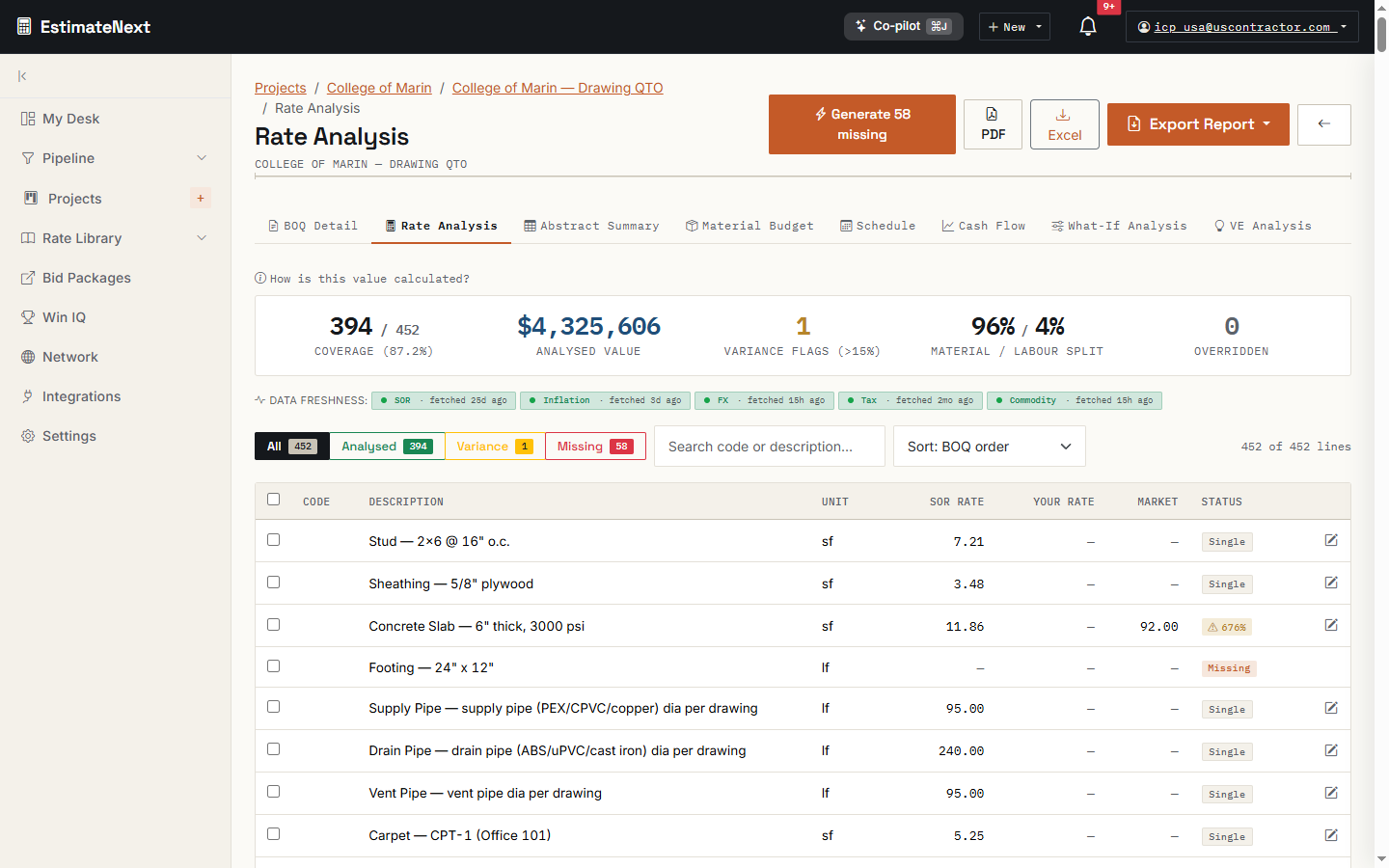
Rate Analysis (Where Required)
- Build-up of key rates from labour, material, and plant components
- Reference to source catalogues or quotations
- Adjustments for location, market conditions, or specification variations
Supporting Schedules
- Area schedule by floor and zone
- Measurement summary cross-referenced to drawings
- Subcontractor quote summary
- Provisional sum register
Appendices
- Drawing list and revision register
- Subcontractor and supplier quotations
- Rate catalogue references
- Assumptions register
Report Quality as a Competitive Advantage
In design-build and negotiated tenders, your report is part of your bid. It communicates not just the price, but your understanding of the project, your thoroughness, and your professionalism.
A GC who submits a 120-page cost report with clear element breakdowns, rate analyses for major items, and a cash flow forecast makes a very different impression than one who submits a 10-page summary with rounded numbers and no supporting detail.
Clients and their QS consultants evaluate bids partly on the quality of the submission. A well-structured report:
- Reduces tender queries (saving everyone time)
- Demonstrates scope understanding (reducing risk perception)
- Facilitates value engineering (because alternatives can be compared at item level)
- Builds confidence in the contractor's ability to manage costs during construction
Generating Reports from EstimateNext
The platform generates reports in multiple formats directly from your estimate data:
- PDF reports with your company branding, structured per the selected framework
- Excel exports for clients who want to manipulate the data
- Summary dashboards for executive presentations
- Detailed schedules for QS verification
Each report pulls from the same underlying data. Change a rate and regenerate — every report reflects the update instantly.
Real Scenario: Multi-Format Submission
A PMC managing a hospital project in Abu Dhabi requires:
- NRM2 elemental cost plan for the design team
- CSI MasterFormat breakdown for the US-based healthcare planner
- A client-specific 47-element format for the developer's board presentation
- A FIDIC Schedule of Payments linked to the programme
From a single estimate, EstimateNext generates all four documents. The QS reviews each for accuracy and submits. Total report generation time: two hours, including formatting review.
Getting Started
Generate a cost report from your current project and compare it to what you produce manually. Pay attention to the level of detail, the consistency of formatting, and the time it took.
Ready to see professional reporting in action? Book a demo and we will generate a report from your project data.