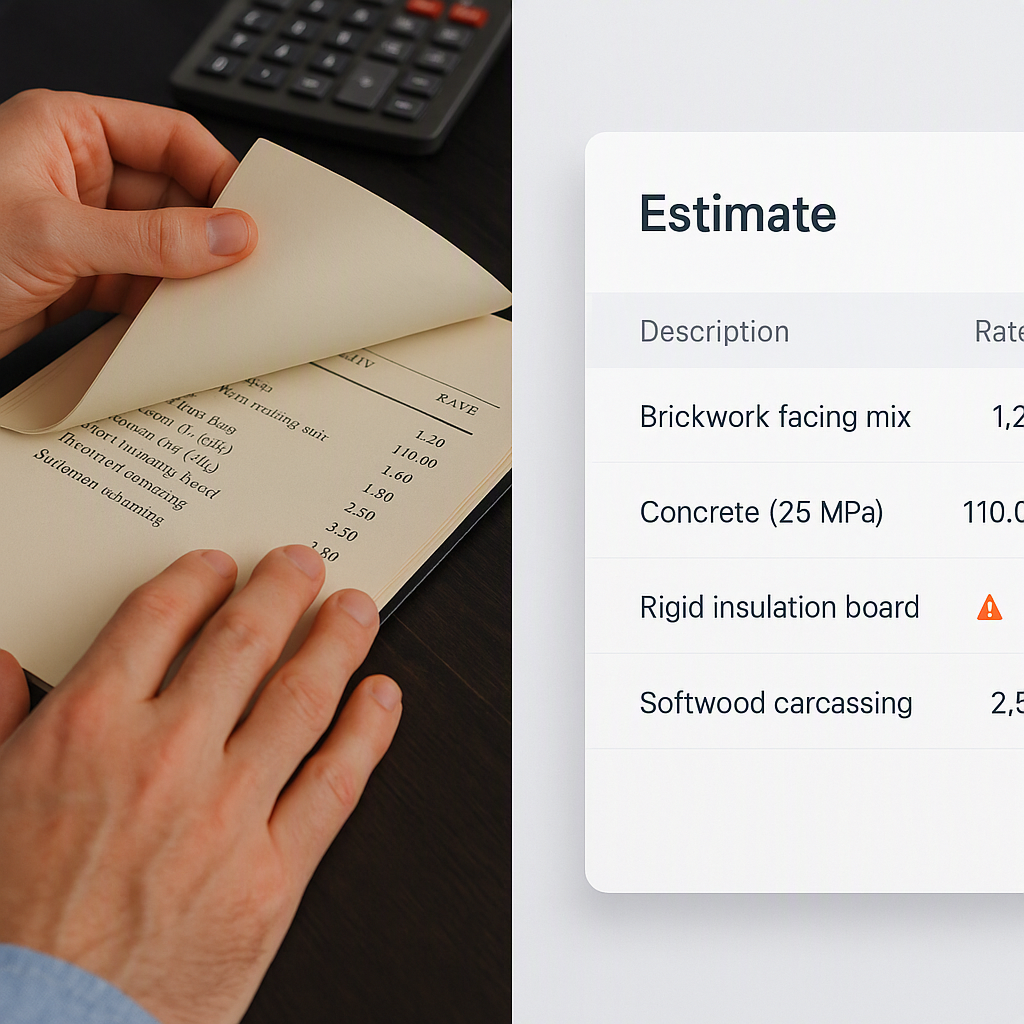
I Used to Think Manual Rate Lookup Was Just Part of the Job
When I started in construction estimation, I thought manual rate lookup was just something you had to deal with. You'd flip through rate books, dig into PDFs, and double-check every line item to make sure the numbers made sense. It wasn’t perfect, but it felt like a necessary evil. After all, how else would you ensure accuracy?
And honestly, manual lookup wasn’t the worst part. It gave you a sense of control. You knew the numbers because you'd traced them back to their source. But it also burned hours—sometimes days—on something that wasn’t adding value. I’d spend hours just pulling rates for a mid-sized project. That’s time I couldn’t spend reviewing subcontractor quotes, checking drawings, or strategizing margins.
Then something changed.
Why Manual Methods Have Limitations
Manual rate lookup feels safe because it’s familiar, but it’s not as foolproof as we like to believe. Humans make mistakes. We misread tables, transpose numbers, or forget to consider inflation adjustments. These errors can lead to inaccurate estimates, which can have significant consequences for project budgets and timelines.
Moreover, manual methods are time-intensive. The hours spent flipping through rate books or searching for the latest subcontractor quotes could be better spent on higher-value tasks, like refining bid strategies or analyzing market trends.
Key Challenges of Manual Rate Lookup
- Human Error: Misreading a table or forgetting inflation adjustments can result in discrepancies that ripple through the entire project budget.
- Time Wastage: Spending hours flipping pages or searching PDFs limits your ability to focus on strategic tasks like pricing analysis or risk mitigation.
- Outdated Information: Rate books or PDFs may not reflect real-time changes in material or labor costs, especially in volatile markets.
- Scalability Issues: As projects grow larger, manual methods become exponentially harder to manage.
Practical Steps for Identifying Manual Lookup Limitations
- Audit Your Process: Track how much time you spend on rate lookup during a typical project. Compare it to the time spent on other tasks.
- Analyze Mistakes: Review past estimates and identify errors related to manual lookup. Were rates outdated, misread, or omitted?
- Consider Project Growth: Assess whether your rate lookup methods can scale effectively for larger or more complex projects.
This is where AI-powered rate matching tools come in. They automate repetitive tasks, allowing estimators to focus on strategic decision-making while reducing the likelihood of human error.
How AI Rate Matching Actually Works
AI-powered rate matching simplifies the estimation process by leveraging automation and smart algorithms. Here’s a detailed breakdown of how these tools work:
Step-by-Step Workflow
-
BOQ Upload You upload your Bill of Quantities (BOQ) in widely supported formats like Excel, CSV, or PDF. The AI parses the document, auto-detects items, and organizes them by category. This eliminates the need for manual data entry.
For example: If you have a line item for "M20 concrete," the AI identifies it as a concrete rate and starts searching the relevant catalog section automatically.
-
Catalog Search The AI scans your preferred rate catalogs—whether it’s RSMeans, CPWD DSR, or a custom rate book your company uses—and finds the best matches. Using semantic search, it understands context and synonyms, ensuring "M20 concrete" and "20 MPa concrete" are treated as the same item.
-
Customization Many projects require custom rates based on local supplier agreements or specialized materials. You can add these custom rates to the system, and the AI will prioritize them for future matches. This ensures the tool adapts to your specific needs.
-
Flagging Uncertainties For every match, the AI flags items it’s uncertain about for human review. You retain full oversight, and this collaborative approach ensures no critical errors slip through.
-
Real-Time Updates Need to adjust a rate due to inflation, supplier changes, or market fluctuations? The system updates all related items instantly and maintains an audit trail for transparency.
How It Reduces Errors
AI tools use algorithms to cross-reference rates, detect inconsistencies, and flag potential issues. For instance, if a rate for a material seems abnormally high or low compared to historical data, the system alerts the user.
Ensuring Smooth Implementation of AI Tools
- Start Small: Begin with less complex projects to familiarize yourself with the tool.
- Train Your Team: Organize training sessions to ensure everyone understands how to use the software effectively.
- Monitor Outputs: Regularly review the AI’s recommendations to build confidence in its accuracy and identify areas for improvement.
Benefits of AI-Powered Rate Matching
Adopting AI-powered rate matching tools offers clear benefits over manual methods. Here are the most significant advantages:
Time Savings
Automating rate lookup frees up hours that can be reinvested in higher-value tasks like bid strategy development, subcontractor negotiations, or margin analysis.
Improved Accuracy
By systematically pulling rates and flagging uncertainties, AI reduces the likelihood of errors caused by human oversight.
Adaptability
AI tools can incorporate custom rates and adapt to changes such as inflation or supplier adjustments in real time. This flexibility means your estimates stay accurate regardless of external factors.
Scalability
Whether you’re estimating for a small residential project or a multi-million-dollar commercial development, AI tools can handle the workload efficiently without slowing down.
Enhanced Collaboration
With real-time updates and audit trails, AI tools improve transparency and collaboration across teams.
Decision Framework: Manual vs. AI Rate Matching
| Criteria | Manual Lookup | AI-Powered Lookup |
|---|---|---|
| Accuracy | Prone to human error | Systematic and error-flagged |
| Time Investment | High; hours or days per project | Low; minutes to process BOQ |
| Scalability | Poor; scales poorly for large jobs | Excellent; scales seamlessly |
| Adaptability | Limited; requires manual updates | High; real-time adjustments |
| Ease of Use | Familiar but tedious | User-friendly; intuitive workflows |
| Cost Efficiency | Time-intensive, costly in the long run | High ROI due to time savings |
Final Thoughts
If you’re still relying on manual rate lookup, you’re leaving time—and potentially money—on the table. AI-powered tools aren’t just faster; they’re smarter, more accurate, and designed to make your life easier. By automating repetitive tasks, these tools allow you to focus on what truly matters: creating competitive bids, building strong client relationships, and delivering successful projects.