Stop Burning 36 Hours on Rate Lookups: AI Fixes It Instantly
It’s no secret that rate lookups are one of the most frustrating parts of construction estimating. If you’ve ever flipped through a 2,000-page RSMeans or CPWD DSR book, you know exactly what I mean. You spend hours hunting for the right item, cross-referencing rates, and praying you didn’t miss anything critical. Multiply that across several trades, and suddenly you're wasting 36 hours — or more — on a single bid.
Why does this happen? Because traditional methods rely on manual effort. Even the most experienced estimators struggle with outdated workflows like Excel formulas and PDF searches. It’s slow, error-prone, and frankly, avoidable. That’s where AI-powered rate matching steps in.
The Problem: Manual Rate Matching is a Bottleneck
Let’s get specific. Imagine you’re pricing a high-rise project. You need rates for everything from concrete columns to HVAC duct installation. What happens?
- Manual Lookup: You open your rate book or PDF catalog, search for each item, and jot down the rates. If the catalog is poorly indexed (looking at you, CPWD DSR), this can take hours per trade.
- Verification: Once you find a rate, you cross-check it against local cost indexes or historical data. Did the labor rate increase this year? Is the material cost accurate post-inflation? More time wasted.
- Spreadsheet Entry: Finally, you input everything into Excel, hoping your formulas don’t break. Spoiler: They often do.
A Case of Compounding Delays
Let’s say you’re estimating for a hospital project with multiple trades: electrical, plumbing, HVAC, and structural. Each trade requires hundreds of rate lookups. If it takes six hours per trade, you’re already looking at 24 hours of manual effort. Add the time for cross-verification and spreadsheet input, and you’re easily burning 36 hours — or more — on a single bid.
Hidden Costs of Manual Workflows
The cost isn’t just in time. Manual rate matching increases the risk of errors, which can lead to underbidding or overbidding. For example:
- Underbidding: Missing a labor rate adjustment could leave you absorbing unexpected costs, slashing your profit margin.
- Overbidding: Adding unnecessary contingencies to compensate for uncertainty could make your bid uncompetitive.
These risks aren’t hypothetical. A 2021 Dodge Data & Analytics report found that 35% of construction firms lost bids due to inaccurate estimates.
The Solution: Semantic Search with AI
This is where AI-powered tools like EstimateNext shine. Instead of flipping through catalogs manually, you upload your BOQ (Bill of Quantities) and let the software do the heavy lifting. Here’s how it works:
Step-by-Step Breakdown
- BOQ Parsing: EstimateNext analyzes your BOQ file, detects merged cells, section headers, and hierarchies automatically. No manual formatting required.
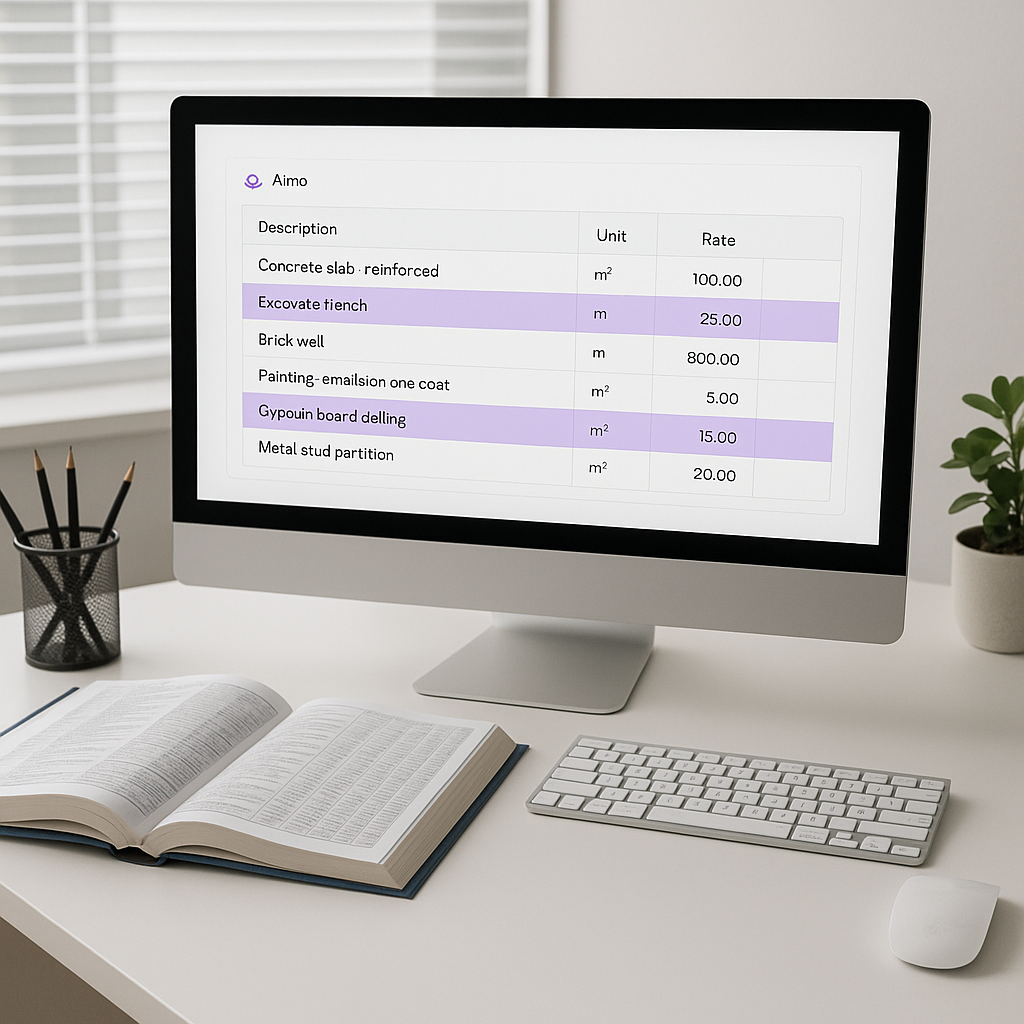
- Semantic Search: The AI scans 78,000+ SOR (Schedule of Rates) items across 135 catalogs, including RSMeans, CPWD DSR, and regional indexes. Need the labor rate for installing pre-stressed concrete girders? Type it in, and the system matches it instantly.
- Rate Analysis: Once rates are matched, the tool breaks them down by material, labor, and equipment costs. It even suggests inflation adjustments based on catalog year.
- Custom Catalogs: Got project-specific rates? Upload them, and the AI integrates them seamlessly for future use.
Why Semantic Search is a Game-Changer
Unlike keyword-based searches, semantic search understands context. For instance, if you’re searching for "steel reinforcement," it recognizes related terms like "rebars" or "reinforced concrete" and suggests the most relevant matches. This eliminates ambiguity and ensures faster, more accurate results.
What Makes It Scalable?
Whether you’re estimating a $500,000 residential project or a $1 billion infrastructure bid, AI-powered tools scale effortlessly. They handle complex BOQs with multiple trades and hundreds of line items without breaking a sweat.
Real-World Example: Skanska’s Rail Bridge
Take Skanska’s $1 billion rail bridge project as an example. The team needed rates for everything from structural steel to rail ties — all pulled from DOT-approved catalogs. Using AI, they completed rate matching in seconds, saving 36 hours per estimate. That’s not just faster; it’s smarter.
Their own case study notes that AI tools reduced takeoff discrepancies by 80%. The ROI? Massive. Early adopters of AI in construction see average cost savings of 10-20% per project, according to a 2023 McKinsey report. Read more.
Another Example: Small Firm, Big Savings
Even smaller firms are benefiting. A 10-person general contractor in Ohio used EstimateNext for a $2 million school renovation project. Instead of spending 20 hours on rate lookups, they finished in under 2 hours. The time saved allowed them to focus on refining their bid strategy, which ultimately won them the project.
Common Objections
You might be thinking, “Sure, AI is fast, but it doesn’t understand the nuances of construction.” That’s partially true—but it also misses the point. AI doesn’t replace your expertise; it amplifies it.
Addressing Common Concerns
-
“What if the AI makes a mistake?” AI tools include features like confidence scoring and manual override. You can review matches and make adjustments as needed. Think of it as a collaborative tool, not a black box.
-
“Will this replace my team?” Not at all. AI automates repetitive tasks, freeing up your team to focus on high-value work like bid strategy and client negotiations.
-
“Is it hard to integrate with my current tools?” Most AI solutions integrate seamlessly with construction software like Procore, Autodesk Build, and even Excel. You won’t need to overhaul your workflows.
Why It Matters
In construction, time is money. Every hour spent on manual rate lookups is an hour you could’ve spent fine-tuning your bid strategy or negotiating better subcontractor terms. AI-powered rate matching doesn’t just save time; it reduces human error and improves accuracy.
Here’s the Math
- Time Saved: 36 hours per bid.
- Cost Avoided: $130/hr x 36 hours = $4,680 per bid.
- ROI: Up to 52X on a $100/mo tool cost.
FAQ
Q: How accurate are AI-generated rate matches?
AI tools like EstimateNext are highly accurate, but no system is perfect. That’s why they include features like manual override and confidence scoring, so you can review and adjust as needed.
Q: Can I use AI estimation tools with existing software?
Yes. EstimateNext integrates seamlessly with platforms like Procore, Autodesk Build, and Excel. You can export estimates directly into your workflows.
Q: What if my rates are custom or project-specific?
AI tools let you upload your own rate catalogs or define custom rates for specific items. This ensures your estimates reflect your actual costs.
Q: Does this work for smaller projects?
Absolutely. AI-powered estimation scales to any project size, whether you’re handling a $1M renovation or a $1B infrastructure bid.
Q: How much training does it require?
Most tools are designed to be user-friendly. With minimal training — often less than an hour — your team can start using them effectively.
Decision Framework: Should You Adopt AI-Powered Rate Matching?
| Factor | Manual Rate Matching | AI-Powered Tools |
|---|---|---|
| Time per bid | 36+ hours | Under 2 hours |
| Risk of human error | High | Low |
| Scalability | Limited | Unlimited |
| Initial cost | None | ~$100/mo |
| Learning curve | None | Minimal |
Call to Action
Stop wasting 36 hours flipping through rate books. EstimateNext’s AI-powered rate matching gets it done in seconds — and saves you thousands per bid. Get started free →