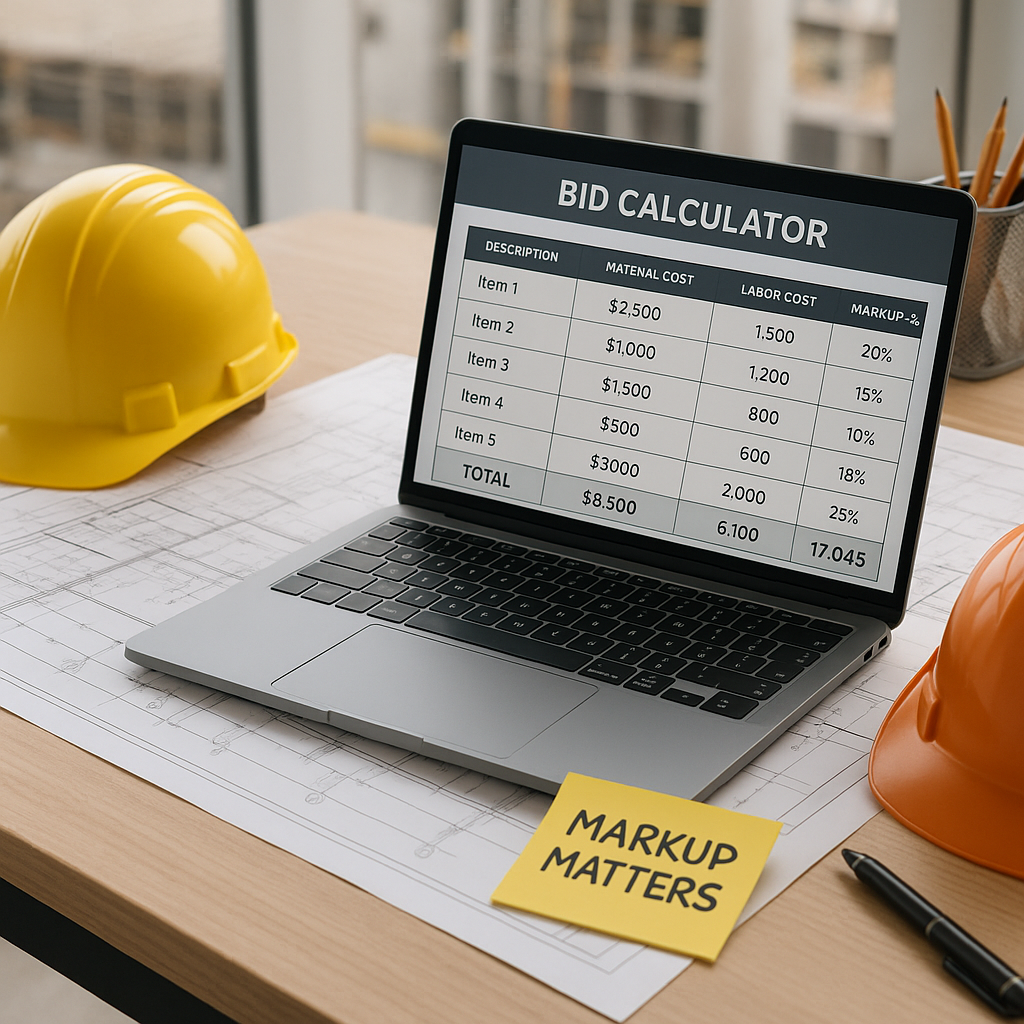
Why Most Contractors Get Markup Wrong
Let’s face it: markup feels like a gamble. Too high, and you lose the bid. Too low, and you win the job but lose your profit—or worse, take a loss. The stakes are brutal, especially when margins are already razor-thin.
The problem? Most contractors guess their markup. They slap on a percentage they’ve always used or copy what a competitor does. But here’s the thing: markup isn’t random. It’s a calculated number that balances your costs, overhead, and profit goals. Get it wrong, and the consequences are expensive.
We’ve seen it happen. An electrical contractor in the Midwest underbid two hospital renovation projects by 7%. They won both jobs but ended up losing $180,000 because their labor costs were underestimated. That’s the kind of mistake you can’t afford to repeat.
So how do you calculate a markup that’s competitive and profitable? Let’s break it down.
The Construction Markup Formula That Works
Forget complicated formulas that only accountants understand. Here’s the straightforward approach:
Bid Price = (Direct Costs + Indirect Costs) x (1 + Markup%)
Where:
- Direct Costs are materials, labor, and equipment—basically, everything tied directly to the project.
- Indirect Costs are your overhead expenses like office rent, salaries for non-project staff, and software subscriptions.
- Markup% is the percentage you add to cover profit and risk.
Real-World Example
Let’s say your direct costs for a $100,000 project are $70,000. Overhead is 10%, and you’re targeting a 15% profit margin. Here’s how it looks:
- Overhead: $70,000 x 10% = $7,000
- Profit: $70,000 x 15% = $10,500
- Markup: ($7,000 + $10,500) ÷ $70,000 x 100 = 25%
Your bid price should be $70,000 + 25% = $87,500. If you had guessed a 15% markup (confusing it with margin), your bid would have been $80,500—$7,000 short of what you need to cover overhead and profit.
Actionable Steps to Nail Your Markup
- Start with Accurate Costs: If you’re estimating labor or materials, use updated numbers. Don’t rely on outdated spreadsheets.
- Determine Overhead as a Percentage: Add up your annual overhead costs (office rent, salaries, etc.) and divide by your yearly revenue. This gives you a baseline percentage to apply to bids.
- Set a Profit Goal: Be realistic. Many contractors aim for 10-20%, but this varies by industry and project type.
Why Flat Markup Doesn’t Work
Here’s another common mistake: applying the same markup to every cost category. Labor-intensive jobs often need higher markups to account for risk, while materials might need less. For example:
A roofing contractor in Texas used a flat 15% markup for years. While they won plenty of bids, their profit margins consistently underperformed.
After recalculating using a variable markup approach, they realized they needed a 25% markup on labor and 10% on materials to hit their profit targets. The result? An 18% increase in annual profits without losing clients.
Comparison Table: Flat Markup vs. Variable Markup
| Factor | Flat Markup | Variable Markup |
|---|---|---|
| Labor Costs | Often underpriced due to higher risk | Adjusted for complexity and risk |
| Material Costs | Overpriced in low-risk scenarios | Adjusted based on volatility |
| Profit Margins | Inconsistent | More predictable |
| Client Retention | High but less profitable | Balanced profitability and retention |
When to Use Variable Markup
- Labor-Intensive Projects: High-risk tasks like custom builds or renovations.
- Volatile Materials: Projects requiring materials with fluctuating prices (e.g., lumber, steel).
- Specialized Equipment: Unique tools or rentals that require contingency planning.
The Hidden Costs of Guesswork
Let’s talk about what happens when you guess—or worse, copy-paste from past bids. Material prices fluctuate. Labor rates change. Every project has unique challenges. Using outdated data is a shortcut to losing money.
Example: Ignoring Market Trends
A general contractor in California lost $50,000 on a commercial office build because they didn’t adjust for a 15% spike in lumber prices. A simple market check could have saved the project.
Hidden Overhead Costs to Watch For:
- Software Subscriptions: Estimation tools, accounting software, and project management platforms eat into profits.
- Utilities: Office electricity, internet, and even maintenance add up.
- Idle Time: Downtime for crews due to poor scheduling.
Actionable Steps:
- Update Cost Data Quarterly: Prices for materials and labor are always changing. Stay ahead of market trends.
- Run Post-Project Audits: Analyze completed projects to identify hidden costs you didn’t account for.
- Use Technology: Replace guesswork with tools that can factor in real-time costs and risks.
How EstimateNext Simplifies Markup Calculation
This is where tools like EstimateNext come in. Manual calculations are prone to errors and take time you don’t have. EstimateNext’s Rate Analysis Tool breaks down every cost—materials, labor, equipment—into detailed line items with full audit trails. You can even adjust for inflation or market conditions in seconds. No more guessing. No more Excel chaos.
Case Study: HVAC Contractor Saves Time and Money
An HVAC contractor bidding on a large-scale commercial project saved 40 hours per estimate by switching to EstimateNext. The platform suggested markup adjustments for specialty components based on historical data, helping the contractor avoid underbidding.
Key Features of EstimateNext:
- Automated Cost Updates: Reflects market changes in real-time.
- Markup Recommendations: Tailored suggestions based on project type and complexity.
- Audit Trails: Transparency for every line item, reducing disputes with clients.
Practical Tips for Better Markup
-
Audit Your Costs Regularly Labor shortages? Material price hikes? These change constantly. Update your cost data every quarter to avoid surprises.
-
Use a Bid Markup Calculator Whether it’s EstimateNext or a simpler tool, calculators ensure you’re not under- or overpricing.
-
Account for Market Conditions If competitors are consistently bidding lower, find efficiencies instead of blindly dropping your prices. AI tools can help you spot areas to cut costs without sacrificing quality.
-
Differentiate Markup by Category Don’t apply a flat percentage. Adjust for labor-intensive tasks, high-risk scopes, or volatile materials.
-
Track Job Performance Compare estimated vs. actual costs after every project. This will fine-tune your markup formula over time.
The Bottom Line
Stop guessing your markup. The difference between a smart calculation and a bad one could mean tens of thousands in lost profit—or worse, a failed project. Use the formula, audit your costs, and let tools like EstimateNext do the heavy lifting.
If you’re tired of manual calculations and costly errors, EstimateNext can help →.


