Sub Bid Leveling: The Hidden Time Sink
Let’s talk about one of the most frustrating parts of preconstruction: sub bid leveling. If you’ve ever had to normalize seven subcontractor quotes by hand, you know it’s a time vampire. One missed scope item or miscalculated markup can turn a profitable bid into a nightmare. And if you’re racing to submit a GMP for a $100M project, every hour matters.
Here’s the math: leveling seven sub bids manually takes around six hours. That’s six hours of flipping through PDFs, recalculating rates, and chasing subs for clarifications. Multiply that by 20 bids a year, and you’re looking at 120 hours of pure chaos. For a GC director earning $130/hour, that’s $15,600 burned annually—and that’s just labor costs.
The True Costs of Manual Bid Leveling
The financial cost of manual bid leveling is one thing, but the hidden costs add up just as quickly. Think about these scenarios:
- Opportunity Cost: Those six hours spent on manual leveling could’ve been used to prepare for another project, finalize value engineering options, or strengthen client relationships.
- Burnout: Estimators and preconstruction managers often work under tight deadlines. Adding repetitive tasks like bid leveling increases fatigue and the chance of errors.
- Reputation Risks: Submitting a bid with inaccuracies—whether it’s missing scope or overestimated rates—can harm your reputation with clients and subcontractors alike.
In short, manual bid leveling doesn’t just hurt your bottom line; it hurts your team and your ability to compete effectively.
The AI Fix: 30 Minutes, Not 6 Hours
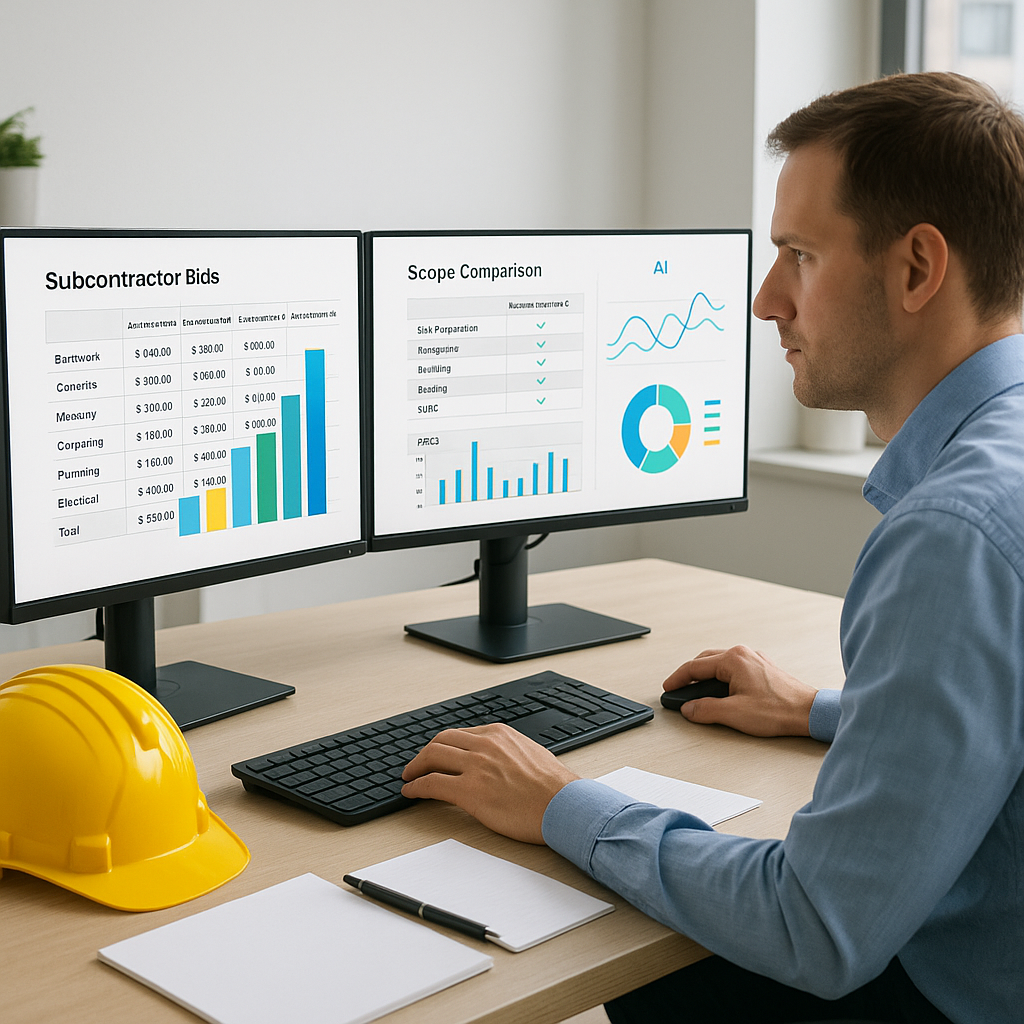
AI-powered tools like EstimateNext slash bid leveling time to just 30 minutes. How? The software normalizes scope differences across subcontractor quotes automatically. It flags missing items, aligns quantities, and even ranks subs based on L1/L2/L3 pricing. You get a clean, ranked comparison without the grunt work.
How Does It Work?
Here’s a step-by-step breakdown of how AI tools like EstimateNext streamline sub bid leveling:
- Upload Sub Bids: Drag and drop subcontractor quotes into the platform. Formats like PDFs, Excel sheets, and even scanned documents are supported.
- Automated Scope Matching: The AI identifies scope line items, quantities, and units of measure. It highlights discrepancies, such as missing items or mismatched quantities.
- Rate Analysis: The system normalizes rates across all subs, accounting for different markup structures, labor rates, and material costs.
- Comparison and Ranking: Each subcontractor is ranked based on pricing tiers (L1, L2, L3) and compliance with scope requirements.
- Custom Adjustments: Estimators can manually override or adjust any AI-generated recommendations to reflect real-world nuances.
Real-World ROI: A Case Study
In a case study on a mid-sized GC, EstimateNext showed that AI sub bid leveling saved 120 hours on a high-rise project. That’s two full weeks of labor avoided—and they still met their GMP deadline. If you’ve ever scrambled to finalize a bid at 11:47 PM, you know how valuable that is.
But it’s not just about time savings. The GC also reported fewer errors in their bids, which translated to more competitive pricing and higher client satisfaction. One project manager noted, “We went from constant rework to being confident in our numbers. That confidence showed in our client meetings.”
Why Manual Processes Fail
You might be thinking, “Why not stick with Excel? It works.” Sure, Excel is functional, but it’s fragile. One formula error or overlooked scope item can domino into a $342K mistake. And let’s not forget the human factor: fatigue, rushed deadlines, and unclear instructions from subs.
Common Pain Points in Manual Bid Leveling
- Complex Scope Items: On larger projects, scope items like MEP coordination or specialized installations (e.g., curtain walls) are often misinterpreted or missed entirely.
- Conflicting Standards: In international markets like the GCC, subcontractors might use conflicting measurement standards (FIDIC vs. CESMM3). Normalizing these bids manually is a logistical nightmare.
- Human Error: A misplaced decimal point in an Excel formula or a forgotten email chain with clarifications can lead to costly errors.
Real Example: A $1B Rail Project
On a $1B rail project, subcontractor coordination was a logistical beast. With 15 subs submitting quotes for specialized work like track installation and bridge decking, leveling manually would’ve taken weeks. AI tools reduced this process to hours by automating scope matching and rate alignment. The result? The GC submitted their bid three days early, with a 99% reduction in discrepancies.
That’s not just faster—it’s smarter. Early submission gave the GC room to negotiate better terms, ensuring their bid was both competitive and profitable.
The Obvious Objection: “AI Can’t Think Like an Estimator”
I hear this all the time: “AI is fast, but it doesn’t understand construction.” That’s partially true—AI doesn’t replace your expertise. You’re still the one making judgment calls, negotiating with subs, and deciding on markup. The AI just handles the grunt work.
Think of it like hiring an intern who never sleeps, never misses details, and gets smarter with every project. EstimateNext’s AI learns from your feedback, improving accuracy by the third bid. It’s not perfect, but it’s damn close.
Actionable Tip: Start Small
If you’re skeptical, start by using AI tools on smaller projects. Test the software’s accuracy, provide feedback, and see how much time you save. Most platforms offer free trials, so there’s minimal risk.
What About Smaller GCs?
You might be wondering, “Does this scale to smaller projects?” Yes. AI tools work just as well for a $1M fit-out as they do for a $1B rail bridge. In fact, smaller GCs often see higher ROI because every hour saved is more noticeable.
Example: A Small Contractor’s Success Story
Take an interior fit-out contractor specializing in Cat-A office spaces. They used EstimateNext to level bids for a $2M renovation. Instead of spending three days on bid leveling, they finished in under four hours. That’s a 12X speed improvement—and it allowed them to respond to two more bids that same week.
Decision Framework: Should You Invest in AI Bid Leveling?
Here’s a comparison table to help you decide if AI is right for your business:
| Criteria | Manual Process | AI Tools (e.g., EstimateNext) |
|---|---|---|
| Time Required | 6 hours per bid | 30 minutes per bid |
| Error Risk | High (fatigue, complexity) | Low (automated checks) |
| Scalability | Limited | High |
| Integration | Manual export/import | Seamless (integrates with Procore, Bluebeam) |
| Training Required | None | Minimal (<2 weeks) |
| Cost | Labor-intensive | Subscription-based (scales with usage) |
If you’re processing more than 10 bids per year, the time savings and error reduction alone can justify the investment.
CTA
If sub bid leveling is eating up your time, EstimateNext can help. Upload your bids, and let AI do the heavy lifting. Get started free →