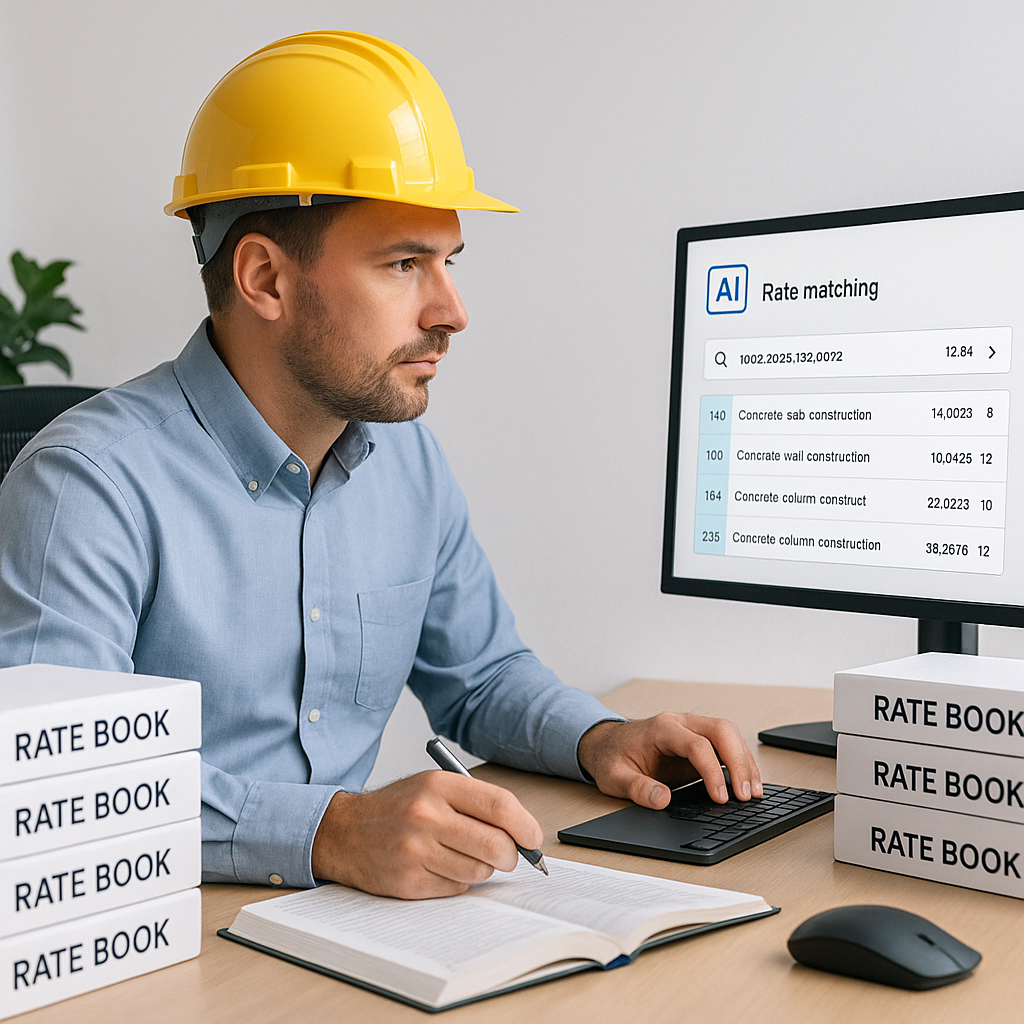
Stop Losing 36 Hours: AI Fixes Manual Rate Lookups
Why Manual Rate Lookups Are a Hidden Killer
Every estimator knows the pain of flipping through 2,000-page rate books or digging through local PDFs for pricing information. On average, this process eats up 36 hours per bid. That’s nearly a full workweek wasted on something that should take seconds.
Even worse? Manual lookup isn’t just slow — it’s error-prone. Say you miss a single rate adjustment for inflation or misread a labor category. That mistake snowballs, messing up your bid margins and potentially costing you the project.
Real-World Example: The Hidden Cost of Errors
Let’s put this into perspective. Imagine a $20 million commercial project where the margin is 8%. A single 1% error due to outdated or incorrect rates could cost $200,000 — effectively wiping out a quarter of the expected profit. Worse, if the bid is too low, you might win the project but lose money during execution.
So, why do we keep doing this? Because for years, there hasn’t been a better way. Until now.
The AI Solution: Rate Matching in Seconds
AI-powered tools like EstimateNext are changing the game. Instead of manually flipping through rate books, AI uses semantic search to find the exact rate you need in seconds. Here’s how it works:
- Upload your BOQ: Whether it’s an Excel sheet or a PDF, the system parses the file automatically.
- Search across 78,000+ items: Need the labor cost for installing pre-stressed concrete girders? Type it in, and the tool pulls the rate instantly from its catalog.
- Custom catalogs: Got project-specific materials or finishes? Upload them once, and the AI integrates them for future bids.
Case Study: Mid-Sized GC Saves 36 Hours Per Bid
A mid-sized general contractor (GC) working on a $1 billion rail project used AI rate matching to process their BOQ in minutes. Traditionally, the process required a team of three estimators spending 12 hours each on manual rate lookups. By switching to AI, they not only saved 36 hours on lookup time but also reduced their error rate. This allowed the team to focus on high-value tasks like subcontractor negotiations and refining their bid strategy.
What Makes AI Rate Matching Reliable?
You might be thinking, “Sure, AI is fast, but can it really nail the nuances of construction estimation?” Fair question.
AI tools like EstimateNext don’t just dump results on your screen. They include confidence scores and manual override options so you can double-check every rate. Plus, the system learns from user feedback. By the third project, most teams report significant accuracy improvements.
Built-In Safeguards for Accuracy
- Confidence Scoring: Rates are tagged with a confidence level, so you know which ones might need closer inspection.
- User Feedback Loops: Adjust a rate or correct an error, and the AI remembers it for next time.
- Localization: Rates are automatically adjusted for inflation, regional variations, and project-specific factors.
Supporting Data: The McKinsey Report
A 2023 McKinsey report found that early adopters of AI in construction save an average of 10-20% per project. That’s not small change. For a $10 million project, that’s $1-2 million saved — enough to fund an entirely new project team or invest in growth.
ROI: The Math That Makes It Worth It
Let’s talk numbers. If rate lookups currently eat up 36 hours per bid, and your estimators cost $130/hour, that’s $4,680 gone for every estimate. Multiply that by 5-8 GMP pursuits per year, and you’re leaking $23,400-$37,440 annually.
Now compare that to an AI tool costing $99/month per seat. For less than the price of lunch, you’re saving thousands. The ROI is obvious.
Extended ROI Analysis
| Metric | Manual Rate Lookups | AI Rate Matching |
|---|---|---|
| Time per bid | 36 hours | 1-2 hours |
| Annual cost (8 bids) | $37,440 | $1,188 |
| Error risk | High (5-10% margin impact) | Low (1-2% margin impact) |
| Team focus | Data entry | Strategic tasks |
What About Edge Cases?
You might wonder, “What if my rates are hyper-specific or localized?” No problem. AI tools allow you to upload custom rate catalogs or define unique inflation adjustments. For example:
- Indian Contractors: Integrate CPWD DSR rates for public-sector projects.
- GCC Firms: Pull data from AECOM Middle East databases for infrastructure bids.
- US Contractors: Use RSMeans or CSI MasterFormat catalogs for private-sector projects.
This flexibility makes AI viable for any market, whether you’re pricing a $1 million office fit-out or a $1 billion infrastructure bid.
Actionable Steps to Get Started
- Audit your current process: How many hours are your team spending on manual rate lookups? If it’s more than 10 per project, you need to rethink your approach.
- Test an AI tool: Platforms like EstimateNext offer free trials. Upload a small BOQ and see how fast the rates populate.
- Train your team: AI tools don’t replace your expertise — they amplify it. Pair junior estimators with the platform and free up senior staff for high-value tasks.
- Measure ROI: Track time savings and error reductions over 3-5 bids to calculate your actual cost-benefit.
- Scale adoption: Once proven, deploy the tool across your projects and integrate it with other systems like project management software.
The Bottom Line
Manual rate lookups don’t make sense anymore. They’re slow, wasteful, and prone to mistakes. AI-powered tools like EstimateNext slash that process to seconds, saving your team thousands every year.
If you’re tired of losing time and money on outdated methods, EstimateNext can help. Get started free →


