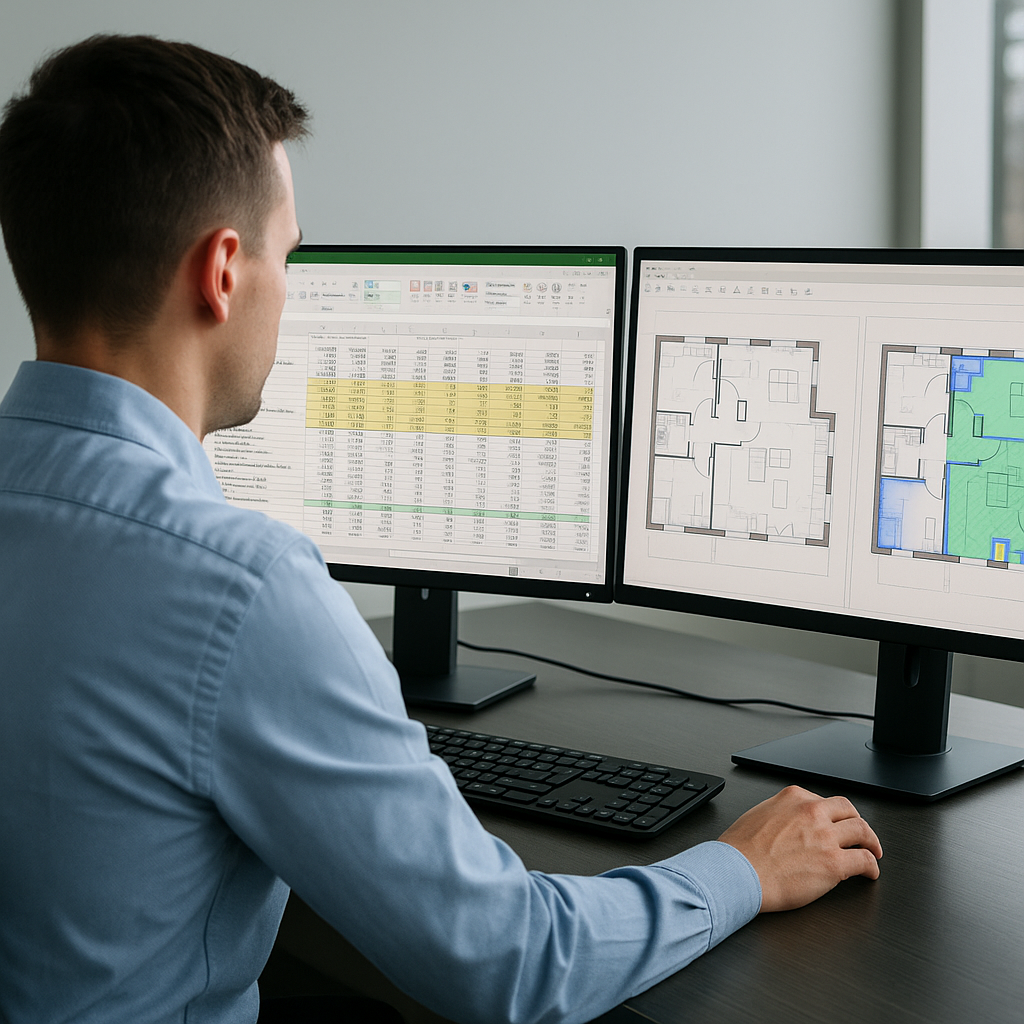
Why Manual Takeoffs Are Killing Your Productivity
If you’ve ever spent two full days measuring line lengths and window counts on a set of drawings, you know the pain of manual takeoffs. It’s slow, error-prone, and frankly, outdated. General contractors, subcontractors, and QS firms are still burning 40 hours per bid just to count quantities. Why? Because the tools they rely on—Bluebeam, Excel, and sometimes pen and paper—were never designed for speed.
Here’s the brutal math: Two estimators working full-time on takeoffs cost ~$130/hr each. Multiply that by 40 hours, and you’re spending $10,400 per bid just on quantity extraction. Worse, human error means you’re probably missing details or miscounting quantities, which leads to inaccurate estimates and margin erosion.
This isn’t just hypothetical. A survey by Dodge Data & Analytics found that nearly 35% of construction professionals cite manual takeoffs as a major bottleneck in project bidding. Many smaller firms also struggle to scale because they simply can’t handle more bids without adding staff.
Enter AI-powered tools like EstimateNext. These platforms use Vision AI to take the grunt work out of takeoffs. Instead of spending days manually measuring PDFs, you upload your drawings and get quantities in just 10 minutes. Yes, minutes.
How Vision AI Works
Here’s the process:
-
Upload Your Drawing Set: PDFs, DWGs, or scanned blueprints—Vision AI can handle them all. For example, subcontractors working on retail fit-outs can upload PDFs directly from architects and get instant measurements for flooring square footage, fixture counts, and ceiling grids.
-
Automated Quantity Extraction: The AI scans every page for room areas, wall lengths, fixture counts, and more. It even flags low-confidence measurements for manual review. For instance, on a set of residential drawings, it might highlight irregular window shapes for a closer look.
-
Revision Tracking: Got a drawing revision? No problem. Upload the new set, and the AI compares changes automatically. This has been a game-changer for teams managing high-frequency updates, like those working on design-build contracts.
A case study from a mid-sized GC showed Vision AI saved them 120 hours on a high-rise bid. That’s two full weeks of labor costs avoided. In their words: “It’s like hiring a full-time estimator without the overhead.”
The Obvious Objection: “But AI Can’t Think Like an Estimator”
You might be thinking, “Sure, AI is fast, but it doesn’t understand the nuances of construction.” That’s partially true—but it’s also missing the point. AI doesn’t replace your expertise; it amplifies it. You’re still the one making judgment calls, negotiating with subs, and deciding on markup. The AI just handles the grunt work.
Think of Vision AI as the apprentice you always wanted—one that never gets tired, never makes arithmetic mistakes, and finishes takeoffs 10X faster.
For example, a drywall subcontractor might still need to decide how much waste factor to apply based on specific jobsite conditions. However, the AI can quickly deliver accurate total wall measurements, saving hours of manual counting.
What About Accuracy?
No system is perfect, but AI tools have come a long way. EstimateNext’s Vision AI, for example, includes confidence scoring and manual override features. If the system isn’t sure about a measurement, it flags it for review. This ensures that human oversight remains part of the process.
In my view, the combination of speed and auditability makes AI takeoff tools far more reliable than manual methods. You’re not just saving time—you’re reducing risk. A study by McKinsey found that construction teams adopting AI tools reduce rework by up to 15%, saving both time and money.
Who Benefits Most?
Let’s break it down:
General Contractors
Saving 40 hours per bid means your team can handle more GMP pursuits. For a GC director managing 5–8 bids per year, that’s $52,000 saved annually. This extra bandwidth lets you focus on winning more projects without increasing headcount.
MEP Subcontractors
Faster takeoffs mean faster quote responses. Instead of scrambling to meet deadlines, you’re delivering bids in 4 hours—not 3 days. For example, an HVAC subcontractor could quickly provide precise ductwork quantities without combing through multiple plan sets.
QS Firms
Accuracy and speed make AI tools a no-brainer for quantity surveyors juggling multiple projects. The ROI is massive when you consider the time saved per estimate. A UK-based QS firm reported cutting their bid preparation time by 70%, allowing them to take on twice as many jobs.
Real-World Edge Cases
Here’s where AI really shines:
Large-Scale Infrastructure
A $1B rail bridge project requires quantities for concrete columns, beams, and rail decks. With AI, that work gets done in 10 minutes instead of 56 hours. This is especially critical for public-sector bids where deadlines are nonnegotiable.
Multi-Market Complexity
Projects spanning multiple regions often require compliance with different measurement standards (CSI MasterFormat, NRM2, CPWD DSR). AI platforms like EstimateNext handle this seamlessly, eliminating the need for manual conversions.
Revision Chaos
Mid-project design changes usually mean redoing takeoffs from scratch. AI tools handle revisions automatically, saving days of rework. For example, a subcontractor working on a hotel chain renovation saved 15 hours per project when dealing with frequent architectural updates.
Comparison: Manual vs. AI Takeoffs
| Feature | Manual Takeoffs | AI-Powered Takeoffs |
|---|---|---|
| Time Per Bid | ~40 hours | ~10 minutes |
| Accuracy | Prone to errors | Confidence scoring |
| Revision Handling | Labor-intensive | Automated tracking |
| Cost | $10,400 per bid | ~$500 per bid |
| Scalability | Limited | Unlimited |


