Why Quote Turnaround Is Killing Subcontractors
Deadlines are brutal in construction. If you miss one, you're out—no excuses. For MEP subcontractors responding to 30–60 bid packages a year, the quoting process is a massive time suck. A typical package might take three full days to price. That’s 72 hours where your team could be working on other bids—or, better yet, winning projects.
Why Does It Take So Long?
The quoting process is labor-intensive and repetitive, with a few key bottlenecks that subcontractors face repeatedly:
-
BOQ Parsing: Every bid package is different. You’re spending hours reformatting Excel workbooks and cleaning up merged cells or inconsistent layouts.
-
Rate Matching: Flipping through outdated catalogs and PDFs to find the right labor, material, and equipment rates. If you’ve ever had to dig through an MCAA manual or a vendor price sheet, you know how time-consuming this gets.
-
Scope Confirmation: Cross-checking plans, specs, and drawings for accuracy. It’s painstaking work that feels like solving a puzzle with half the pieces missing.
Multiply this by 30 packages a year, and you’re losing weeks of productive time—not to mention the bids you never submit because you’re bogged down.
Real-Life Impacts
Take the example of a mid-sized electrical subcontractor that handles 40 bids annually. Spending three days on each package means nearly 120 workdays a year—just for quoting. That’s almost half the year spent on tasks that don’t directly generate revenue. Worse, this firm loses out on at least 10 bids annually because their team simply doesn’t have the bandwidth to respond.
How AI Turns Days Into Hours
AI doesn’t magically eliminate all the work, but it handles the grunt work so your team can focus on strategy and decision-making. Tools like EstimateNext streamline the quoting process into a 4-hour workflow. Here’s how:
1. Smart BOQ Parser
Upload your Excel or PDF Bill of Quantities (BOQ) directly. The AI automatically detects merged cells, section hierarchies, and headers. Instead of spending two hours cleaning up data, you’re done in 10 minutes.
Example:
A plumbing subcontractor recently used EstimateNext to process a 125-line BOQ. The AI reordered the entire document in minutes, saving the team two hours of manual cleanup. They immediately moved on to rate matching, shaving off even more time.
2. Rate Matching Across 135+ Catalogs
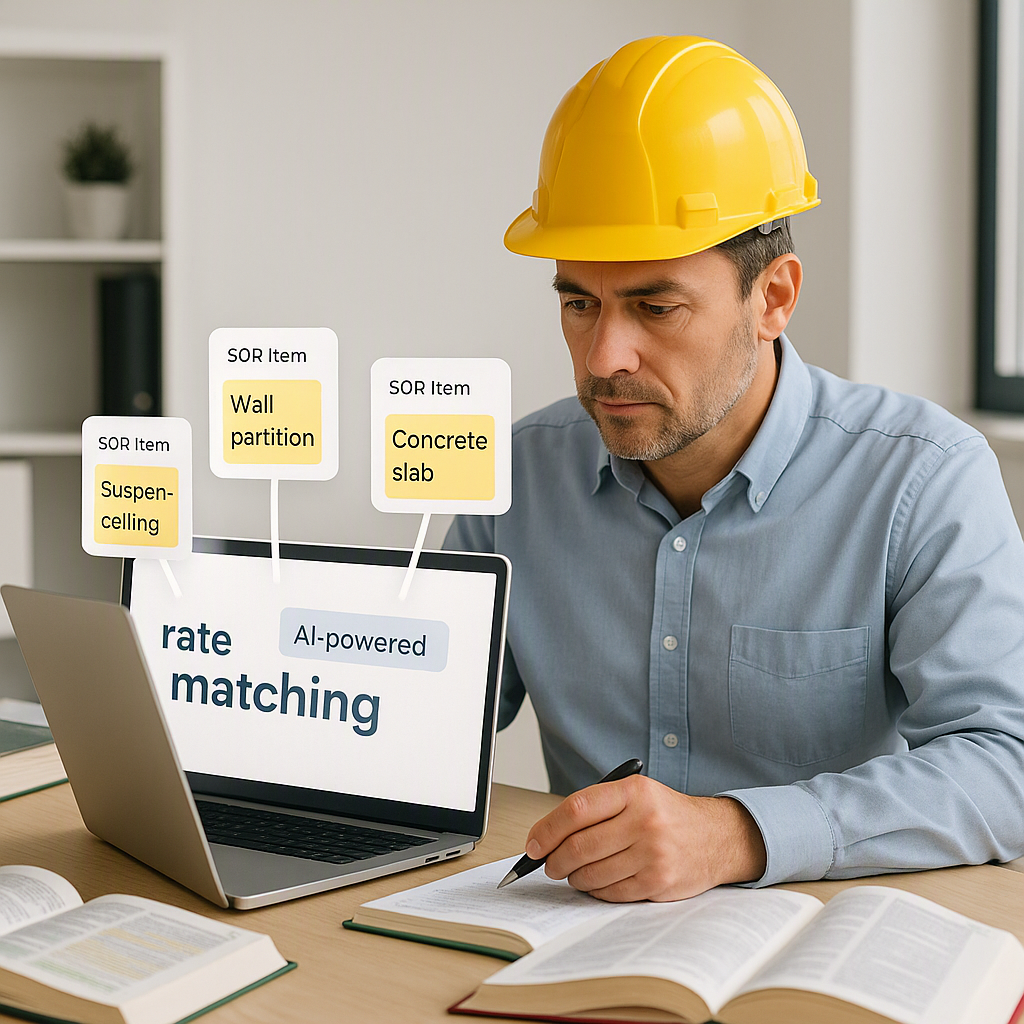
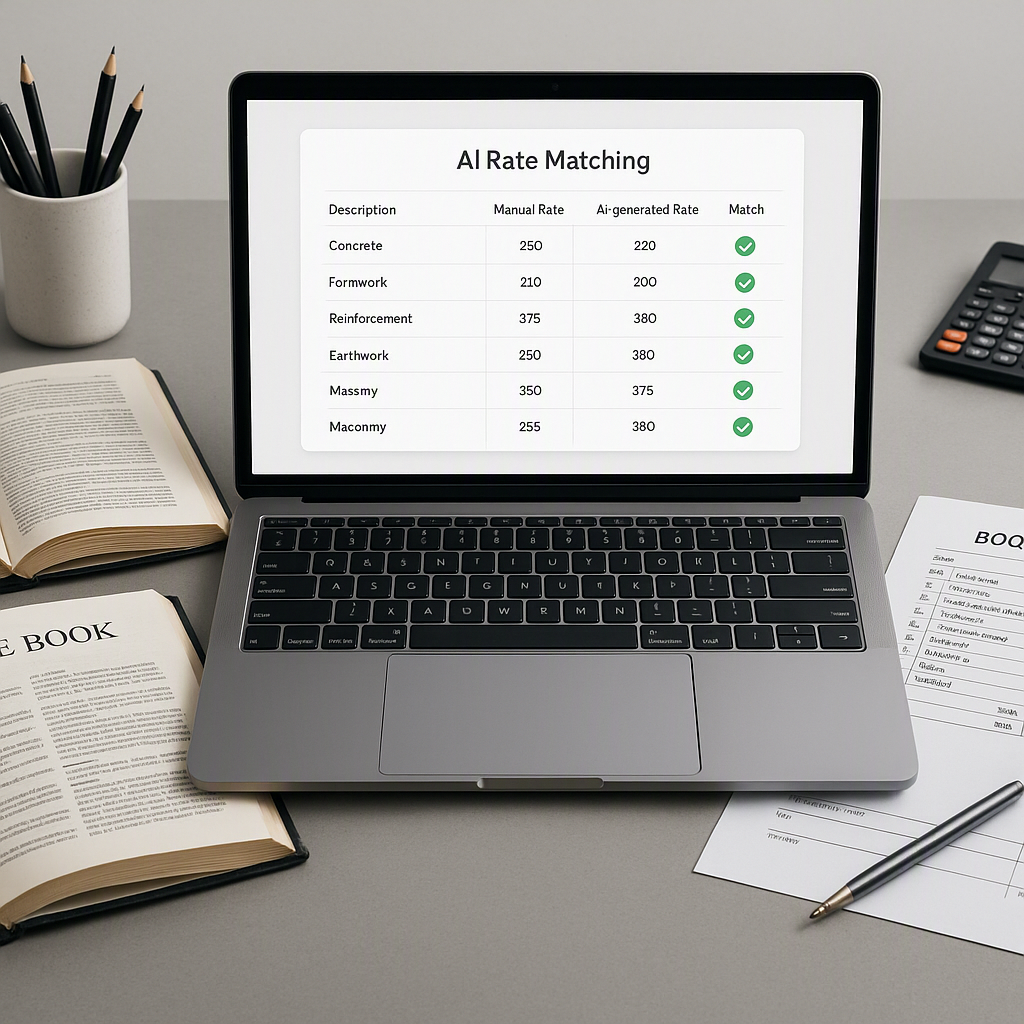
AI-powered semantic search matches BOQ line items to rates from 78,000+ Schedule of Rates (SOR) items across catalogs like MCAA, NECA, and CPWD DSR. Need a custom HVAC controller rate? The AI can suggest matches based on your history or fallback to wider catalog searches. What used to take six hours is done in seconds.
Practical Example:
A mid-sized HVAC firm priced out a 200-line-item BOQ in under an hour using EstimateNext’s catalog matching. They compared rates across MCAA standards and their own historical data to ensure accuracy.
3. Scope Review with Vision AI
EstimateNext’s Vision AI extracts quantities directly from drawings—door counts, wall lengths, fixture placements. You can verify scope in minutes instead of manually remeasuring everything.
Comparison:
Traditional manual takeoffs for a 10,000-square-foot build typically take 6–8 hours. Vision AI reduces this to under 30 minutes.
4. Real-Time Quote Builder
Adjust rates, margins, and overhead percentages directly in the platform. Every change propagates instantly across the quote. No more rebuilding spreadsheets for every what-if scenario.
Impact: Shaving Off 68 Hours
These four steps shave off 68 hours from your typical quote cycle. That’s not just faster—it’s a game-changer for subs who need to respond to more bids without hiring more estimators.
Real Results: Case Study
One mid-sized HVAC subcontractor used EstimateNext to price 45 bid packages in a month—double their usual output. By cutting quote turnaround to four hours, they responded to bids they’d normally ignore. The result? Six new project wins worth $1.2 million in revenue.
More Examples:
Another electrical subcontractor saved 320 hours in a single quarter by integrating AI into their estimating workflow. They increased their bid response rate by 35% and secured three high-value contracts they would have otherwise missed.
The Obvious Objection: “Can AI Handle Complex Trade Work?”
You might think, “Sure, AI works for simple rates, but what about specialist trades like plumbing or electrical?” That’s valid. Not all AI tools are equipped for niche calculations like pipe sizing or panel load analysis.
Addressing Complexity:
EstimateNext addresses this with specialist trade tools:
- HVAC: SMACNA duct sizing, ASHRAE load computations
- Electrical: NEC Table 220 demand load, cable/conduit sizing
- Plumbing: IPC fixture units, trap sizing, vent/backflow calculations
These tools integrate directly into the quote builder, so you’re not jumping between software. Everything stays in one place.
Decision Framework: Should You Use AI?
| Question | Traditional Process | AI-Powered Process |
|---|---|---|
| How long does BOQ parsing take? | 2–3 hours per bid | 10 minutes |
| Rate matching effort? | 4–6 hours per bid | Seconds |
| Scope review duration? | 6–8 hours per bid | 30 minutes |
| Overall quote turnaround? | 72 hours (3 full days) | 4 hours |
| Can it handle specialty trades? | Requires multiple tools | Integrated AI tools |
If your team spends weeks on quoting and struggles to respond to more bids, AI tools like EstimateNext can make a measurable difference in efficiency and revenue.
Call to Action
If you’re tired of missing deadlines or losing bids to faster competitors, EstimateNext can help. Get started free →