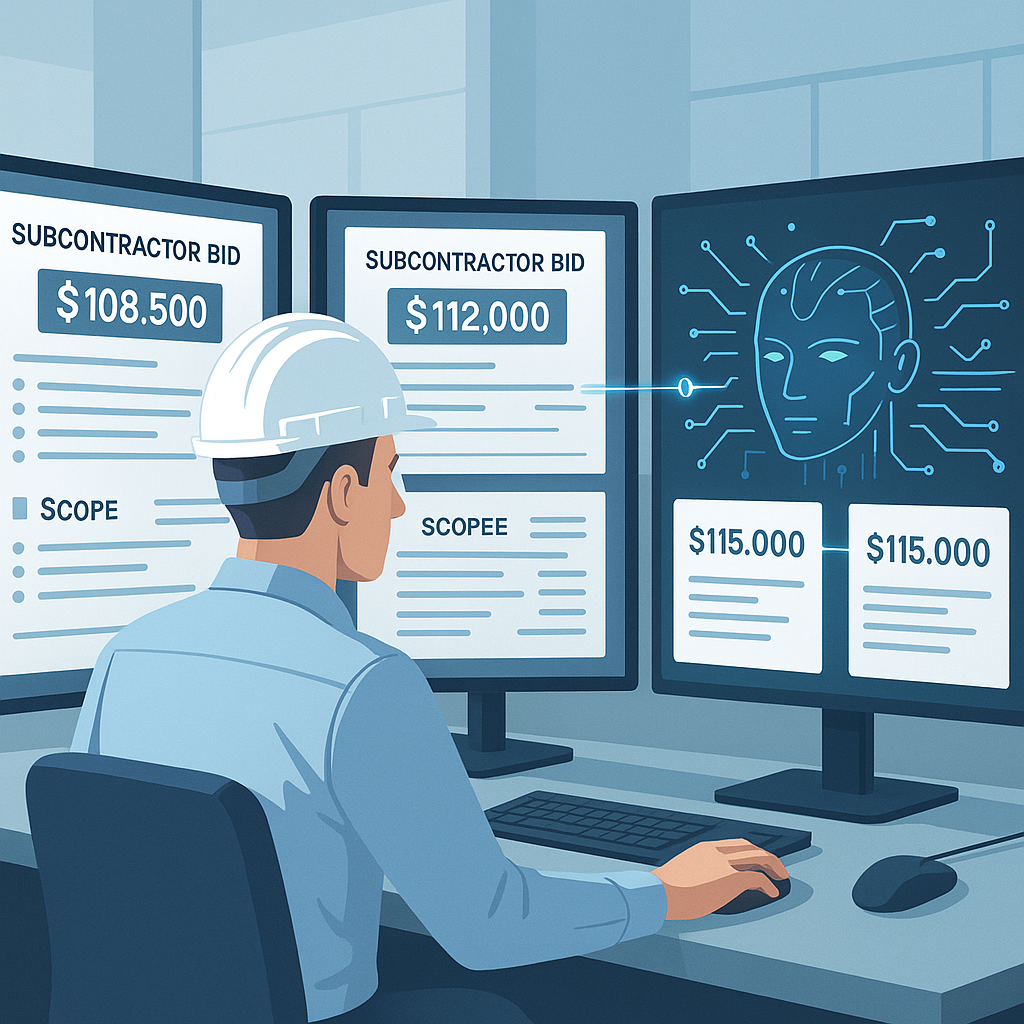
Why Sub Bid Leveling Is the Hidden Time Sink in Preconstruction
Let’s talk about something no one enjoys: leveling subcontractor bids. You’ve got seven quotes sitting in your inbox, all formatted differently, with varying scopes and exclusions. Figuring out who’s actually competitive takes hours — sometimes days — of manual work. Sound familiar?
Here’s the problem: manual bid leveling isn’t just slow. It’s error-prone. Miss a scope gap or overlook an exclusion, and you’re either overpaying or underestimating. Neither is good for your bottom line. Worse, these errors can lead to project delays, budget overruns, or strained subcontractor relationships.
The AI Fix: 12X Faster Bid Leveling
This is where AI-powered tools like EstimateNext come in. Instead of slogging through Excel sheets, AI takes your sub bids, normalizes their scopes, and ranks them in under 30 minutes. That’s a 12X speed improvement compared to manual methods.
How AI Works in Bid Leveling
EstimateNext’s bid intelligence engine uses natural language processing (NLP) to parse subcontractor quotes. It identifies scope mismatches, exclusions, and even pricing anomalies. Then, it generates a ranked list of L1, L2, and L3 options, complete with recommendations. AI doesn’t just speed up the process; it adds precision by reducing human error.
Concrete Example: Parsing Scope Data
For instance, let’s say you receive five quotes from electrical subcontractors for a commercial office project. One quote includes material costs but excludes labor, another provides an all-inclusive price, and the remaining three mix and match costs unpredictably. AI can instantly highlight these inconsistencies, ensuring you’re comparing apples to apples.
Real-World Example: The $342K Saved on a High-Rise Project
A mid-sized general contractor recently used EstimateNext for a high-rise project. They were juggling bids from five HVAC subcontractors, each with wildly different pricing structures. One included ductwork labor; another didn’t. One bundled equipment costs; another split them out.
With the AI-powered bid leveling tool, they normalized all five quotes in 30 minutes and uncovered a $342,000 discrepancy in scope. That’s money they would’ve missed without automation.
Another Case Study: Saving Time on a Retail Build-Out
On a smaller scale, a contractor doing a retail build-out saved 14 labor hours by using AI. They uploaded quotes from three drywall subcontractors, and the tool flagged exclusions related to fireproofing. Without the tool, this exclusion might have been overlooked, leading to costly change orders mid-project.
Common Pushbacks: “AI Doesn’t Understand Construction”
You might be thinking, “Sure, AI is fast, but it doesn’t understand the nuances of construction.” Fair point. AI doesn’t replace your expertise — it amplifies it. You’re still the one making judgment calls and negotiating with subs. The AI just handles the grunt work.
Actionable Comparison: Manual vs AI Bid Leveling
| Feature | Manual Leveling | AI-Powered Leveling |
|---|---|---|
| Time Required | 6–12 hours per bid batch | 30 minutes per batch |
| Error Rate | High (prone to scope gaps) | Low (automated checks) |
| Scalability | Limited by human capacity | Easily handles 10+ bids |
| Cost Efficiency | Labor-intensive, costly | Saves labor costs |
| Expert Input | Required for every step | Amplified by AI insights |
Practical Benefits: Time, Accuracy, ROI
Let’s break down the tangible benefits:
- Time Saved: Sub bid leveling drops from six hours to 30 minutes. That’s 5.5 hours you can spend on higher-value tasks like strategizing, meeting clients, or refining project schedules.
- Accuracy Improved: NLP ensures scope mismatches and exclusions are flagged, reducing costly oversights that could lead to change orders or disputes.
- ROI Delivered: Faster leveling means quicker bid submissions. More bids = more wins. Simple math.
Data Point: ROI of Automation
According to McKinsey, automation in construction processes can improve productivity by up to 50%. AI tools like EstimateNext fall squarely in this category, offering contractors a measurable edge in bid management.
How to Get Started
If you’re ready to ditch manual leveling, here’s the actionable plan:
- Upload Your Sub Quotes: EstimateNext supports PDFs, Excel files, and even scanned images.
- Run the AI Normalization: The tool parses each quote, flags scope mismatches, and generates rankings.
- Review and Finalize: You get a ranked list of subs, complete with scope comparisons and pricing breakdowns.
- Award the Bid: Save time, win more projects.
Tips for Effective Adoption
- Train Your Team: Ensure your estimators and project managers understand how to interpret AI-generated recommendations.
- Start Small: Test AI tools on a single project before rolling them out company-wide.
- Monitor Results: Track time savings and accuracy improvements to measure the tool’s impact.
Final Thoughts
Manual bid leveling is a productivity killer. Whether you’re a small general contractor or a large construction firm, the hours spent combing through quotes could be better spent elsewhere. AI tools like EstimateNext can save you time, improve accuracy, and help you win more projects without adding overhead.
Ready to stop wasting hours on sub bid leveling? Get started free →


