Why Rate Lookups Are Killing Your Estimation Workflow
You know the drill. You’re in the middle of pricing a bid, and you hit a snag. The BOQ lists “pre-stressed concrete girders,” but the rate isn’t in your catalog. What’s next? Hours spent flipping through a 2,000-page rate book, hoping you don’t miss a line. Sound familiar? It should. Rate lookups are one of the most frustrating—and time-consuming—parts of preconstruction estimation.
Here’s the kicker: according to a 2023 McKinsey report, manual rate lookups add an average of 12 hours to every estimate. That’s a day and a half of lost productivity per bid. Multiply that by 5-8 GMP pursuits a year for a mid-sized GC, and you’re looking at 60-100 hours wasted annually. For a team of three estimators, that’s nearly 300 hours of unproductive time every year.
Still not convinced? Think about what that time represents: fewer bids submitted, less time refining proposals, and more stress for your team. And let’s not forget the risk of errors—mispriced rates or missed items that lead to budget overruns and change orders.
If you’re thinking, “We’ve always done it this way,” that’s a problem. Because while you’re stuck in a 1990s workflow, your competitors are already using AI tools to price bids faster and more accurately. Want to catch up? Let’s talk about AI-powered rate matching.
How AI Rate Matching Works
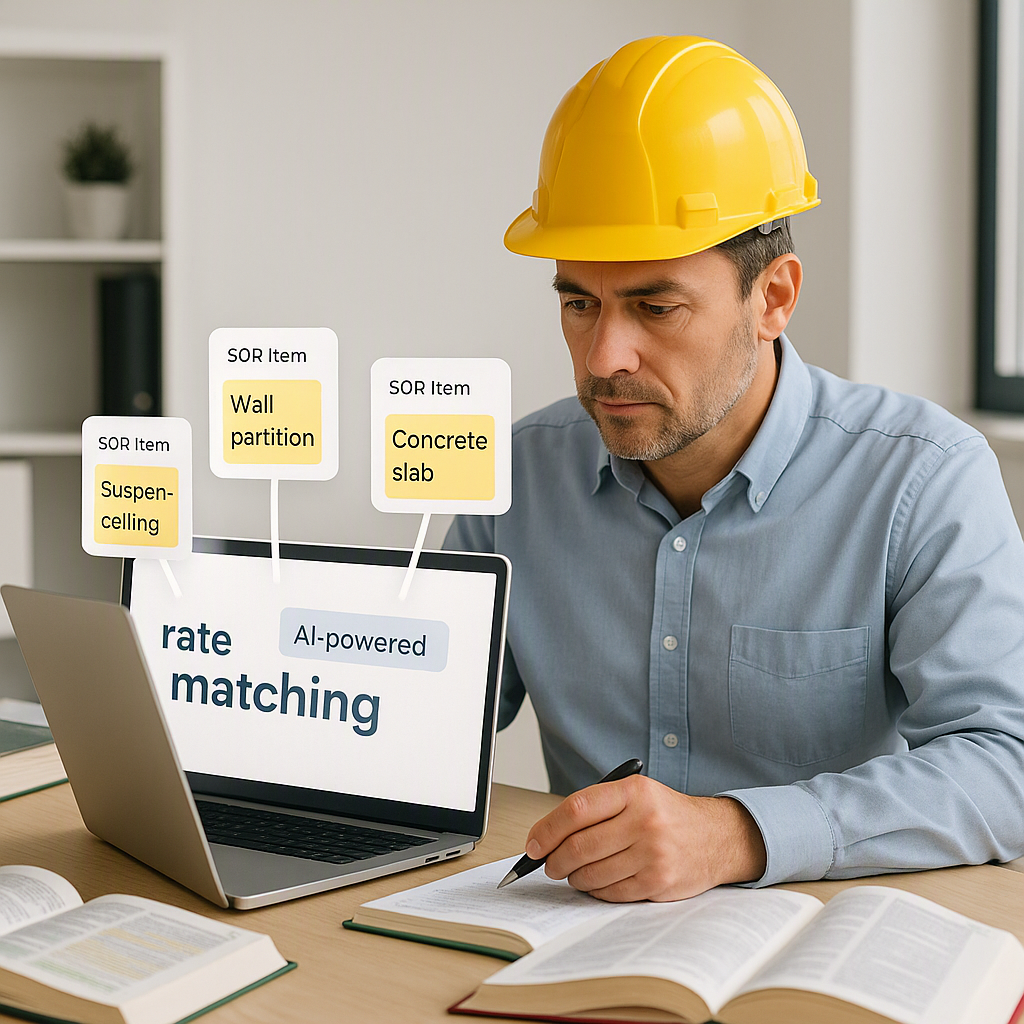
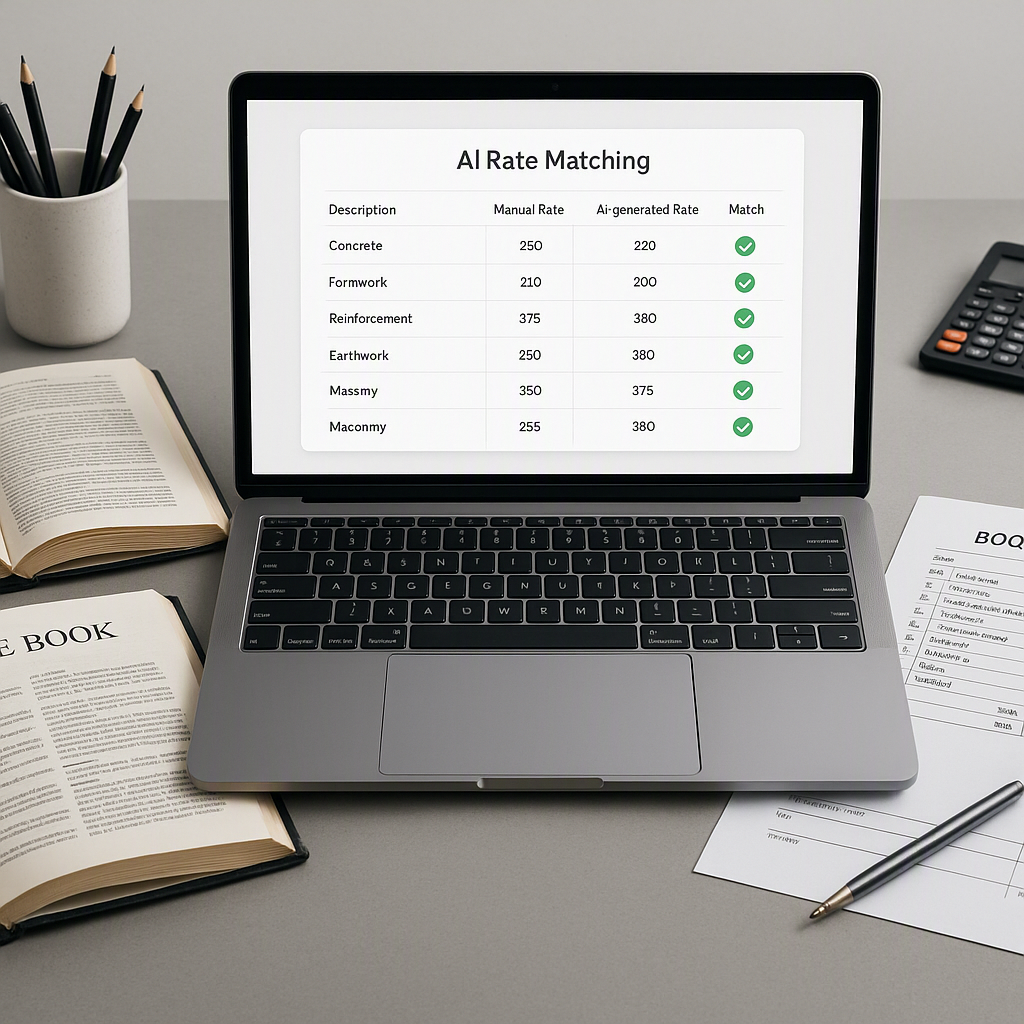
AI rate matching takes the grunt work out of estimation. Instead of flipping through PDFs or relying on outdated spreadsheets, you upload your BOQ, type in what you’re looking for, and let the software do the rest.
Take EstimateNext, for example. Its semantic search engine scans 78,000+ SOR (Schedule of Rates) items across 135 catalogs in seconds. Need the labor cost for installing pre-stressed concrete girders? Done. Wondering if there’s a cheaper alternative in your region? It’ll show you that, too. And because the system learns from every search, it gets smarter over time—meaning fewer errors and faster results as you go.
A Real-World Example
Here’s a real-world scenario: A mid-sized contractor in Chicago recently used EstimateNext to price a $14.4M infrastructure bid. Instead of spending 10+ hours manually matching rates to the BOQ, their team got it done in under 15 minutes. That’s not just time saved; it’s time reallocated to refining the bid and negotiating better rates. In their words, “It’s like having a junior estimator on steroids.”
Similarly, a civil contractor in India struggled with CPWD DSR (Central Public Works Department's Schedule of Rates), which runs over 1,000 pages. By using an AI tool, they cut their rate lookup time by 80%, allowing them to focus on optimizing subcontractor pricing.
The ROI of AI Rate Matching
Still skeptical? Let’s break down the numbers. Say your team handles 6 GMP pursuits a year. If you’re saving 12 hours per bid, that’s 72 hours annually. At an average estimator rate of $130/hour, that’s $9,360 in labor savings alone. Add in the improved accuracy (fewer missed rates, fewer change orders down the line), and the ROI becomes undeniable.
But the benefits go beyond just labor savings. Faster rate lookups mean:
- More bids submitted: If your team saves 12 hours per estimate, that’s time that can be spent preparing additional bids, increasing your chances of winning more work.
- Better negotiation leverage: With instant rate comparisons, you can identify cost-saving alternatives and negotiate better deals with subcontractors.
- Reduced stress: Instead of rushing through rate lookups, your team can focus on strategic decisions, like value engineering or identifying project risks.
Case Study: A Large General Contractor
A large GC bidding on a $50M healthcare project used AI rate matching to reduce errors. Previously, their change orders averaged 3% of project costs due to missed rates. With AI-powered tools, they reduced that to under 1%, saving $1M in unexpected costs.
The Obvious Objection: “But AI Can’t Think Like an Estimator”
This is the pushback we hear most often. And it’s fair—AI doesn’t have your experience, your intuition, or your ability to spot red flags. But that’s not the point. AI isn’t here to replace you; it’s here to handle the tedious tasks so you can focus on the strategic ones.
A Comparison: Manual vs. AI Workflow
| Task | Manual Process | AI-Assisted Process |
|---|---|---|
| Rate Lookups | 10-15 hours per bid | 10-15 minutes per bid |
| Error Checking | Manual cross-referencing | Automated suggestions |
| Catalog Updates | Sporadic, time-intensive | Real-time updates |
| Time for Strategic Analysis | Minimal | Significantly increased |
Think of it this way: you wouldn’t manually calculate HVAC load requirements when ASHRAE standards exist, right? The same logic applies to rate lookups. AI tools like EstimateNext automate the grunt work, giving you more time to analyze the big picture. You’re still in control; the AI just makes your job easier.
How to Get Started with AI Rate Matching
- Audit Your Current Process. How much time does your team spend on rate lookups? Track it for a week—you might be surprised. Identify bottlenecks and inefficiencies.
- Choose the Right Tool. Look for platforms that integrate with your existing tools (like Excel, Bluebeam, or Procore) and offer features like custom catalogs, regional rates, and semantic search.
- Start Small. Test the tool on a single project. Measure the time saved, the accuracy of the results, and team feedback.
- Train Your Team. AI tools are only as good as the people using them. Invest in training sessions and create internal how-to guides.
- Scale Up. Once you see the ROI, roll the tool out across more projects. The more you use it, the smarter it gets thanks to machine learning algorithms.