Why Takeoffs Are Still the Biggest Time Sink in Preconstruction
Every estimator knows the pain of manual takeoffs. You’re staring at a PDF with dozens of pages, trying to measure room areas, wall lengths, and fixture counts. Even with tools like Bluebeam, it’s slow work — calibrating scales, rechecking measurements, and flipping between pages. For a mid-sized bid, this process eats up 40 hours. That’s two full workdays for two estimators.
But here’s the frustrating part: takeoffs aren’t strategic. They don’t win bids. They’re just grunt work that has to be done before you even start pricing. And the bigger the project, the more time you lose.
Manual Takeoffs: A Hidden Bottleneck
Manual takeoffs often go unnoticed as the bottleneck of preconstruction. Why? Because they’re seen as just part of the job — a step every estimator has to endure. But the reality is this: the time and cost associated with manual takeoffs can cripple efficiency and profitability.
The Brutal Math of Manual Takeoffs
Let’s break down the cost:
- Time: 40 hours per bid × 130 bids/year = 5,200 hours wasted annually for a busy general contractor (GC).
- Labor: At $100/hour (the average US estimator rate), that’s $520,000/year spent on manual takeoffs.
And what’s worse? Errors. Mismeasuring wall lengths or missing a window cutout could mean underestimating quantities — and overpaying subs later. Inaccurate takeoffs bleed profits, and the impact compounds as the project scales up.
Real-World Example: The Domino Effect of Errors
Take a recent case: A GC bidding on a $10 million commercial office building miscalculated flooring quantities due to an oversight in manual takeoffs. They underestimated the square footage by 15%, leading to a $150,000 cost overrun when the flooring subcontractor submitted a revised quote. These types of errors not only eat into profits but can also strain relationships with clients and subs.
How AI Cuts Takeoffs from 40 Hours to 10 Minutes
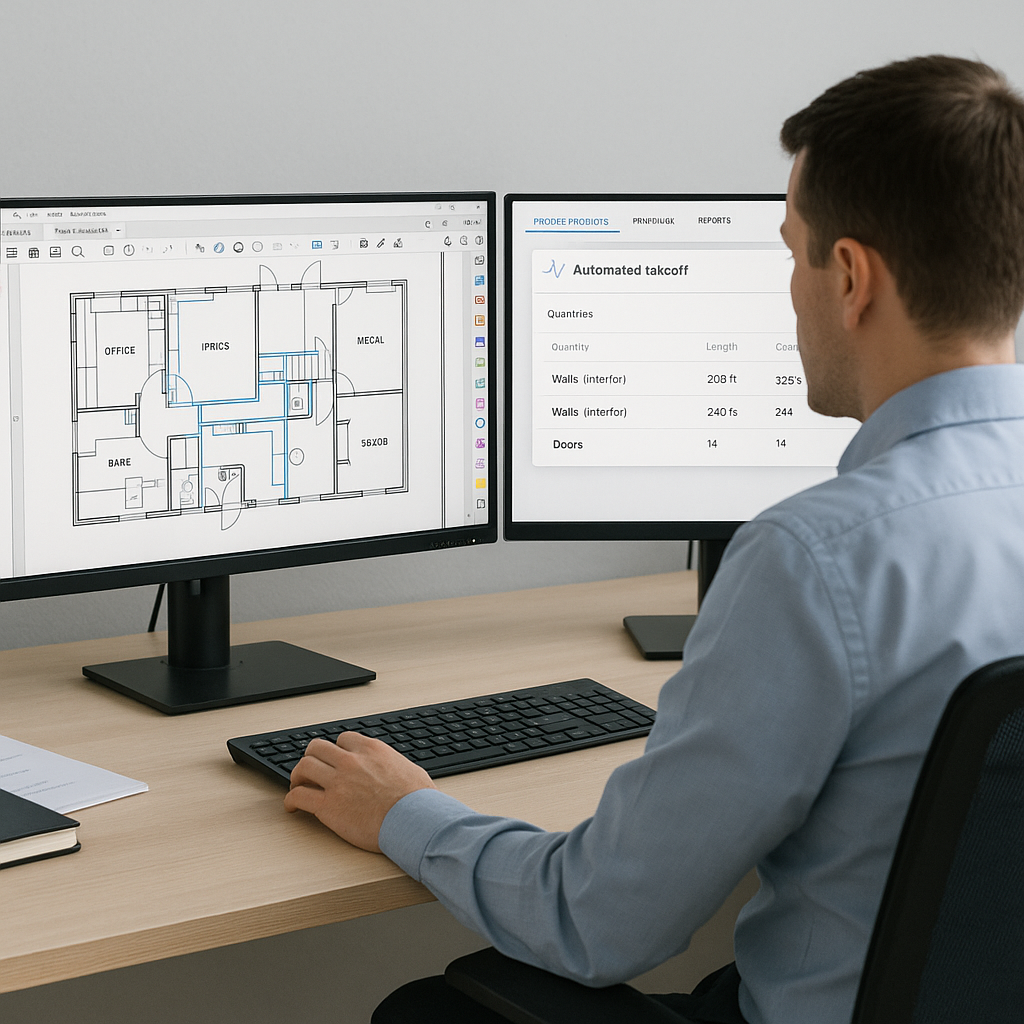
This is where AI-powered tools like EstimateNext come in. The platform’s Vision AI reads PDF drawings and extracts quantities automatically. No manual measuring. No flipping back and forth between pages.
How It Works:
- Upload Your PDF: Drag and drop your drawing set into the tool.
- Let AI Analyze: The system scans every page for room areas, lengths, counts, and more.
- Review Low-Confidence Areas: Any measurements flagged as uncertain are highlighted for quick rechecking.
- Export to Your BOQ: Quantities are uploaded directly into your Bill of Quantities (BOQ), ready for pricing.
By automating repetitive tasks, AI tools allow estimators to focus their attention on strategic decision-making and bid optimization.
Real Results: Mid-Sized GC Transforms Bid Process
A mid-sized GC used EstimateNext on a high-rise bid. Instead of spending two weeks on takeoffs, they finished in under an hour. The team estimated they saved 120 hours total — almost $12,000 in labor costs. More importantly, they redirected that time to fine-tuning their pricing and proposal, ultimately winning the project.
Actionable Steps to Implement AI Takeoffs
- Evaluate Your Current Process: Track the time and cost of your manual takeoffs to understand the potential ROI of AI tools.
- Test AI Tools: Start with a free trial of platforms like EstimateNext to see how they handle your typical project sizes.
- Integrate AI into Workflow: Ensure the AI tool integrates seamlessly with your existing construction software, such as Procore or Bluebeam.
- Train Your Team: Allocate time for your estimators to get familiar with the new tool. Many platforms offer training and support to make onboarding smooth.
Why AI Doesn’t Replace Estimators (But Makes Them Faster)
You might be thinking, “Sure, AI is fast, but it doesn’t understand the nuances of my project.” That’s fair. AI isn’t perfect, and it can’t make judgment calls like a seasoned estimator. But it handles repetitive tasks — like takeoffs — far better than humans.
Think of AI as your junior estimator. It does the grunt work so you can focus on strategy: analyzing sub quotes, finalizing margins, and negotiating deals.
Common Objection: “What About Complex Projects?”
AI-powered takeoffs work for both simple and complex bids. For example, on a $1 billion rail project, EstimateNext’s Vision AI extracted quantities for concrete columns, beams, and rail decks in just 10 minutes. The GC team then reviewed the outputs, added context, and finalized their BOQ. The result? 99% accuracy and weeks saved.
Case Study: Complex Infrastructure Project
In another example, a global infrastructure firm used AI on a multi-phase airport expansion project. With over 5,000 pages of drawings, the manual takeoff process was estimated to take six weeks. Using AI, the firm completed initial quantity extraction in just two days, enabling them to submit their bid ahead of competitors. The project team credited AI with uncovering several scope discrepancies early, avoiding potential change orders worth millions.
The ROI of AI Takeoffs
Let’s revisit the math, but this time with AI:
- Time: 10 minutes per bid × 130 bids/year = ~22 hours annually spent on takeoffs.
- Labor: At $100/hour, that’s just $2,200/year.
You’re saving $517,800 per year in labor costs — and freeing up your team to price more bids or focus on higher-value tasks.
Decision Framework: Manual vs. AI Takeoffs
| Factor | Manual Takeoffs | AI-Powered Takeoffs |
|---|---|---|
| Time Per Bid | 40 hours | 10 minutes |
| Annual Labor Cost | ~$520,000 | ~$2,200 |
| Error Risk | High | Low (with human review) |
| Scalability | Limited | High |
| Focus on Strategy | Minimal | Significant |
What’s Next?
If you’re still spending days on manual takeoffs, it’s time to rethink your process. AI tools like EstimateNext allow you to upload your drawings, extract quantities in minutes, and export directly to your BOQ. The system even highlights low-confidence areas, so you can review and adjust before submitting.
Ready to cut your takeoff time by 99%? Get started free →
If you're ready to stop wasting time on manual takeoffs, EstimateNext can help. Upload your first BOQ and get a priced estimate in minutes.