The Brutal Math of Manual Takeoffs
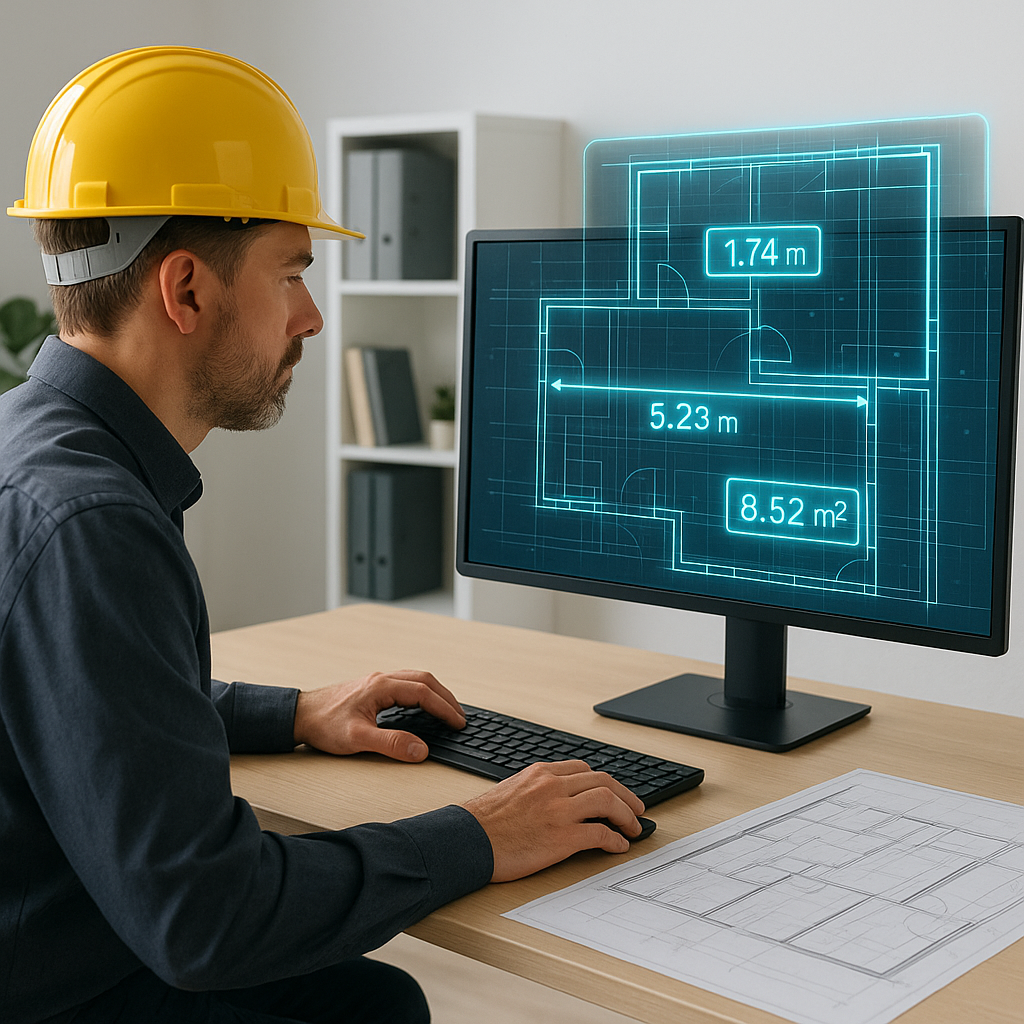
Let’s start with a reality check. If you’re manually measuring drawings for every bid, you’re spending 40 hours per project. That’s two full workdays for two estimators, just to count walls, doors, and areas. Think about it. How much of your team’s time is lost to busy work rather than actual estimation? Multiply that across dozens of projects per year, and the inefficiency starts to snowball.
The Hidden Costs of Manual Takeoffs
Manual takeoffs aren’t just time-consuming; they’re expensive. Let’s break it down:
- Labor Costs: If your estimators earn $35/hour, a single project’s 40-hour takeoff costs $1,400. Multiply that across 30 bids annually, and you’re sinking $42,000 in labor costs just for measurement.
- Error Costs: Studies show manual processes can be error-prone. A miscalculated beam length or missed door opening might cost your firm thousands in change orders. For example, the Construction Industry Institute found that rework costs account for up to 10% of total project value.
- Opportunity Costs: While your team is stuck measuring walls and doors, competitors who embrace automation are submitting more bids and winning projects you never had time to pursue.
Why Manual Takeoffs Are a Bottleneck
Manual takeoffs rely on human accuracy, which can be error-prone — especially on complex projects like a $1B rail bridge or a high-rise office. Even seasoned estimators miss details here and there. A small oversight, like mismeasuring concrete volumes, can spiral into costly rework or project delays.
Take the example of a subcontractor bidding on a $108M municipal water treatment facility. Midway through construction, they discovered an error in their original takeoff. The issue resulted in a $300,000 change order, eating into their margins and damaging their reputation. Could this have been avoided? Absolutely — with better tools.
How AI-Powered Takeoff Tools Work
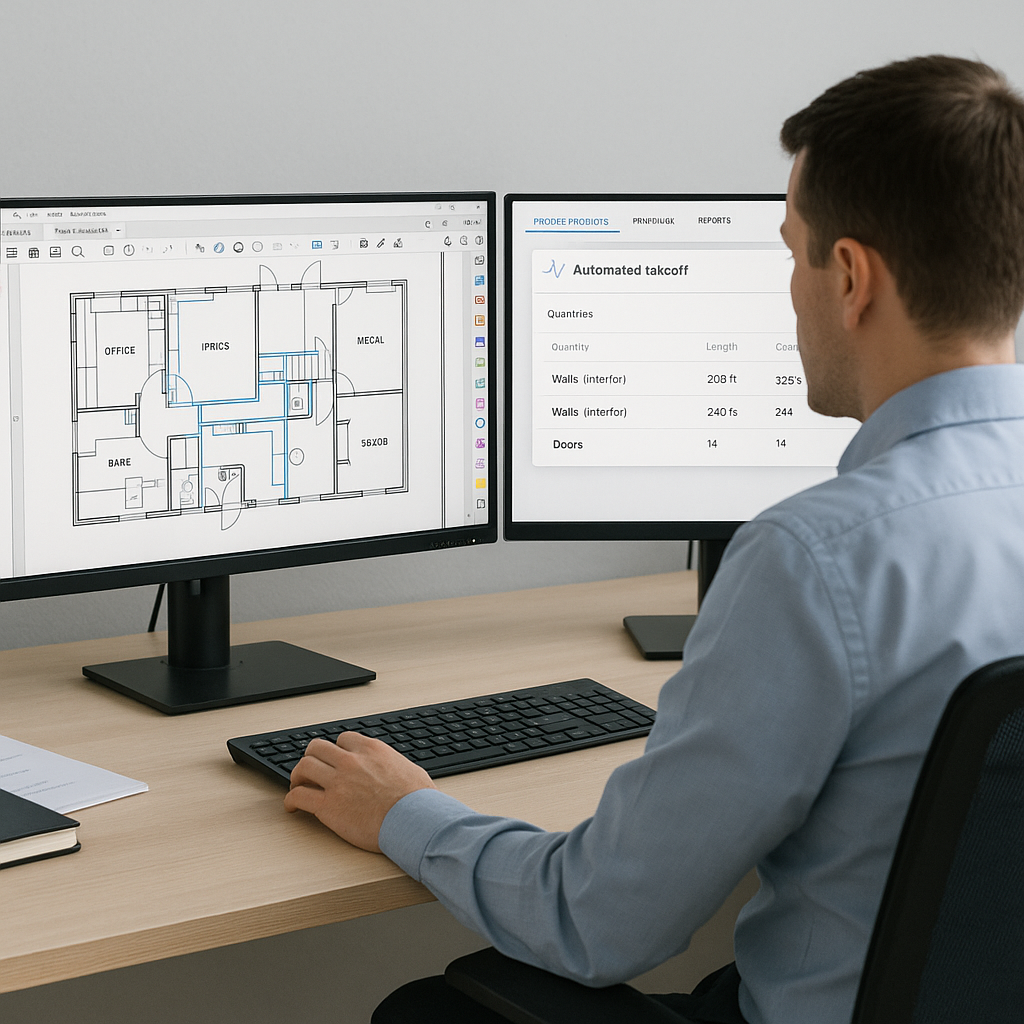
AI-powered tools like EstimateNext completely change the game. Their Vision AI extracts quantities from drawings in just 10 minutes, a staggering 10X speed improvement over manual methods. Here’s how it works:
Step-by-Step Process:
- Upload Your Drawings: PDFs, DWGs, or even scanned documents — the platform supports a variety of formats.
- AI Scans the Drawings: Using machine vision, the system identifies walls, windows, doors, and lengths. It even flags low-confidence areas for manual review.
- Instant Results: Quantities are extracted, audited, and ready for your Bill of Quantities (BOQ).
No more rulers. No more calibration errors. No more tedious hours scrolling through Bluebeam or On-Screen Takeoff. With AI, you get accurate results in minutes.
Real-World Example: Labor Savings
A mid-sized general contractor recently used EstimateNext’s Vision AI on a high-rise bid. The result? They saved 120 hours — equivalent to two full weeks of labor costs. In their own words: “It’s like hiring a full-time estimator without the overhead.”
Let’s break this down:
- Labor Cost Avoided: At $35/hour, 120 hours equates to $4,200 saved.
- Bid Volume Increase: With AI, the contractor was able to submit 10% more bids that quarter, landing two additional projects and generating $1.2M in revenue.
The Most Common Objection: “AI Can’t Think Like an Estimator”
You’re absolutely right — AI doesn’t replace your expertise. It amplifies it. AI is designed to handle grunt work like takeoffs and recalculations, freeing you to focus on judgment calls, negotiating with subs, and optimizing markup.
Here’s how tools like EstimateNext address common concerns:
- Confidence Scoring: The AI flags low-confidence measurements so you can manually review them.
- Customizable Catalogs: You can tailor material catalogs to match the specs of unique projects like bridges, airports, or custom builds.
- Self-Learning Algorithms: The more projects you complete, the smarter the system becomes, reducing the need for manual overrides.
Think of AI as a junior estimator that never gets tired, never calls in sick, and costs a fraction of a human hire.
Why Speed Matters
Speed isn’t just a luxury; it’s a necessity. Here’s why:
For Subcontractors:
If it takes you 72 hours to turn around a quote, you’re already behind. General contractors often award bids to the fastest responder — not necessarily the cheapest.
For Firms Scaling Up:
Responding to 30-60 bid packages annually leaves little room for inefficiency. AI tools cut turnaround time to 4 hours, an 18X improvement. For a $200M revenue firm, those extra bids can translate into $800K-$1.6M in incremental revenue. That’s not just theory; it’s backed by case studies from EstimateNext clients.
Edge Cases: Custom Projects
What happens when a project involves odd specs — custom materials, irregular dimensions, or niche compliance requirements? AI tools like EstimateNext can handle these through:
- Customizable Material Catalogs: Tailor measurements to unique project needs.
- Machine Learning Adaptation: The tool improves accuracy as it processes more projects.
Case Study: A structural steel fabricator used AI for a custom-designed sports arena. Despite irregular dimensions and unique material requirements, the AI delivered accurate takeoffs, reducing errors by 85% and saving 80 hours of manual labor.
FAQ
Q: How accurate are AI-generated takeoffs?
A: AI tools are highly accurate, often reducing discrepancies by up to 80% compared to manual methods. However, human oversight remains essential for edge cases or low-confidence measurements flagged by the system.
Q: Can AI handle complex projects like bridges or airports?
A: Yes, AI scales to any project size. For example, EstimateNext has processed takeoffs for $1B rail bridges and $108M water infrastructure projects. Accuracy depends largely on the quality of the input drawings.
Q: Is AI hard to learn?
A: Most platforms, including EstimateNext, prioritize ease of use. Onboarding is typically straightforward, with training programs lasting under two weeks.
Q: What if my drawings are messy — scanned PDFs, not clean DWGs?
A: AI tools are designed to handle messy inputs. Vision AI can process scanned documents and flag low-confidence areas for manual review.
Q: Does AI replace estimators?
A: No. AI takes over repetitive tasks, like takeoffs, while you focus on high-value activities such as decision-making and negotiations. Think of AI as a tool to amplify your team’s efficiency, not replace it.
Comparison Table: Manual vs AI-Powered Takeoffs
| Metric | Manual Takeoffs | AI-Powered Takeoffs |
|---|---|---|
| Time per Project | 40 hours | 4 hours |
| Error Rate | 10-15% | 2-5% |
| Labor Cost per Project | $1,400 | $140 |
| Scalability | Limited | High |
| Learning Curve | None | 1-2 weeks |
Call to Action
If you’re tired of wasting 40 hours on manual takeoffs, EstimateNext can help. Upload your first BOQ and get a priced estimate in minutes. Get started free →