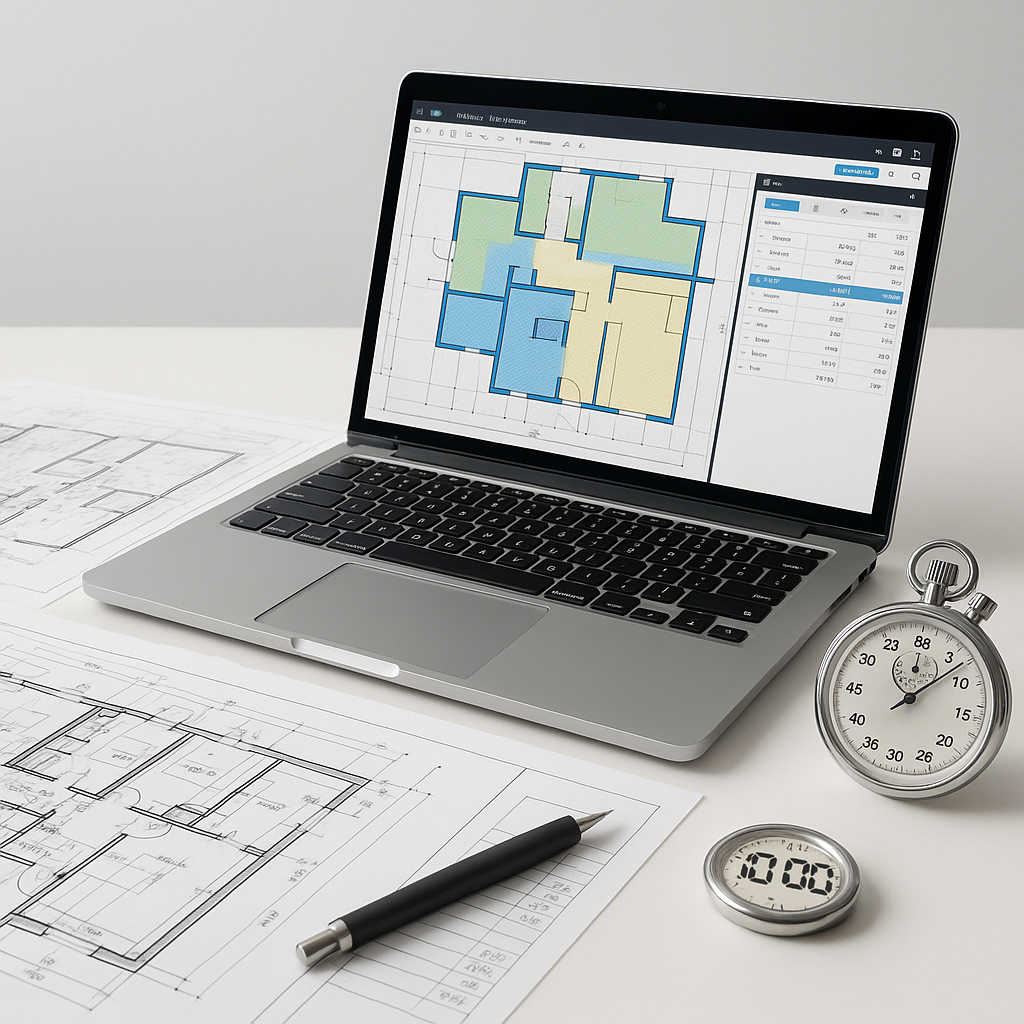
The Brutal Math of Manual Takeoffs
Preconstruction is tough enough without wasting 40 hours on manual takeoffs for every bid. Yet that’s exactly what most teams are still doing. Two estimators, two days, tracing drawings and manually calculating quantities. It’s slow, error-prone, and frankly outdated.
Think about it: if you’re pursuing five GMP bids a year, that’s 200 hours—just on takeoffs. What could your team do with that time back? More bids? Better scope negotiations? Faster approvals? The opportunity cost is enormous.
AI tools like EstimateNext are flipping the script. Their Vision AI engine extracts quantities from drawings in just 10 minutes. That’s not a typo—10 minutes.
How AI-Powered Takeoffs Work
Here’s the process:
- Upload your PDF drawings or BOQ to the platform. Whether you’re working with architectural plans, engineering drawings, or a bill of quantities (BOQ), the AI can process it seamlessly.
- Vision AI scans the documents and identifies key elements. This includes room areas, wall lengths, door/window counts, and even specialized components like HVAC systems or electrical fixtures.
- It spits out a detailed quantity takeoff, ready for review. You get an exportable report that integrates with your existing estimating workflow.
Example: A Mid-Sized General Contractor
One mid-sized GC saved 120 hours on a high-rise bid using EstimateNext. Before AI, the team spent three full days on manual takeoffs, often requiring overtime to meet deadlines. After adopting AI-powered takeoffs, the same project was completed in under two hours, with significantly fewer errors. In their words, “It’s like hiring a full-time estimator without the overhead.”
Actionable Steps for Implementation:
- Start with a pilot project. Select one upcoming bid and test an AI tool like EstimateNext to evaluate time savings and accuracy.
- Train your team. Most platforms are user-friendly, but a two-week onboarding period ensures everyone knows how to leverage the tool effectively.
- Integrate with existing software. Many AI tools integrate seamlessly with platforms like Bluebeam, Autodesk, and Procore, ensuring smooth adoption.
The Real ROI of AI Takeoffs
Let’s break down the numbers:
- A senior estimator costs around $130/hour. This is a conservative estimate in many markets.
- Saving 40 hours per bid = $5,200 saved. This calculation doesn’t include the opportunity cost of delayed approvals or lost bids.
- Multiply that by 5 GMP bids = $26,000 saved annually.
Now compare that to the cost of an AI tool like EstimateNext, which starts at $99/month. That’s a 52X ROI. Even for smaller teams handling 2-3 bids annually, the savings quickly justify the investment.
Case Study: Large Infrastructure Firm
A national construction firm specializing in infrastructure projects adopted AI-powered takeoffs for a $500 million rail bridge bid. The manual process previously required six estimators working for two weeks. Using AI, the same takeoff was completed in three days, saving over $50,000 in labor costs and enabling the team to focus on bid optimization.
Actionable Comparison:
| Manual Takeoffs | AI-Powered Takeoffs |
|---|---|
| 40-80 hours per project | 10-120 minutes per project |
| Error-prone calculations | High accuracy with AI review |
| Labor-intensive process | Minimal human input required |
| Limited scalability | Scalable across bid volumes |
The Obvious Objection: “AI Can’t Think Like an Estimator”
I hear this all the time. And it’s true—AI doesn’t replace your expertise. It amplifies it. You’re still the one making judgment calls, negotiating with subs, and deciding on markup. The AI just handles the grunt work.
Addressing Concerns:
- What about edge cases? Low-confidence lines or ambiguous elements are flagged for manual review. You’ll still have the final say.
- Complex bids require human judgment. AI doesn’t replace your expertise in interpreting ambiguous specs or managing unique project challenges.
- AI tools evolve with your feedback. Many platforms allow users to train the system over time, improving accuracy for future projects.
Example: Residential Builder
A residential builder initially hesitated to adopt AI due to concerns about edge cases. After using EstimateNext on several bids, they reported a 30% reduction in rework caused by errors in manual takeoffs. The AI flagged unclear areas, enabling estimators to focus their attention where it was needed most.
What Happens to the Saved Time?
This is the question every GC director should be asking. If your team isn’t bogged down in manual takeoffs, they can:
- Respond to more bid invitations. Some users report a 50% increase in bids submitted after adopting AI tools.
- Spend more time value-engineering proposals. This leads to more competitive bids and higher win rates.
- Improve internal processes. Use the extra time to refine subcontractor bid leveling, establish better workflows, or train team members on new technologies.
Actionable Steps to Maximize Time Savings:
- Set up a bidding calendar. Use the extra capacity to pursue higher-value projects.
- Focus on quality. Dedicate time to refining bid scopes and ensuring competitive pricing.
- Invest in team development. Train your staff on emerging technologies to further improve efficiency.
Why Now?
The construction industry is under pressure. Skilled labor shortages, rising material costs, and tighter deadlines mean you can’t afford inefficiencies. AI-powered tools are no longer optional—they’re essential.
Supporting Data:
- McKinsey Report: Early adopters of AI in construction see 10-20% cost savings per project.
- Dodge Data & Analytics: Firms using AI tools report a 25% improvement in bid accuracy.
Actionable Reasons to Adopt AI Now:
- Competitive advantage. Firms adopting AI tools early can outbid competitors and win more projects.
- Mitigate risks. AI reduces errors that lead to costly rework and disputes.
- Adapt to market trends. As more firms adopt AI, staying manual will put you at a disadvantage.


