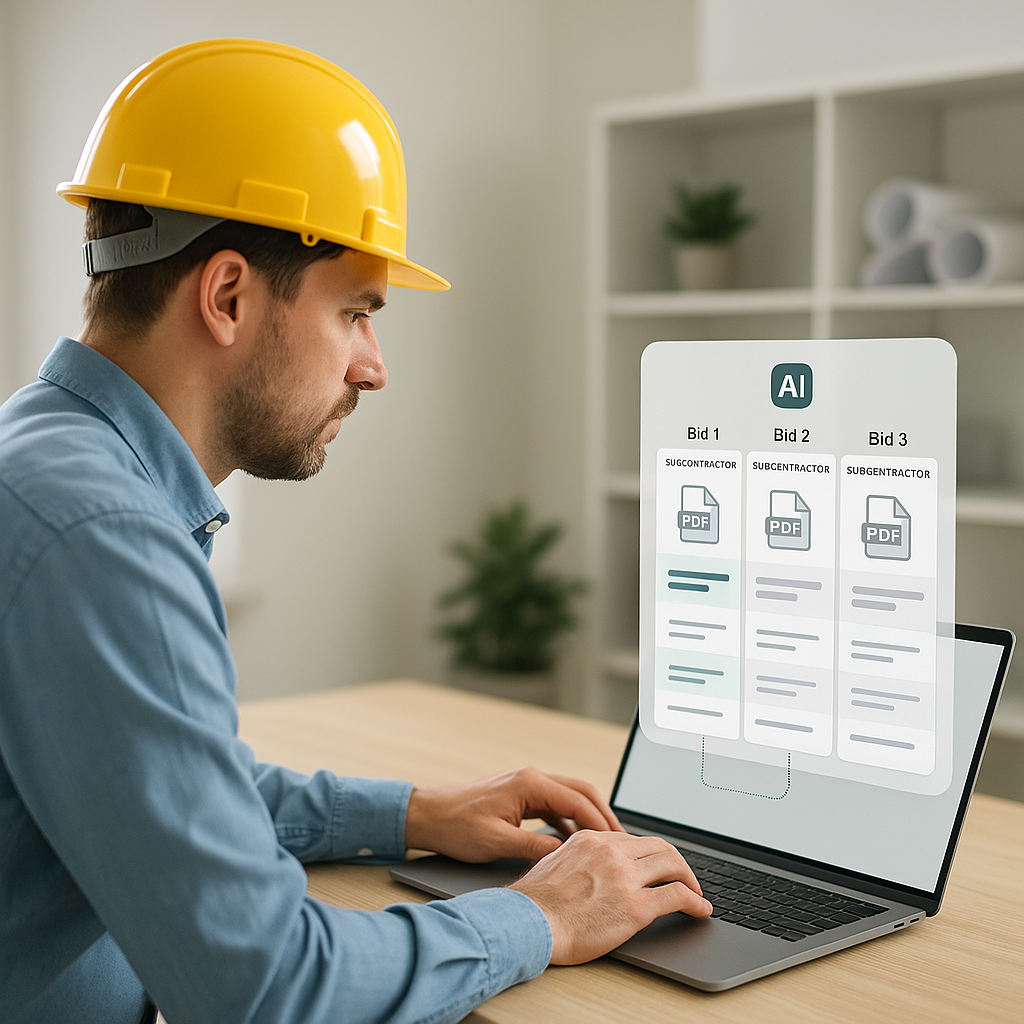
Why Sub Bid Leveling Is Still a Nightmare
If you've ever had to normalize subcontractor (sub) bids, you know how painful it is. Seven subs send their quotes, each with different formats, scopes, and exclusions. One bid might miss excavation costs; another throws in an alternate material you didn’t ask for. And guess who has to untangle the mess? You. Manually.
On average, leveling sub bids takes 6 hours per project, according to industry surveys. That’s 6 hours of squinting at PDFs, comparing apples to oranges, and praying you don’t overlook a buried clause. Worse, it’s error-prone. Miss one exclusion, and you’re stuck explaining a blown budget to your boss—or to the client.
Why is this still the norm? Because most tools—Excel, Bluebeam, even Procore—don’t help. They’re great for organizing data, but they don’t analyze it. And that’s the real bottleneck. Let’s break down why manual bid leveling is inefficient and how technology, especially AI, changes the game.
Why Manual Sub Bid Leveling Fails
Manual bid leveling fails for three reasons:
-
Inconsistent Formats: Subcontractors rarely follow the same format. One might submit a detailed breakdown, another a lump sum. Without a standard structure, you’re left piecing together line items manually.
-
Hidden Scope Gaps: Subs often exclude key scope items (e.g., demolition or specific finishes) without making it obvious. Unless you read every exclusion clause in detail, you might miss costly omissions.
-
Human Error: After hours of comparing PDFs and spreadsheets, mistakes happen. Maybe you transpose a number or overlook a key detail in a rushed review. These errors can lead to blown budgets, scope disputes, or even losing the project altogether.
Real-World Horror Story
A general contractor working on a $20 million school project missed a key exclusion in a sub bid for HVAC work. The sub had excluded duct insulation in their bid, but this wasn’t flagged during bid leveling. When construction began, the oversight came to light, resulting in a $75,000 change order. Preventable? Absolutely. But without a better system for bid normalization, these mistakes are common.
How AI Turns 6 Hours into 30 Minutes
AI-powered tools like EstimateNext are finally fixing this. Instead of spending hours cross-checking sub bids, AI levels them in minutes. Here’s how it works:
1. AI Scope Detection
Upload your sub bids (PDF, Excel, or Word), and the AI extracts key line items. It identifies inclusions, exclusions, and overlaps automatically. For example, if Sub A’s bid excludes demolition but Sub B includes it, the AI flags this immediately.
2. Normalization
The tool aligns every bid to the same scope baseline. If Sub A doesn’t include excavation costs, the AI uses historical data or your custom rate library to fill in the gap. This ensures an apples-to-apples comparison across all bids.
3. Ranking
Once the bids are normalized, the tool ranks them based on total cost, scope coverage, and other criteria you define (e.g., past performance, schedule). The result? A clear L1/L2/L3 ranking in minutes.
4. Audit Trail
Every adjustment the AI makes is logged in an audit trail. This transparency ensures you can defend the final recommendation to your team, your boss, or the client.
Actionable Steps for Adopting AI in Bid Leveling:
- Start Small: Test AI tools on smaller projects first to understand their capabilities.
- Define Your Scopes Clearly: The clearer your project’s scope, the better the AI can normalize bids.
- Integrate Historical Data: Upload past project data to give the AI a stronger baseline for cost and scope assumptions.
Real-World Example: $1B Rail Project
A general contractor managing a $1 billion rail project used EstimateNext to level bids for a structural steel package. They received quotes from six subs, each with wildly different formats and assumptions:
- Sub A excluded welding entirely.
- Sub B included welding but at a rate 30% higher than market norms.
- Sub C bundled miscellaneous steel but left out critical supports.
Results with AI:
- Time Saved: The AI leveled all six bids in under 40 minutes, compared to the 8+ hours it would have taken manually.
- Scope Gaps Identified: Welding was flagged as a scope gap in four bids. The AI suggested using historical rates for normalization.
- Cost Savings: By awarding the package to the true lowest bidder (after normalization), they avoided a $350,000 scope claim.
This is just one example, but it underscores the potential of AI to streamline bid leveling while reducing both time and risk.
The Obvious Objection: “Can AI Really Catch Everything?”
You might be thinking, “Sure, AI is fast, but can it really handle the nuances of construction bids?”
The Honest Answer: It Depends
AI can handle 90% of the grunt work—extracting line items, comparing scopes, and identifying gaps. But for complex edge cases (e.g., custom materials, highly specific exclusions), human oversight is still critical. Think of AI as your first pass, not your final arbiter. It clears the noise so you can focus on the tough calls.
When AI Works Best:
- Standardized scopes (e.g., concrete, drywall).
- Repetitive work (e.g., leveling bids across similar trades).
- Large-scale projects with numerous bids.
When You Still Need Human Expertise:
- Highly custom or unique scopes (e.g., bespoke finishes).
- Projects with significant unknowns or incomplete designs.
Why This Matters for You
General Contractors:
Cutting 5+ hours per bid means your team can review more bids without adding headcount. It also reduces the risk of costly scope misses, giving you a competitive edge in tight-bid situations.
Subcontractors:
Faster bid leveling means you can submit more competitive quotes, increasing your chances of winning work. It also ensures transparency and fairness in how your bids are compared.
Developers and Owners:
AI-enhanced bid leveling reduces the risk of budget overruns, scope disputes, and timeline delays. It ensures your project team is focused on strategy, not data entry.
Comparison: Manual Bid Leveling vs. AI-Enhanced Bid Leveling
| Feature | Manual | AI-Enhanced |
|---|---|---|
| Time to Level 5 Bids | 6+ hours | 30-40 minutes |
| Risk of Errors | High | Low (with oversight) |
| Scope Gap Detection | Manual (inconsistent) | Automatic |
| Transparency/Audit Trail | Limited | Full |
| Scalability | Difficult | High |
What’s Next?
Sub bid leveling is just one piece of the preconstruction puzzle. Tools like EstimateNext also handle takeoffs, rate matching, and even bid/no-bid decisions. The goal isn’t just to save time—it’s to win more work and protect your margins.
Ready to stop wasting hours on manual bid leveling? Get started with EstimateNext →


