Stop Flipping Through Rate Books: The AI Solution You’ve Been Waiting For
Let’s talk about something every estimator hates: rate lookups. You’re deep into pricing a bid, and you spend hours—sometimes days—digging through outdated rate books or PDFs to find the cost of materials, labor, or equipment. It’s mind-numbing. Worse, it’s error-prone.
Now multiply that by 5-8 GMP pursuits a year if you’re a general contractor (GC). Or 30-60 bid packages if you’re an MEP subcontractor. That’s hundreds of wasted hours. Time you should be spending on value engineering, subcontractor negotiations, or analyzing bid strategies—not flipping pages.
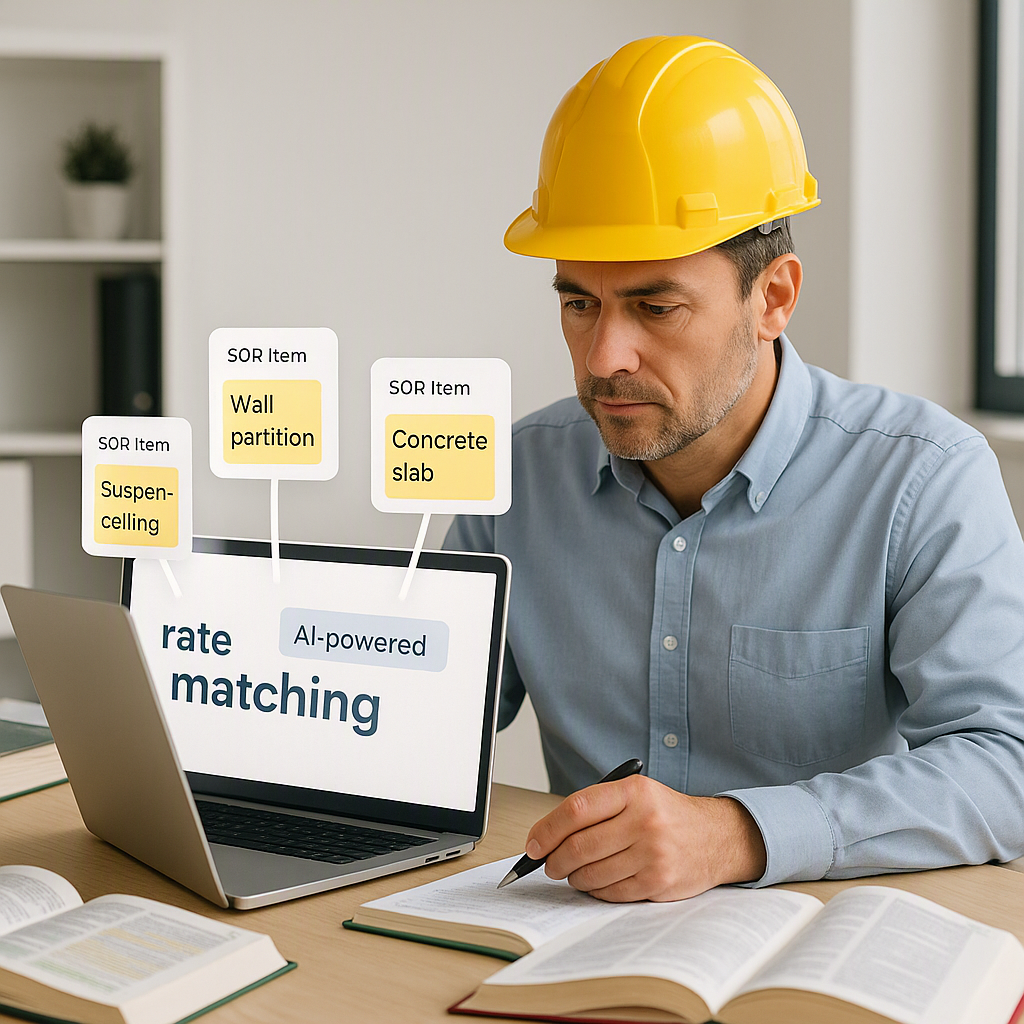
Here’s where AI-powered tools like EstimateNext change the game. With semantic search across 78,000+ Schedule of Rates (SOR) items, you can find what you need in seconds. Yes, seconds.
What’s Semantic Search?
It’s not just a fancy buzzword. Semantic search means the AI understands the context of your query, not just the keywords. For example, if you type “install pre-stressed concrete girders,” the tool doesn’t just look for an exact match. It considers synonyms, related terms, and even regional variations in how that task is described. The result? Accurate matches, fast.
Concrete Example: Rail Bridge Estimate
In one case, a contractor pricing a $1B rail bridge used EstimateNext to pull DOT-approved rates for structural steel, rail ties, and even concrete columns. What would’ve taken 12 hours by hand was done in under 10 minutes. They saved nearly a full day of work—and avoided the risk of missing a critical rate.
Actionable Tip: Train Your Team on Semantic Search
If you’re adopting a tool like EstimateNext, spend 1-2 hours training your team on how to phrase search queries for maximum relevance. For example, instead of searching "concrete," try "labor cost for pouring reinforced concrete slabs." The more precise your query, the better the results.
Why Manual Lookups Are a Problem
Let’s get specific about the pain points:
-
Time Sink: On average, flipping through rate books eats up 12 hours per estimate. Multiply that by the number of bids your team handles annually, and you’re looking at weeks of lost productivity. According to a 2022 study by Dodge Construction Network, 63% of contractors report spending 8+ hours on manual rate lookups per bid.
-
Human Error: Misreading a rate or using an outdated version of the catalog can cost you the bid—or worse, your profit margin. For example, a 2020 case study by FMI Corporation found that 22% of project overruns were linked to errors in preconstruction estimates.
-
Inflexibility: Standard rates often don’t capture project-specific needs, like custom finishes or regional labor adjustments. Manually calculating these factors adds even more time to the process. For instance, if you’re pricing a high-rise in New York City, local union wage adjustments can vary dramatically from what’s listed in national rate books.
We’ve all been there. You’re on page 368 of a rate book, and your eyes start to blur. Did you just skip the section on fireproofing? Better go back and check. Meanwhile, the bid deadline looms.
Comparison Table: Manual Lookups vs. AI-Powered Search
| Criteria | Manual Lookups | AI-Powered Search |
|---|---|---|
| Time Required | 8-12 hours per bid | 10 minutes per bid |
| Error Rate | High (human fatigue, outdated data) | Low (validated, up-to-date data) |
| Adaptability | Limited | High (custom rates supported) |
| Scalability | Labor-intensive | Handles unlimited queries |
How AI Fixes It
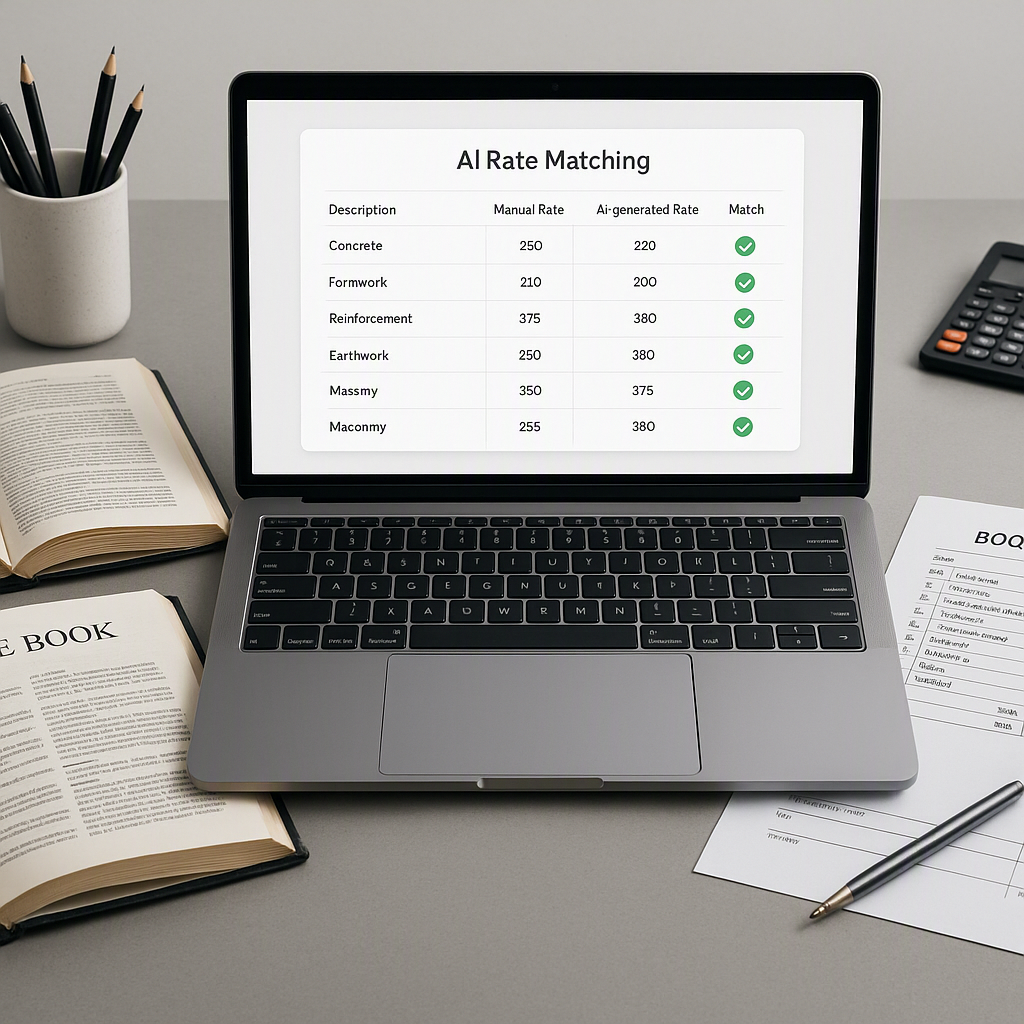
AI-powered rate matching tools tackle these problems head-on:
-
Speed: Instead of manually searching, you type your query, and the AI returns results instantly. Need the cost of HVAC duct installation? Done in seconds.
-
Accuracy: AI pulls from up-to-date catalogs and cross-references data to ensure you’re using the right rates. Plus, tools like EstimateNext allow you to upload custom rate sheets and integrate them into the search results.
-
Customization: The AI doesn’t just spit out a number. It breaks down the rate into materials, labor, and equipment costs, so you can adjust for project-specific factors like inflation or local wage differences.
-
Audit Trail: Every rate you select is logged, complete with source details. If someone questions your estimate, you’ve got the data to back it up.
Actionable Steps:
- Upload Your Rate Catalogs: Start by uploading your custom rate sheets to the AI tool to ensure results reflect your unique cost structure.
- Set Up Project Templates: Configure project-specific templates for recurring tasks, like "urban high-rise projects" or "industrial plant construction."
- Leverage Confidence Scores: Use the AI’s confidence scoring feature to prioritize high-certainty matches and manually review lower-confidence items.
Real-World Example: HVAC Subcontractor
An HVAC subcontractor we worked with was drowning in bid requests—40+ packages a month. Their bottleneck? Rate lookups. Each package involved matching 20-30 line items against SMACNA and NECA standards, plus local labor rates. It took them three days, on average, to submit a quote.
After switching to an AI-powered tool, they cut their quote turnaround time to four hours. Four hours. That’s an 18X speed improvement. More importantly, they could respond to 50% more bids, leading to 6 additional wins in a year. With an average project value of $200K, that’s $1.2M in additional revenue.
Comparison: Before vs. After AI Adoption
| Metric | Before AI | After AI |
|---|---|---|
| Average Quote Time | 3 days | 4 hours |
| Monthly Bid Volume | 40 packages | 60 packages |
| Annual Project Wins | 12 | 18 |
| Additional Revenue | $0 | $1.2M |
Common Objections to AI Rate Matching
“But can it handle my custom rates?”
Yes. Tools like EstimateNext let you upload your own rate catalogs. The AI integrates them seamlessly, so your estimates reflect your actual costs—not some generic average.
“What about edge cases?”
No system is perfect. But AI tools include confidence scoring and manual override options, so you can review and adjust rates as needed. Think of it as a productivity multiplier, not a replacement for your judgment.
“Isn’t this overkill for smaller projects?”
Not at all. Whether you’re pricing a $1M renovation or a $1B infrastructure project, the time savings scale proportionally. And with subscription costs starting as low as $39/month, even small contractors see a quick ROI.
Actionable Tip: Start Small
If you’re hesitant to overhaul your entire workflow, start by testing the AI tool on a small project. Measure the time savings and accuracy improvements, then scale from there.
If you’re tired of spending 12 hours on something that could take 10 minutes, it’s time to make a change. Get started with EstimateNext for free →