Manual Rate Lookups Are Killing Your Preconstruction Team
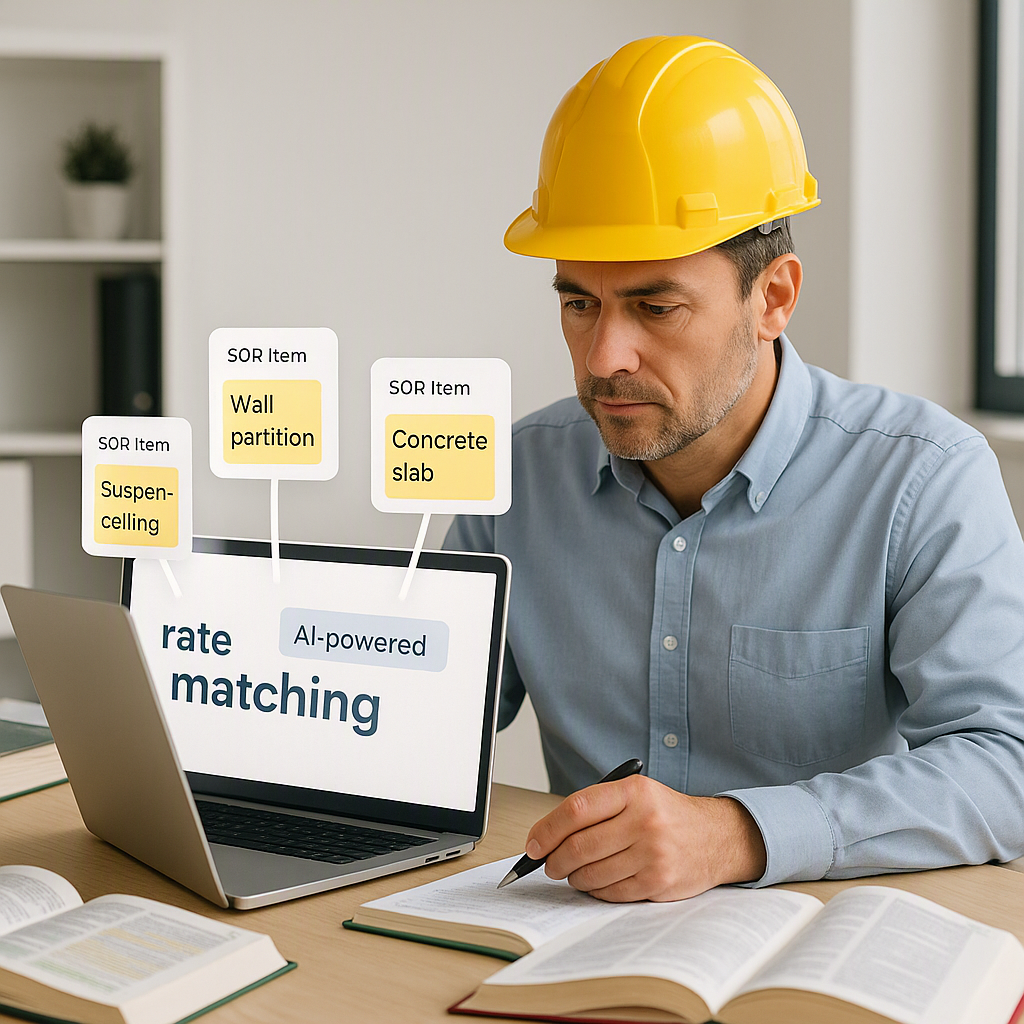
Let’s be honest—rate lookups are the bane of every estimator’s existence. Flipping through 2,000-page rate books or scrolling endlessly through PDFs isn’t just tedious; it’s a productivity nightmare. On average, it eats up 36 hours per bid. That’s nearly a week of work just to match line items to rates. For general contractors chasing five or more GMP pursuits annually, the math is brutal: 180+ hours wasted on busywork.
And let’s not pretend errors don’t creep in. Forgetting to apply inflation adjustments or missing a region-specific labor rate isn’t just embarrassing—it can cost you the bid. According to a 2021 McKinsey report, 75% of construction project delays are caused by preconstruction inefficiencies, including errors in estimations.
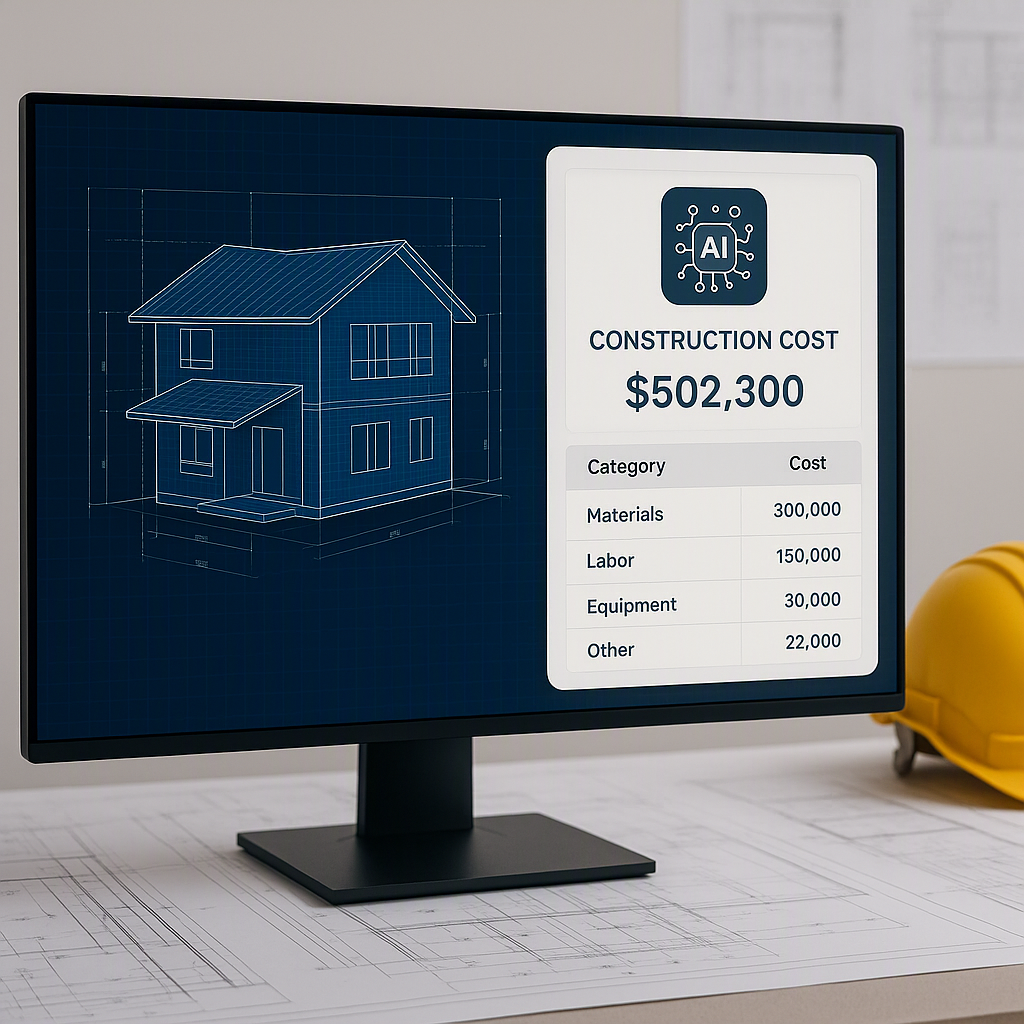
But here’s the thing: rate matching doesn’t need to be this hard. AI-powered tools like EstimateNext are rewriting the script with semantic search and self-learning algorithms. Let’s break down how this works and why it’s a game-changer.
How AI Rate Matching Works—and Why It’s Faster (and Smarter)
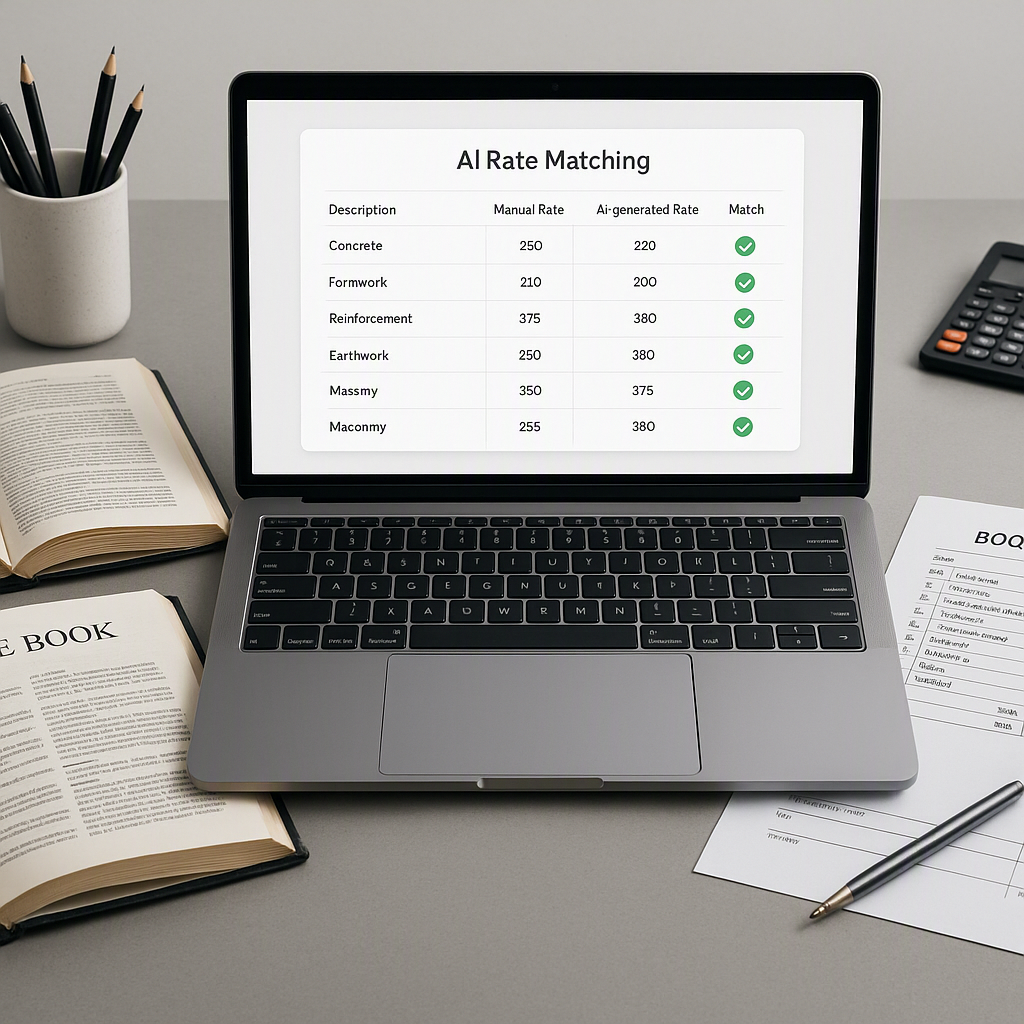
At its core, rate matching is about connecting BOQ (Bill of Quantities) line items to the correct Schedule of Rates (SOR). With traditional methods, you’re relying on two things: the estimator’s memory and the indexing quality of the rate book. Both are unreliable.
With AI, it’s different. Here’s a step-by-step of what happens when you upload a BOQ into a tool like EstimateNext:
-
Smart BOQ Parsing: The AI scans your uploaded Excel or CSV file, auto-detecting section headers, hierarchies, and even merged cells. No more manual cleanup.
- Example: A BOQ section labeled "Electrical works" with multiple merged cells for subcategories like "Lighting" and "HVAC" will be parsed into a clear hierarchy for faster matching.
-
Semantic Search Across SORs: Instead of you manually typing search terms into a PDF or flipping through pages, the AI uses natural language processing (NLP) to understand your BOQ descriptions.
- Example: If your line says “Install 5-ton HVAC unit,” it matches to the correct rate—even if the catalog uses slightly different wording like “HVAC installation, 5-ton capacity.”
-
Self-Learning Matcher: If the AI doesn’t find an exact match, it suggests alternatives ranked by confidence level. Over time, as you accept or reject these matches, the system gets smarter, adapting to your preferences and project history.
- Example: A contractor specializing in public works will see the AI favor rates from DOT-approved catalogs, while a residential contractor might see private-sector standards prioritized.
-
Inflation & Regional Adjustments: The AI auto-applies CPI (Consumer Price Index) adjustments based on the catalog year and region. No more forgetting to update outdated rates.
- Example: A 2020 rate for concrete installation in Texas will automatically adjust for 2023 CPI and labor market variations.
The result? Rate matching that’s 1,440x faster. What used to take hours now takes seconds. A study by Dodge Construction Network found that companies adopting AI tools for preconstruction saw a 50% reduction in overhead costs.
Real-World Example: The $1B Rail Project
In one of EstimateNext’s case studies, a contractor bidding on a $1 billion rail bridge project had to match rates for over 12,000 line items. Using traditional methods, this process would’ve taken weeks. With AI, it was done in under a day.
The kicker? The AI didn’t just save time; it also flagged outdated rates and suggested alternatives from state DOT-approved catalogs. This level of precision helped the contractor submit a highly competitive bid without cutting corners on accuracy.
Another example involves a mid-sized general contractor in the Midwest. After adopting EstimateNext, they reduced their bid preparation time by 40% and won 3 out of 5 bids in highly competitive markets, thanks to more precise rate matching.
The Hidden Costs of Manual Rate Matching
Still not convinced AI is worth the switch? Let’s talk about the hidden costs of sticking with manual methods:
- Labor Hours: At $130/hour for an estimator, those 36 hours per bid add up fast. For a GC pursuing five bids annually, that’s $23,400 burned on rate lookups alone. Over a decade, that’s nearly a quarter-million dollars.
- Lost Bids: Errors in rate matching can lead to overbidding (losing the project) or underbidding (winning but at a loss). Either way, it’s not a sustainable strategy. A 2019 FMI study found that inaccurate bids cost contractors roughly 1-3% of annual revenue.
- Team Burnout: Estimators are already stretched thin. Forcing them to waste hours on repetitive tasks doesn’t just hurt morale—it also increases turnover. A 2022 survey by Procore found that 60% of preconstruction professionals experience burnout due to inefficient processes.
AI doesn’t just save time; it protects your margins and your team.
Common Pushbacks—and Why They’re Wrong
“AI won’t understand our custom rates.”
Fair concern. But most AI tools, including EstimateNext, let you upload custom catalogs. The AI integrates them seamlessly, so your unique material or labor rates are always accounted for.
“What about edge cases?”
No AI is perfect, but that’s why tools like EstimateNext include manual override options. You can review and tweak matches before finalizing. Additionally, edge cases become less frequent over time as the AI learns.
“It’s too expensive.”
Let’s do the math. At $99/month, EstimateNext costs $1,188/year per seat. Compare that to the $23,400 spent annually on manual rate lookups. The ROI is obvious. Add in potential savings from error reduction, and the tool pays for itself within the first bid cycle.
Getting Started with AI Rate Matching
Transitioning to AI doesn’t have to be overwhelming. Here’s a simple roadmap:
- Start Small: Begin with smaller projects to test the system’s accuracy. For example, try AI tools on a 100-line BOQ before scaling up to larger bids.
- Train Your Team: Most platforms, including EstimateNext, have intuitive interfaces and require minimal onboarding time. Still, invest in a 2-hour training session to get everyone comfortable.
- Expand Gradually: Once your team is confident, apply AI tools to larger, more complex bids. Use the time savings to focus on strategic initiatives like value engineering or subcontractor negotiations.
Comparison Table: Manual vs. AI Rate Matching
| Feature | Manual Rate Matching | AI Rate Matching (EstimateNext) |
|---|---|---|
| Time per bid | ~36 hours | ~15 minutes |
| Human Error Risk | High | Low |
| Cost per year (5 bids) | $23,400 | $1,188 |
| Custom Catalog Support | Limited | Full |
| Inflation Adjustments | Manual | Automatic |
| Team Morale Impact | Negative | Positive |
Call to Action
If you’re tired of wasting hours on manual rate lookups, it’s time to try AI-powered estimation. EstimateNext cuts matching time from 36 hours to seconds while improving accuracy and protecting your margins. Get started free →