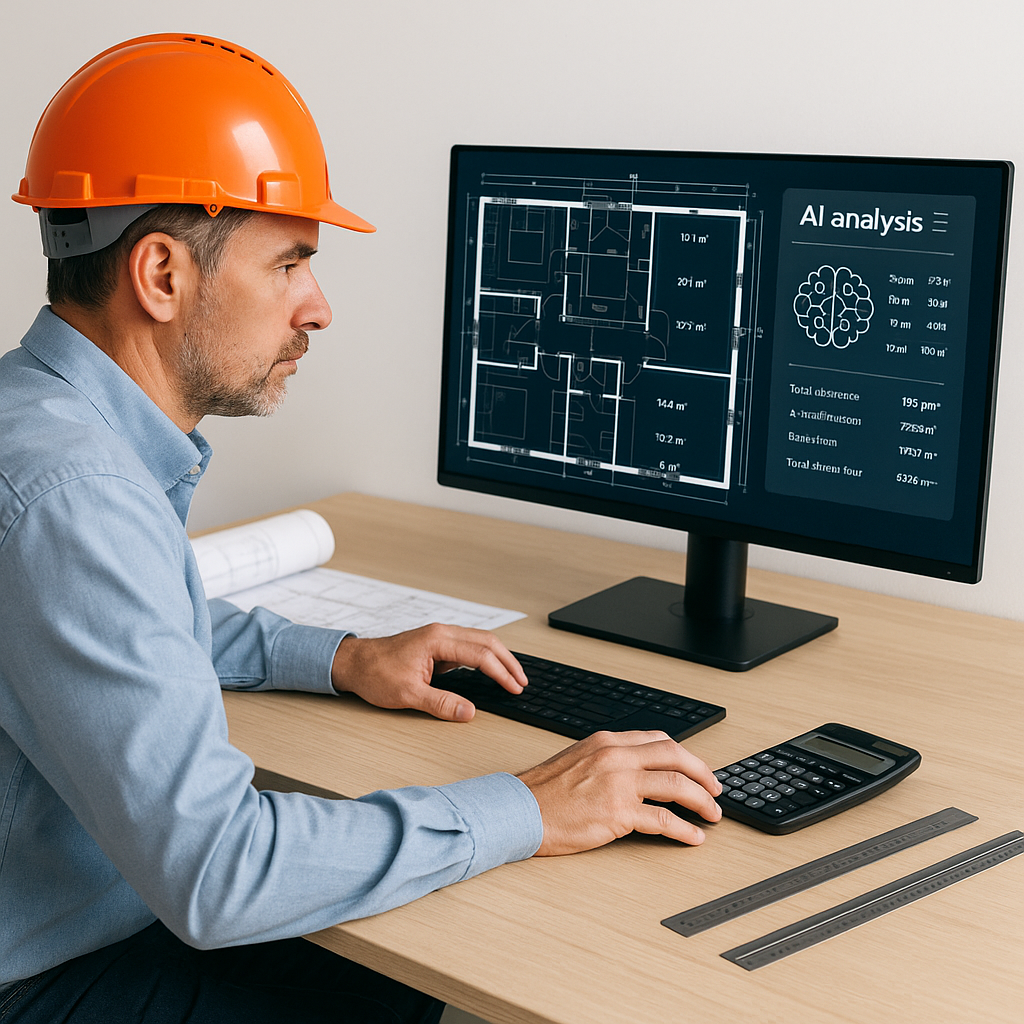
The Problem: Manual Takeoff Bottlenecks
If you’ve ever worked on a construction bid, you know the drill. Two estimators spend two full days tracing PDFs and counting quantities manually—40 hours of labor just to complete the takeoff. It’s mind-numbing, error-prone, and a massive time sink.
And it’s not just the time. Mistakes creep in, especially when deadlines are tight. Miss a few measurements, and you’re either overpricing (and losing bids) or underpricing (and losing money). You’re stuck between a rock and a hard place.
A Real-World Example
A general contractor bidding on a $15 million commercial project found themselves in this exact predicament. Due to time constraints, they rushed the takeoff process and missed a critical measurement for structural steel. The result? They underbid by $90,000, and the project ended up cutting deeply into their margins.
Does it have to be this way? No.
The Solution: AI-Powered Quantity Takeoff
AI tools, like EstimateNext’s Vision AI, can extract quantities directly from your drawings in just 10 minutes. It’s fast, accurate, and scalable. Here’s how it works:
- Upload Your Drawings: You upload your PDF or CAD files into the system. Doesn’t matter if they’re clean or messy—AI handles it.
- AI Extraction: The tool reads the drawings, identifying walls, rooms, doors, and more. It measures lengths, areas, counts, and even angles.
- Review Low-Confidence Areas: Any questionable measurements are flagged for manual review. You stay in control, but without wasting hours on grunt work.
Case Study: Saving 120 Hours on a High-Rise Bid
A mid-sized contractor saved 120 hours on a high-rise bid just by using Vision AI. That’s two full weeks of estimator time freed up—time that could be spent refining margins or chasing more bids. Imagine scaling this across multiple projects annually. The ROI becomes undeniable. Source.
Actionable Steps to Transition to AI-Powered Takeoffs
- Audit Your Current Process: Track how much time your team spends on manual takeoffs over a month. Quantify the cost of errors and missed opportunities.
- Identify AI Solutions: Research platforms like EstimateNext, On-Screen Takeoff, and STACK. Compare features and pricing based on your project needs.
- Run a Pilot Project: Start with a smaller, less complex project to test the system’s capabilities and ease of use.
- Train Your Team: Allocate 2-3 hours for training. Most platforms provide onboarding and support to ensure a smooth transition.
- Measure the Impact: Compare the time savings and accuracy improvements to your manual process. Use the data to justify long-term adoption.
Why Speed Matters
Time isn’t just money in construction—it’s opportunity. Faster takeoffs mean you can respond to more bids, meet tighter deadlines, and reduce the risk of last-minute scrambling.
Example: Increasing Bid Volume
If your team normally completes five GMP pursuits per year, switching to AI-powered takeoffs could allow you to handle six or seven. That extra bid could mean an additional $3-5 million in annual revenue, depending on your win rate and project size.
Industry Data on AI Benefits
According to a 2023 McKinsey report, early adopters of AI in construction see average cost savings of 10-20% per project. For example, a subcontractor specializing in mechanical systems reduced their bidding time by 45% using AI tools, allowing them to pursue more opportunities and win more contracts. Source.
Handling Complex Projects
You might be thinking, “AI sounds great for simple builds, but what about complicated jobs?” Good question. AI-powered tools aren’t limited to cookie-cutter projects. They excel at handling complexity.
Case Study: $1 Billion Rail Project
On a $1 billion rail project, Vision AI automated takeoffs across 12 disciplines, including civil, electrical, and HVAC. The result? A 10X faster workflow and fewer errors compared to manual methods. This allowed the project team to reallocate resources to more strategic tasks, such as value engineering and risk mitigation. Source.
Actionable Steps for Complex Jobs
- Break Down the Scope: Use AI to segment the project into manageable chunks (e.g., by discipline or phase).
- Leverage AI’s Multi-Discipline Features: Choose tools that integrate seamlessly with various scopes, from civil to MEP.
- Combine AI with Specialty Expertise: While AI handles the bulk of quantity extraction, involve specialists to validate critical components like structural steel or intricate HVAC systems.
What About Accuracy?
Skeptical about AI accuracy? You’re not alone. Many estimators hesitate to trust tech for such critical tasks. But here’s the thing: AI doesn’t replace human oversight—it augments it.
Reducing Errors
Vision AI reduces takeoff discrepancies by up to 80%, but it still flags low-confidence areas for manual review. For example, if a drawing is missing key annotations, the system will prompt you to verify the measurements. This hybrid approach ensures that nothing critical is overlooked. Source.
Getting Started
Adopting AI tools doesn’t have to be a headache. Platforms like EstimateNext are designed with usability in mind. Training takes just a few hours, and the software integrates seamlessly with tools you already use, like Procore and Bluebeam.
Comparison Table: Manual Takeoff vs. AI-Powered Takeoff
| Feature | Manual Takeoff | AI-Powered Takeoff |
|---|---|---|
| Time per bid | 40 hours | 10 minutes |
| Error rate | High (10-15%) | Low (2-5%) |
| Scalability | Limited | Unlimited |
| Initial cost | Low | Moderate |
| Long-term ROI | Low | High |
Call to Action
If manual takeoffs are eating up your team’s time, it’s time to rethink your approach. EstimateNext’s Vision AI can save you 40 hours per bid, reduce errors, and help you respond to more opportunities. Get started free →


