The Problem: Manual Takeoffs Are Killing Your Productivity
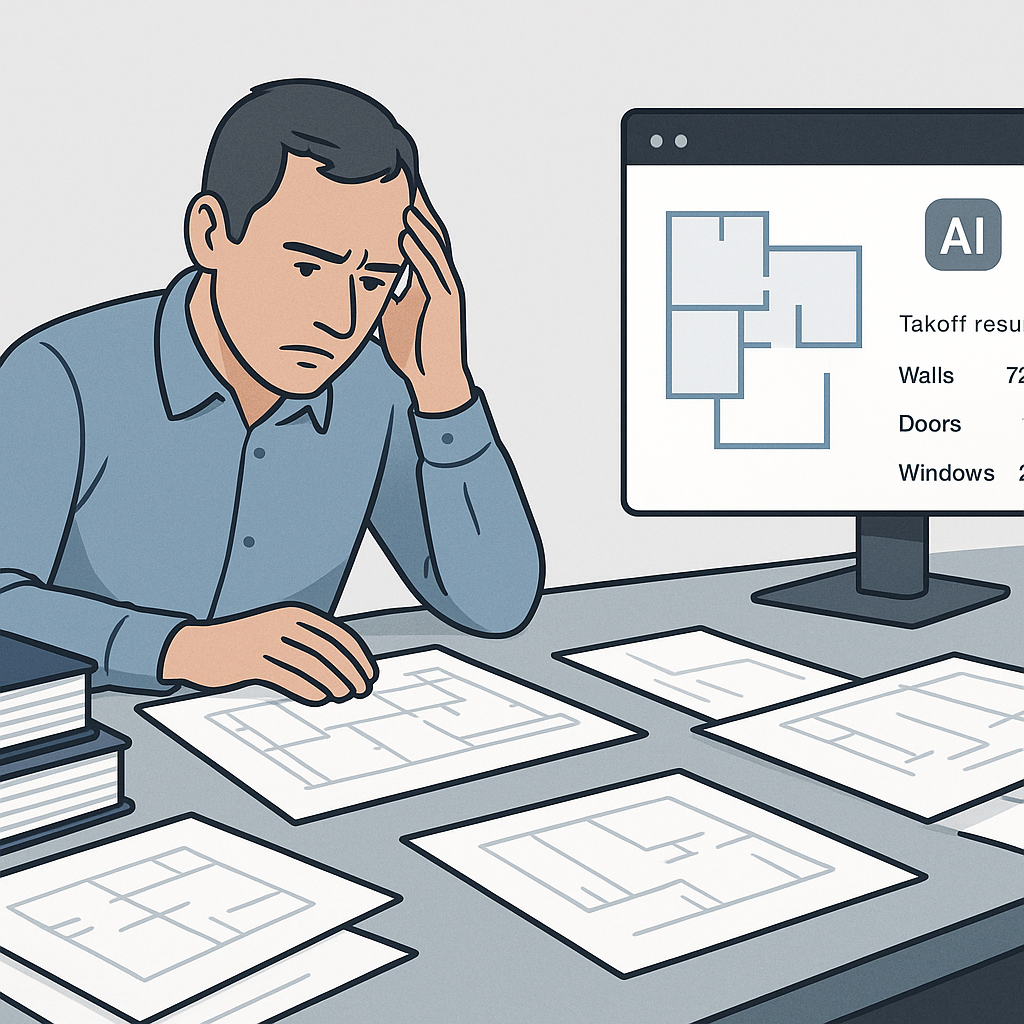
Let’s be honest. Manual takeoffs are the bane of every estimator’s workflow. Flipping through drawings, measuring dimensions, and double-checking quantities isn’t just tedious — it’s a massive time sink. On average, it takes two estimators 40 hours to complete a set of takeoffs for a complex project. That’s a full workweek gone for each bid. And let’s not even start on the human errors that inevitably creep in when you’re rushing to hit deadlines.
Think about it: what could your team do with an extra 36 hours per bid? More bids? Better subcontractor negotiations? Time spent refining cost breakdowns instead of scrambling to finish takeoffs?
The traditional process isn’t just slow — it’s outdated. Manual methods also lack the ability to scale. Imagine bidding on multiple projects simultaneously while relying on paper drawings and rulers. It becomes unmanageable quickly.
To illustrate, a 2021 survey by Dodge Data & Analytics found that 35% of construction professionals cited takeoff inefficiencies as one of their top three productivity bottlenecks. The industry’s reliance on manual processes isn’t just inconvenient — it’s holding companies back.
Enter AI-powered preconstruction estimation.
The Solution: AI Takeoffs in Minutes
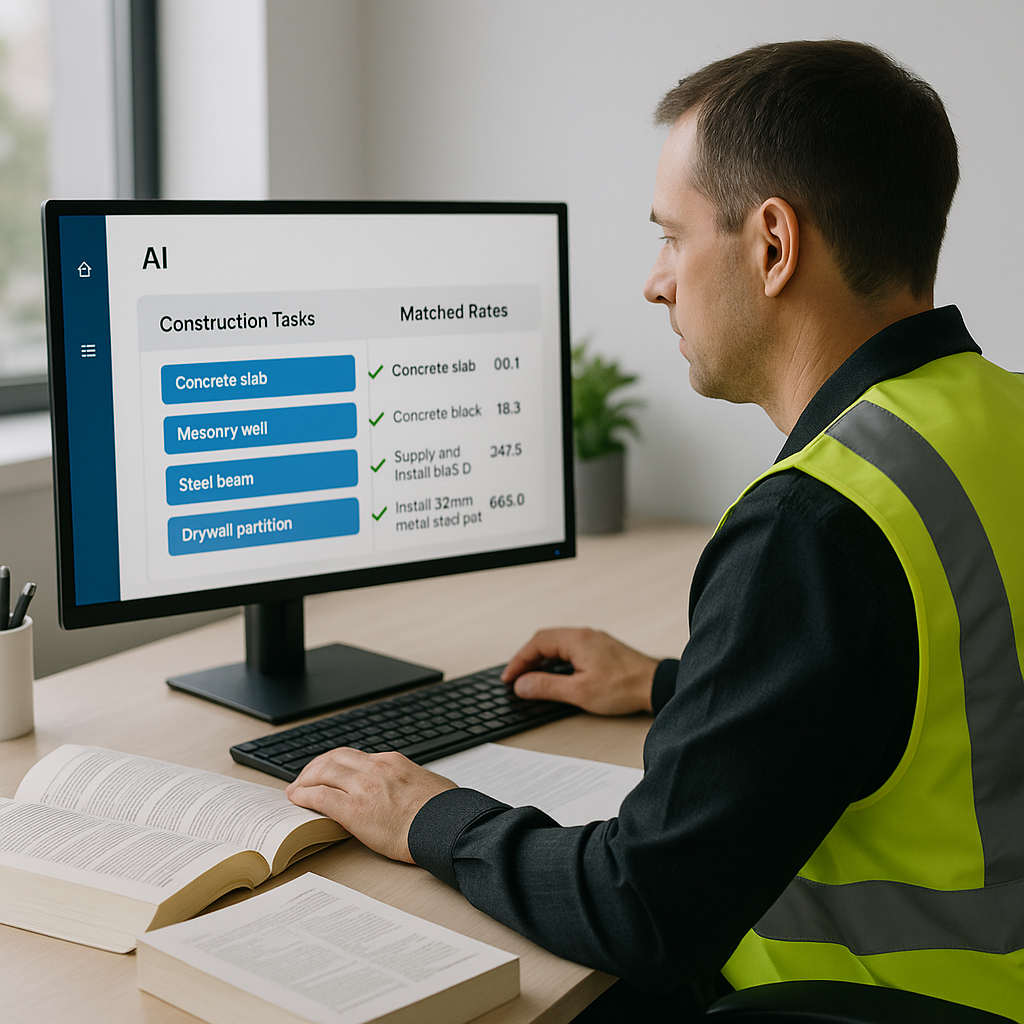
AI tools like EstimateNext are changing the game. Instead of manually tracing every wall, window, and beam on a PDF, you upload the drawings, and the AI extracts quantities in as little as 10 minutes. Yes, 10 minutes. That’s a 10X improvement over traditional methods.
Here’s how it works:
- Upload Your Drawings: PDF, DWG, or even scanned paper drawings. AI doesn’t care.
- Vision AI Kicks In: The system reads the drawings, identifies rooms, walls, doors, windows, and more. It’s trained on thousands of projects, so it knows what to look for.
- Confidence Scoring: Low-confidence items are flagged for your review. You’re still in control, but the grunt work is done.
- Export: Quantities are delivered in your preferred format — Excel, CSI MasterFormat, or even integrated into Procore or Bluebeam workflows.
Actionable Steps for Implementation:
- Step 1: Start with a Pilot Project: Test AI tools like EstimateNext on a small or medium-sized bid. Evaluate the time savings and accuracy compared to manual processes.
- Step 2: Train Your Team: Most AI platforms are user-friendly, but a short training session ensures your estimators are comfortable with the software.
- Step 3: Integrate with Existing Workflows: Leverage integrations with Procore, Bluebeam, and Excel to avoid disruptions in your current processes.
- Step 4: Analyze ROI: Track time saved, accuracy improvements, and cost reductions to justify continued use.
And it’s not just about speed. These tools are accurate, often reducing takeoff discrepancies by up to 80%. Human oversight is still essential, but the AI minimizes errors caused by fatigue or rushed deadlines. For example, a 2023 study by FMI Corporation found that AI-driven takeoffs reduced human errors by 74% in mid-size construction firms.
Real-World Impact: A Case Study
A mid-sized general contractor (GC) recently used EstimateNext’s Vision AI for a $40M high-rise project. The manual takeoff estimate took 36 hours of labor for two estimators. Using AI, they completed it in under 2 hours, including time for review and adjustments.
The result? They saved $4,680 in labor costs (36 hours x $130/hour) on just one bid. Multiply that across 5-8 GMP pursuits per year, and the savings really add up.
But here’s the kicker: they didn’t just save time. The AI also identified discrepancies in the original bill of quantities (BOQ), catching missing quantities that would’ve cost them thousands post-award. For example, the system flagged a missing line item for fireproofing in one section of the building, which the estimators had overlooked. By catching it early, the GC avoided a costly change order down the line.
Additional Case Study: Small Contractor Success
A small residential contractor in Texas adopted AI-powered takeoffs for single-family home bids. Before AI, they could only handle 3-4 bids per month. With AI, they scaled up to 10 bids per month, doubling their opportunities without adding staff. Each bid averaged $15,000 in profit, meaning the increased capacity netted an additional $90,000 annually.
Common Objections: Does AI Replace Estimators?
Short answer: no. AI doesn’t replace your expertise; it amplifies it. You still make the judgment calls, negotiate with subs, and decide on markups. The AI just handles the grunt work — like takeoffs, rate matching, and recalculations. It’s like having a junior estimator on steroids.
The obvious objection is, “But AI can’t think like an estimator.” True. AI isn’t here to replace your experience. It’s here to free up your time so you can focus on high-value tasks that actually win bids.
Key Comparison: Human vs. AI
| Aspect | Manual Takeoffs | AI-Powered Takeoffs |
|---|---|---|
| Time Required | 36-40 hours | 1-2 hours |
| Accuracy | Prone to errors | 80-90% accuracy |
| Scalability | Limited | High |
| Cost Efficiency | Labor-intensive | Cost-saving |
Why This Matters Now
The construction industry is under pressure. Projects are getting more complex, timelines are shrinking, and everyone’s fighting for the same pool of skilled labor. According to a 2023 McKinsey report, early adopters of AI in construction see cost savings of 10-20% per project. That’s not just a competitive edge — it’s survival.
If your team is still burning 40 hours on manual takeoffs while competitors are finishing in 10 minutes, you’re already behind.
Industry Trend: AI Adoption Growth
In 2022, AI adoption in construction grew by 25%, according to a report by Allied Market Research. Experts predict this trend will continue as firms seek to improve efficiency and mitigate labor shortages. Early adopters are already reaping the benefits, while latecomers risk falling further behind.
FAQ: Your AI Takeoff Questions Answered
Q: How accurate are AI takeoffs?
A: Highly accurate, but no tool is perfect. That’s why features like confidence scoring and manual overrides exist. You’re still in control.
Q: Can I integrate AI tools with my existing software?
A: Yes. EstimateNext integrates seamlessly with Procore, Bluebeam, and Excel, so you don’t have to change your workflow.
Q: What if my drawings are messy or incomplete?
A: AI tools are surprisingly resilient. They handle scanned PDFs and can adapt to incomplete data with manual adjustments where needed.
Q: Is AI worth the cost?
A: Absolutely. At $39-$99/month, tools like EstimateNext are 10-60X cheaper than traditional software like CostX or ProEst. And the ROI is undeniable — one saved bid pays for itself.
Q: How long does it take to get started?
A: Most platforms, including EstimateNext, are intuitive enough to learn in under two weeks. Training is minimal, and support is available.
The Bottom Line
Manual takeoffs waste time, money, and talent. AI-powered tools like EstimateNext are faster, more accurate, and cheaper than traditional methods. If your team is still stuck in the manual era, it’s time to rethink your workflow.