The Pain of Manual Rate Matching
If you're an estimator, you know the drill. A new bid drops, and suddenly you're flipping through a 2,000-page rate book like CPWD DSR or RSMeans. Need a rate for installing pre-stressed concrete girders? Good luck. You'll spend hours hunting for it, cross-checking labor, material, and equipment costs, and rebuilding Excel spreadsheets for every 'what-if' question the team throws at you. It's slow, error-prone, and just plain exhausting.
And it’s not just you. Across the industry, manual rate matching eats up 36 hours per bid on average. That’s nearly a full workweek gone to something that feels like it should be automated. Why isn’t it already?
Turns out, it can be. AI tools like EstimateNext are flipping the script, cutting those 36 hours down to seconds. Let me explain how.
How AI Rate Matching Works
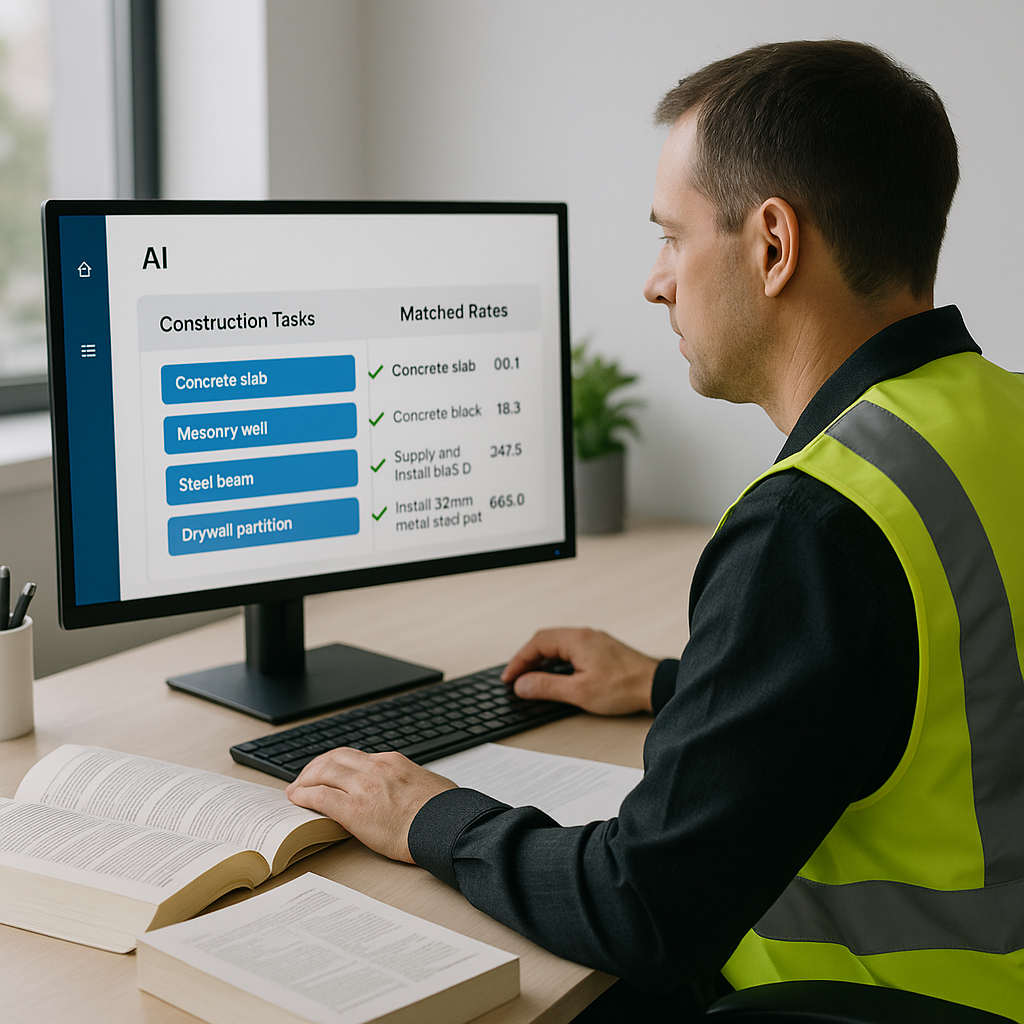
At its core, AI-powered rate matching uses semantic search to instantly find the most relevant rates for your BOQ (Bill of Quantities). Instead of you manually combing through catalogs, the AI scans thousands of rate items in seconds, pulling matches based on keywords, descriptions, and even historical project data.
Here’s a quick example: You upload your BOQ into EstimateNext. The AI scans your line items and suggests rates for each one, pulling from its database of 78,000+ items across 135 catalogs, including CPWD DSR, RSMeans, and more. If you’ve got a custom rate catalog, you can upload that too, and the AI will prioritize those rates for future matches. No more flipping pages or scrolling PDFs.
A Concrete Example
Let’s say you’re preparing an estimate for a mid-rise apartment complex. One of your line items is “installation of HVAC ducts.” Normally, this task would involve:
- Checking the project’s scope and searching for relevant rates in your catalog.
- Cross-referencing labor costs, equipment rental rates, and material prices.
- Manually entering all this information into a spreadsheet.
With AI, you simply upload your BOQ, and the system instantly suggests a rate based on your catalog and historical data. If the initial suggestion doesn’t fit, you can adjust it manually. Over time, the AI learns your preferences and gets better at suggesting accurate rates.
What About Errors?
One common concern is whether AI might misinterpret a line item. For example, “concrete beams” could be matched to multiple rates depending on dimensions, pre-stressing requirements, or finishes. AI tools like EstimateNext address this by allowing manual overrides and incorporating your corrections into their learning algorithms. By your third or fourth project, accuracy improves significantly — much like training a junior estimator who gains experience over time.
Real Results: Saving 36 Hours Per Bid
Still skeptical? Let’s dive into a real-world example. A mid-sized general contractor pricing a $50M high-rise saved 120 hours across four estimators by switching to AI rate matching. That’s 30 hours per estimator, per bid. They didn’t just save time — they used it to refine their bid strategy and improve their win rate. In their words, "It felt like adding an extra estimator to the team without increasing payroll."
Industry-Wide Impact
This isn’t an isolated story. According to a McKinsey report, early adopters of AI tools in construction see cost savings of 10-20% per project. For a $50M project, that’s $5M-$10M in savings, which can make or break your margins.
Take another example: A small civil engineering firm working on municipal road projects used AI rate matching to cut their estimating time in half. By reallocating those hours to client engagement and value engineering, they increased their proposal success rate by 25% within a year.
The Obvious Objection: "AI Can’t Think Like an Estimator"
You might be thinking, "Sure, AI is fast, but it doesn’t understand the nuances of construction." And you’re right — AI doesn’t replace your expertise. It amplifies it.
Think of AI as your grunt work assistant. It handles the tedious tasks like rate matching, freeing you to focus on what actually matters: negotiating with subs, fine-tuning markups, and making judgment calls. You’re still in control; the AI just makes your job easier.
A Practical Analogy
Imagine you’re a chef. Before, you had to chop every vegetable by hand. Now, you have a food processor. The food processor doesn’t decide the recipe or the plating — it just speeds up the prep work so you can focus on creating a masterpiece. That’s what AI does for estimators.
Why Manual Methods Are Holding You Back
Let’s break it down:
| Manual Rate Matching | AI-Powered Rate Matching |
|---|---|
| Takes 12-36 hours per estimate | Takes seconds per estimate |
| Prone to human error | 99% accurate with feedback loops |
| Doesn’t learn or improve | Gets smarter with every project |
| Fixed labor cost | Subscription-based (cheaper overall) |
At $130/hour average estimator cost, those 36 hours equal $4,680 per bid. Multiply that by five GMP pursuits a year, and you’re looking at nearly $25,000 wasted annually. And that doesn’t include the opportunity cost of bids you skipped because your team was too slammed.
Getting Started with AI Rate Matching
Not sure if AI is worth it for your team? Start small. Use AI tools like EstimateNext on a single project to test the waters. Upload your BOQ, let the AI handle the rate matches, and compare the results. Here’s what to watch for:
- Speed: Did AI save you time compared to manual methods?
- Accuracy: Were the suggested rates relevant and usable?
- Ease of Use: Did the tool integrate smoothly into your workflow?
Actionable Steps:
- Pilot a Project: Choose a small or medium-sized project to test an AI tool.
- Customize Your Catalog: Upload any custom rates or past project data to improve accuracy.
- Evaluate ROI: Measure time savings, cost reductions, and overall efficiency.
Most teams find that the learning curve is minimal. According to EstimateNext’s documentation, training typically takes less than two weeks. And since the tool integrates with software like Bluebeam and Procore, there’s no need to overhaul your current setup.
Final Thoughts
AI isn’t just a buzzword in construction anymore. It’s a practical, proven tool that saves time, reduces errors, and boosts productivity. If you’re still doing rate matching manually, you’re leaving money on the table — and burning out your estimators in the process.
If you're ready to stop wasting 36 hours per bid, EstimateNext can help. Get started free →


