The Brutal Math of Manual Takeoffs
Let’s start with the obvious: manual takeoffs are a time sink. If you’re a GC director or a subcontractor responding to bids, you know the pain. One project can eat up 40 hours—two full workdays—just measuring areas, counting fixtures, and tracing drawings. Multiply that across a typical year with 5-8 GMP pursuits, and you’re burning hundreds of hours on tasks that don’t move the needle.
Why is this still happening? Because the tools we’ve relied on for decades—Excel, Bluebeam, RSMeans—weren’t built for speed. They’re fine when you’re pricing a simple renovation but fall apart when you’re deep into a $100M infrastructure bid with thousands of moving parts. And even if you have a solid team of estimators, their efforts are better spent on strategy and value engineering—not repetitive, manual work.
The Hidden Costs of Manual Takeoffs
Beyond the time wasted, manual takeoffs come with hidden costs that compound over time:
-
Human Error: Manual processes are prone to mistakes. A missed measurement or miscounted fixture can lead to underbidding or overbidding—both of which hurt your bottom line. For example, a 2020 study by PlanGrid and FMI found that rework caused by incorrect estimates accounts for nearly 9% of total project costs.
-
Burnout: Spending hours poring over drawings isn’t just tedious—it’s demoralizing. This can lead to high turnover in your estimating team, which comes with its own costs (recruiting, training, lost productivity).
-
Opportunity Cost: Every hour spent on manual takeoffs is an hour you’re not spending on strategic tasks, like building client relationships, refining bids, or pursuing more projects.
AI Takeoffs: 10 Minutes vs. 40 Hours
This is where AI-powered tools like EstimateNext change the game. Instead of spending days manually extracting quantities from PDFs, AI handles it in minutes. Here’s how it works:
-
Upload Your Drawing Set: You upload your PDFs to the platform. It doesn’t matter if they’re architectural plans, structural drawings, or even MEP designs.
-
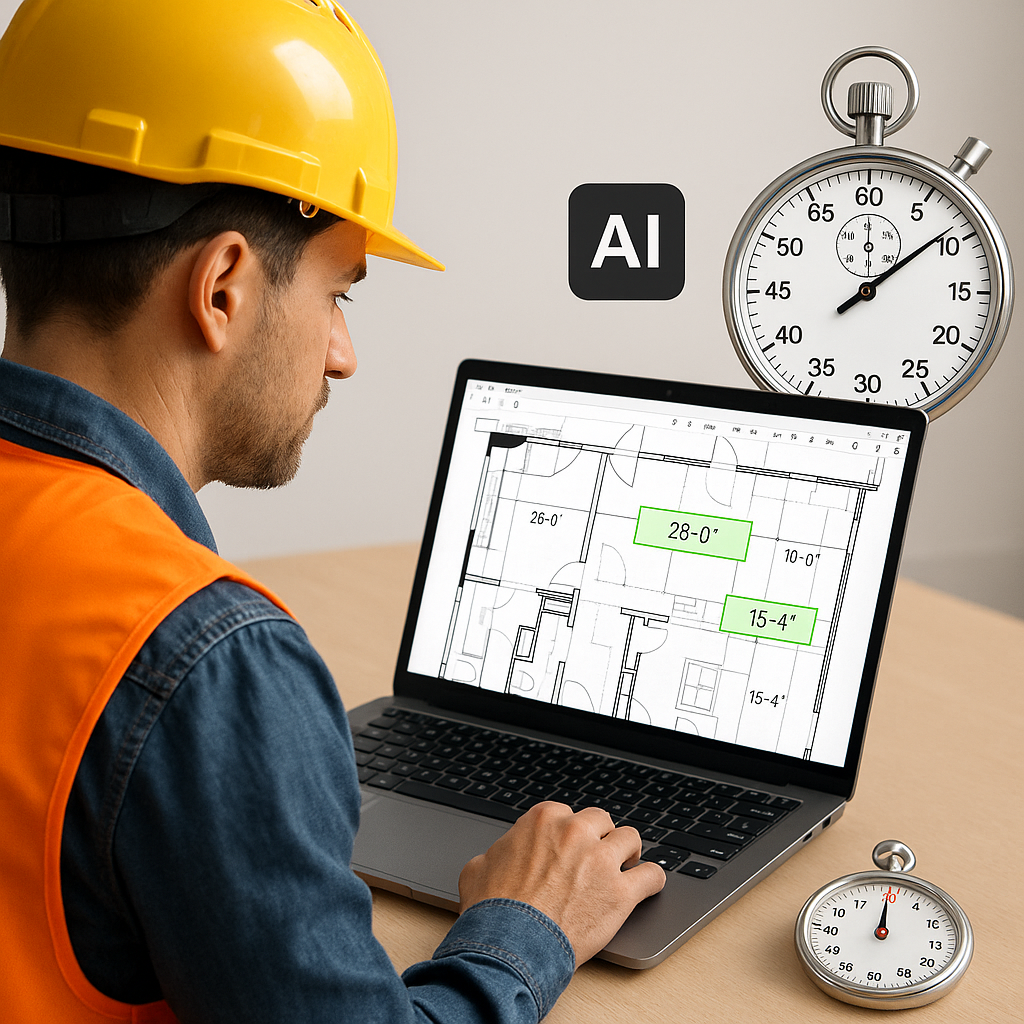
AI Vision Extraction: Using advanced Vision AI, the system reads the drawings, identifies areas, counts fixtures, and measures lengths. It even flags low-confidence measurements for manual review.
-
Instant QTO: In about 10 minutes, you get a complete quantity takeoff (QTO), ready to plug into your BOQ. No tracing, no measuring, no guesswork.
Case Study: High-Rise Contractor Saves 120 Hours
A mid-sized contractor bidding on a 30-story high-rise previously spent 150 hours on manual takeoffs. By switching to EstimateNext, the time dropped to just 30 hours, including manual review. That’s 120 hours saved—or three full workweeks. Beyond the time savings, the contractor reported a 15% increase in bidding capacity, allowing them to pursue more projects concurrently.
The Obvious Objection: “But AI Can’t Think Like an Estimator”
I hear this pushback a lot. You might be thinking, “Sure, AI is fast, but it doesn’t understand the nuances of construction.” That’s partially true—but it’s also missing the point. AI doesn’t replace your expertise; it amplifies it.
What AI Does (and Doesn’t) Do
AI excels at repetitive, data-heavy tasks:
- Extracting quantities from complex drawings
- Identifying patterns and discrepancies
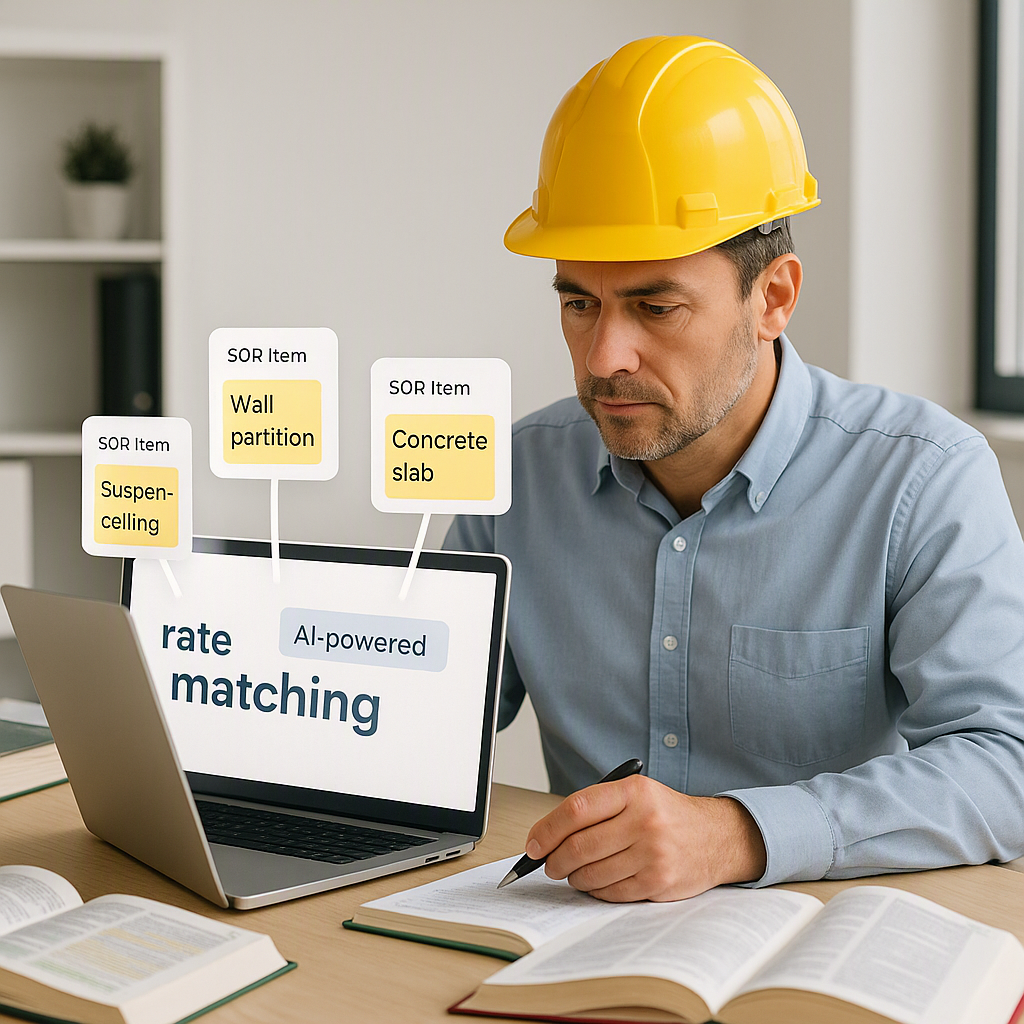
- Automating rate matching and recalculations
But it doesn’t replace the human element. You’re still the one making judgment calls, negotiating with subs, and deciding on markup. Think of it like autopilot for airplanes—it handles the routine tasks, but the pilot is still in charge.
Actionable Tip: Pair AI with Human Oversight
Use AI for the heavy lifting, but always review the final output. Most tools, like EstimateNext, include confidence scores for measurements, so you know where to focus your attention.
Real Numbers: What’s the ROI?
Let’s do the math. For a GC director making $130/hour, saving 40 hours per estimate translates to $5,200 saved per bid. If your team handles 6 GMP pursuits annually, that’s $31,200 in labor savings. Now compare that to the $99/month cost of EstimateNext’s GC plan. You’re looking at a 52X ROI.
Subcontractor ROI: Incremental Revenue
For subcontractors, the ROI is even steeper. Faster quote turnaround means you can respond to more bids. More bids mean more wins—and more revenue. A mechanical contractor using EstimateNext added 4-8 wins per year, generating $800K-$1.6M in incremental revenue.
Comparison Table: Manual vs. AI Takeoffs
| Metric | Manual Takeoffs | AI Takeoffs |
|---|---|---|
| Time per Project | 40 hours | 10 minutes |
| Error Rate | High (human error) | Low (confidence scoring) |
| Annual Cost | $31,200 (labor) | $1,188 (EstimateNext) |
| Bid Turnaround Time | Days | Hours |
| Scalability | Limited | High |
Why Speed Matters in Competitive Bidding
Speed isn’t just about saving time. It’s about staying competitive. In today’s market, clients expect faster turnarounds. If you’re still spending days on takeoffs while your competitors are pricing projects in hours, you’re at a disadvantage.
Market Trends Favoring AI
A 2023 McKinsey report found that early adopters of AI in construction save 10-20% on project costs. That’s not just labor savings—it’s fewer missed deadlines, better bid accuracy, and fewer change orders down the line. Companies leveraging AI report higher client satisfaction and increased repeat business.
Call to Action
If you're tired of wasting days on manual takeoffs, EstimateNext can help. Upload your first BOQ and get a priced estimate in minutes. Get started free →