Why Manual Takeoffs Are Killing Your Margins
Let’s not sugarcoat it: manual quantity takeoffs are a time sink. Two estimators spend 40 hours tracing drawings, recalibrating measurements, and double-checking every count. It’s tedious, error-prone, and expensive—a single mistake can throw your entire bid off.
On average, manual takeoffs cost general contractors $5,200 per project in labor alone. And that doesn’t include missed bid deadlines or untracked revisions. If your team prices five GMP pursuits a year, that’s $26,000 wasted annually. For MEP subs handling dozens of packages, it’s even worse.
The obvious question: why is this still the norm?
The AI Takeoff Advantage
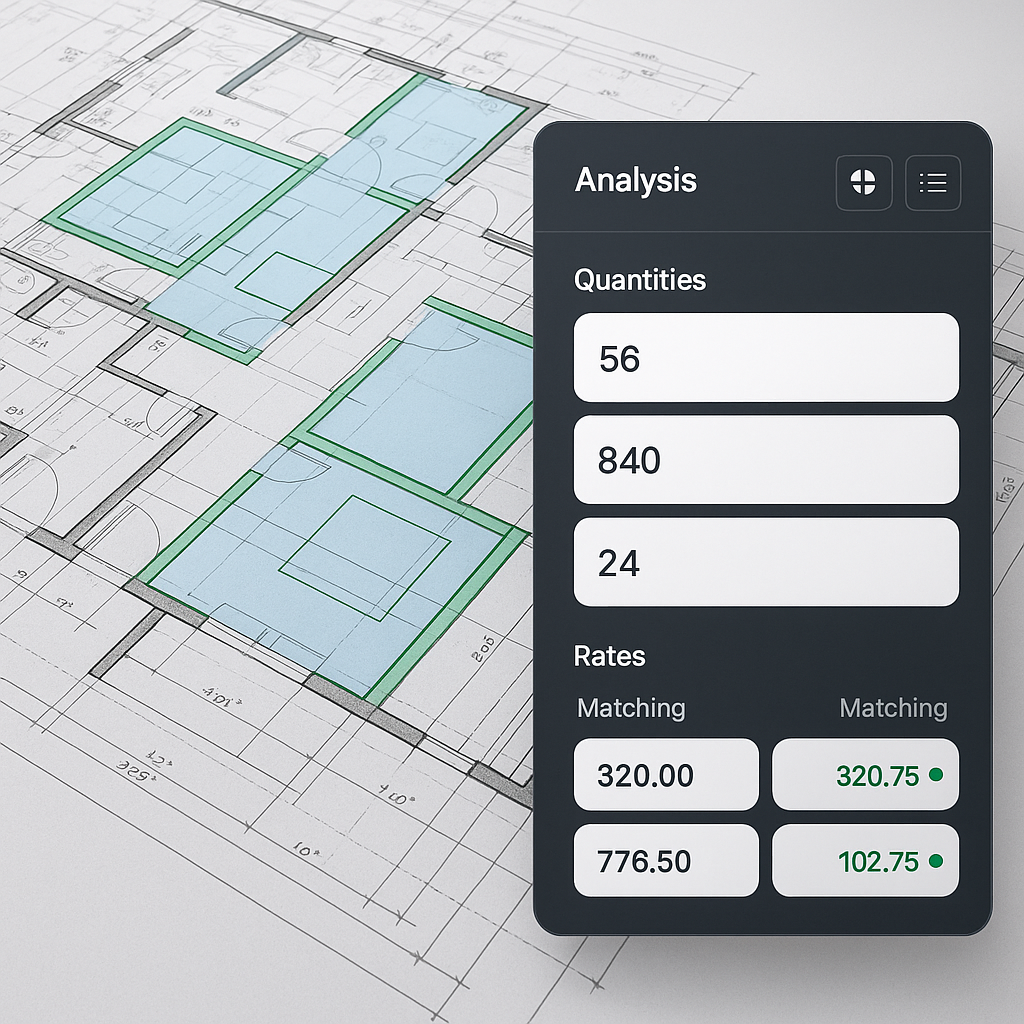
Machine learning flips the script. Tools like EstimateNext’s Vision AI extract quantities directly from PDF drawings in 10 minutes. Not hours. Not days. Ten minutes. That’s a 10X speed improvement over manual takeoffs—and it’s not just about speed.
Here’s what AI-powered takeoffs actually fix:
1. Accuracy
Human fatigue leads to mistakes. AI tools validate measurements, flag inconsistencies, and can reduce discrepancies by up to 80%. For example, a regional GC in California found that switching to AI reduced their bid errors by 15%, saving them from costly change orders down the road.
2. Revision Handling
Need to update quantities after a drawing revision? AI automates the comparison. No recalibrating rulers or re-exporting spreadsheets. Case in point: a Midwestern electrical contractor used AI tools to handle revisions for a large hospital project and cut update time from two days to two hours.
3. Scalability
Whether it’s a $1M renovation or a $1B rail project, AI handles complexity without breaking a sweat. Large infrastructure projects with hundreds of drawing sets can be processed in hours rather than weeks.
Imagine this: you upload a 200,000-square-foot facility drawing set at 9 a.m. By 9:10, the quantities are extracted, categorized, and ready for pricing. That’s smarter, faster, and cheaper.
Real ROI: The Numbers Don’t Lie
Let’s do the math.
General Contractors
A regional GC in Texas saved 30% on average bid prep time by adopting AI-powered takeoff tools. That allowed them to pursue 20% more projects annually. For a firm that typically wins 1 in 4 bids, this meant securing 1-2 additional projects per year—adding $2M in revenue.
MEP Subcontractors
For MEP subcontractors responding to 60 bid packages a year, AI tools cut quote turnaround from 72 hours to 4 hours. That’s 50% more bids submitted—and potentially 4-8 additional wins per year, depending on their close rate.
Small Contractors
Even smaller contractors see ROI. A residential GC in Florida reported saving 10 hours per estimate on single-family home projects. Over the course of 15 projects, they recaptured 150 hours—time spent negotiating better pricing with suppliers and securing higher-margin bids.
Early adopters of AI estimation tools report average cost savings of 10-20% per project. That’s not theoretical—it’s happening right now.
What Makes AI Takeoffs Reliable?
Skeptical? You should be. AI isn’t perfect, and input quality matters. Garbage in, garbage out. But here’s why modern tools like EstimateNext work:
1. Confidence Scoring
AI assigns confidence levels to extracted quantities, so you know where to double-check. For example, a contractor working on a $518M infrastructure overhaul used confidence scoring to identify and manually verify 12 low-confidence measurements. The result? Zero discrepancies in their final bid.
2. Manual Overrides
You can review and adjust any output. It’s not a black box—it’s a collaborative assistant. If your estimator sees a discrepancy, adjustments are straightforward.
3. Self-Learning
Each project feeds the system new data, making future estimates smarter. A New York-based drywall contractor reported that their AI tool improved accuracy by 5% after incorporating project-specific historical data over six months.
In practice, it’s like having an extra estimator on staff—but without the payroll hit.
The Bigger Picture: Time Is Money
When your team isn’t buried in manual takeoffs, they can focus on higher-value tasks: refining margins, optimizing bids, or negotiating with subs. AI doesn’t replace your expertise; it amplifies it.
Workflow Efficiency
Think about your current workflow. How much time do you lose recalibrating measurements? Rebuilding workbooks for every “what if” scenario? Comparing subcontractor quotes by hand? AI tools automate all of it.
For example, a concrete contractor pricing two bids a month shifted to AI tools and started pricing three bids. That’s a 50% productivity boost just from better tools.
Competitive Edge
In crowded markets, faster bid preparation can mean the difference between winning or losing. Contractors who adopt AI tools are consistently submitting tighter, more competitive bids without sacrificing accuracy.
Comparison Table: Manual vs AI Takeoffs
| Feature | Manual Takeoff | AI-Powered Takeoff |
|---|---|---|
| Speed | 40 hours per project | 10 minutes per project |
| Accuracy | Prone to human error | Reduces discrepancies by 80% |
| Revision Handling | Time-intensive | Automated comparisons |
| Scalability | Limited by manpower | Handles large projects easily |
| Labor Costs | $5,200 per project | ~$500 per project |
Ready to Stop Wasting Time?
If manual takeoffs are draining your team’s productivity, EstimateNext can help. Its AI-powered Vision tools cut takeoff time from 40 hours to 10 minutes—saving you thousands per project. Get started free →


