The Hidden Time Sink in Preconstruction Estimation
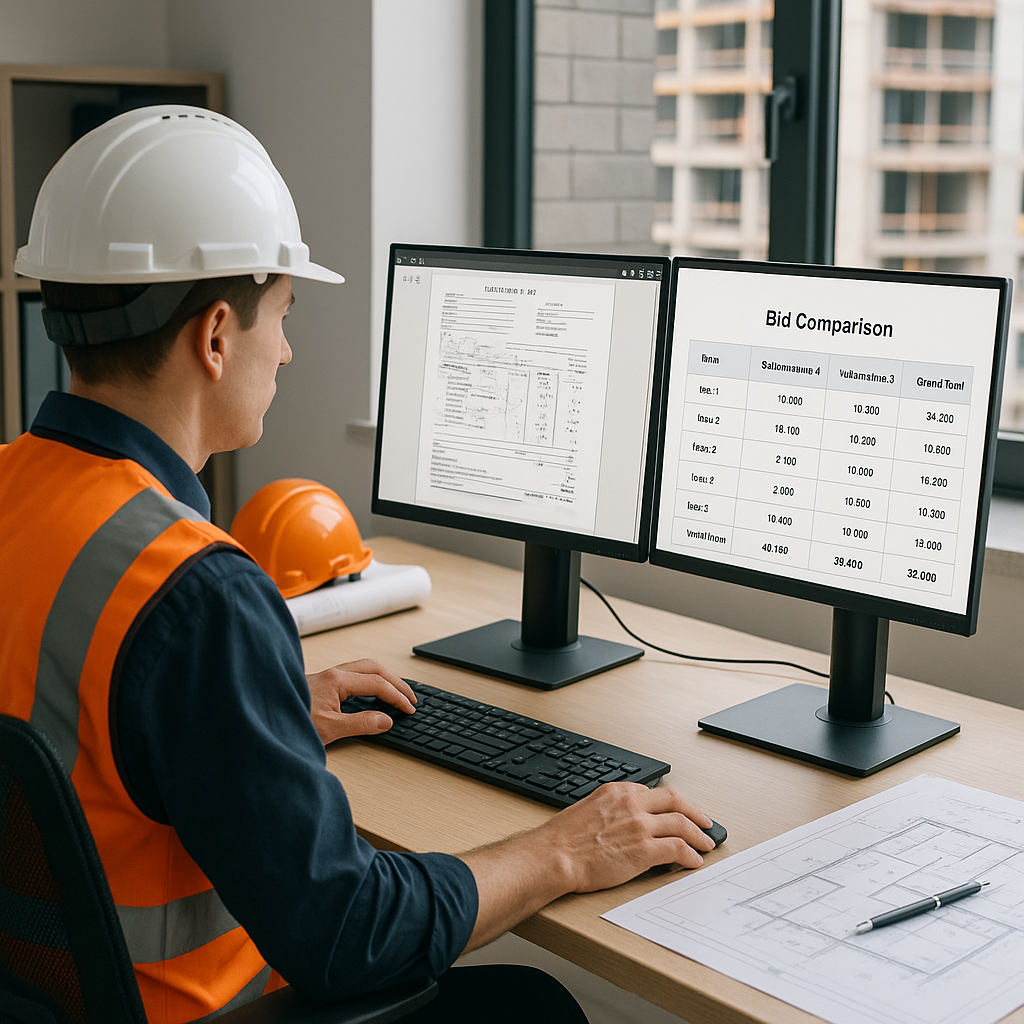
Subcontractor bid leveling. If you've been in preconstruction long enough, you know the drill: five to seven subs send their quotes, and you're left untangling scope differences, exclusions, and wildly varying formats. It's not uncommon for this process to eat up six hours per bid. That's almost a full workday spent just trying to figure out who’s L1 and who’s padding their numbers.
And here's the kicker: it doesn't even guarantee accuracy. Even after hours of manual effort, misinterpretations are common. The wrong sub gets awarded, or worse, you underprice the bid and eat the margin hit later.
Manual bid leveling is outdated. Let’s talk about how AI flips the script.
How AI Cuts Bid Leveling Time by 12x
Here’s where AI-powered tools like EstimateNext come in. The platform automates subcontractor bid leveling, cutting a six-hour slog into a 30-minute task. How? It uses AI to normalize quotes, identify scope mismatches, and rank L1/L2/L3 bidders. No more hunting through PDFs or retyping Excel sheets.
For example, let’s say you’re leveling bids for a mid-rise office project. One sub quotes $350,000 but excludes fire stopping. Another quotes $390,000 but includes fire stopping and adds a $12,000 contingency. Traditionally, you’d need to cross-check specs line by line, call the subs for clarification, and manually recalculate totals. With AI, the tool flags the scope differences automatically and adjusts the comparison. In seconds, you see the normalized numbers: $350,000 becomes $365,000 with fire stopping added, while $390,000 drops to $378,000 after eliminating the contingency.
Here’s another scenario: A subcontractor sends their bid as a blurry PDF scan. Previously, this might have required hours of manual data transfer and clarification calls. With AI, the tool extracts the data, flags inconsistencies, and provides a normalized comparison, even when the input isn’t pristine. The result? You’re left with clear, apples-to-apples comparisons. Less grunt work. More confidence.
Real-World Impact: A Case Study
One mid-sized general contractor shared their experience. They were pricing a $25M high school renovation and received seven sub bids for the HVAC package. The manual leveling process would’ve taken their lead estimator and a junior team member a full day. Instead, they used EstimateNext’s AI-powered bid leveling tool. Result? The task was done in under an hour, saving 14 labor hours.
But here’s the real game-changer: they caught a critical scope exclusion that would’ve cost $30,000 to fix post-award. According to their project manager, “That one feature alone paid for the software for a year.”
Another example comes from a national general contractor pricing a $40M mixed-use development. They used AI to level 10 electrical subcontractor bids — a notoriously tricky trade with dozens of exclusions and alternates. In the past, they would have needed two estimators working 10 hours each to finalize the leveling. With AI, the process was completed in under two hours. They also uncovered a $50,000 discrepancy in one bid that would have been missed manually. This discovery protected their already thin margin.
Why Manual Methods Fail
You might be thinking, "But I’ve been doing this manually for years, and it works fine." Sure, it works — until it doesn’t. Manual methods fail for three key reasons:
-
Human Error: A missed exclusion or miscalculation can snowball into a costly mistake. For example, forgetting to account for material price escalation in one bid could lead to a six-figure margin loss. AI doesn’t miss details — it checks every line item, every time.
-
Inconsistent Formats: Subs send bids in PDFs, Excel, or even handwritten scans. AI parses them all, saving hours of manual data entry and interpretation. A junior estimator at a Texas-based contractor noted, “One sub literally sent me a bid scrawled on notebook paper. I thought we’d never be able to level it, but the AI handled it.”
-
Time Pressure: When bids are due, shortcuts happen. Manual methods often mean rushing through details to meet deadlines, increasing the risk of errors. AI doesn’t cut corners; it works just as accurately under pressure as it does with ample time.
In my view, sticking to manual leveling in 2024 is like using a flip phone when everyone else has smartphones. It gets the job done, but at what cost?
The ROI of AI-Powered Bid Leveling
Let’s do some quick math. If you’re a GC pricing five GMP bids a year, with an average of seven sub packages per bid, that’s 35 bid leveling sessions annually. At six hours per session, you’re burning 210 hours a year. Multiply that by $130/hour for a senior estimator, and you’re looking at $27,300 in labor costs.
Now compare that to EstimateNext’s GC plan at $99/month. That’s $1,188 annually. Even if it only saves you 80% of those 210 hours, the ROI is 18X. And that’s before factoring in the cost of errors avoided.
Another way to think about it: catching a single mispriced scope exclusion in a $10M bid can easily save $50,000. That’s enough to justify the cost of the tool for years.
What About Edge Cases?
You might ask, “What if a sub’s bid is so messy that even AI can’t make sense of it?” Fair question. EstimateNext includes a manual override option. If the tool flags a low-confidence bid, you can step in, adjust the inputs, and re-run the analysis. Think of it as a partnership between human expertise and machine efficiency.
Another edge case? Custom terms or unique exclusions. The AI learns from every project you complete. By the third or fourth bid, it’s already smarter about how your subs work. One contractor I spoke to said, “By our fifth bid, it was like the tool knew our subs better than we did.”
Comparison Table: Manual vs. AI-Powered Bid Leveling
| Feature | Manual Leveling | AI-Powered Leveling |
|---|---|---|
| Time per Bid Leveling | 6 Hours | 30 Minutes |
| Error Risk | High | Low |
| Handles Messy Formats | Limited | Yes |
| Learning Curve | N/A | 1-2 Weeks |
| Scalability | Time-Intensive | Effortless |
| Cost per Year (210 hours) | $27,300 | $1,188 |
The Bottom Line
If you’re still leveling sub bids manually, you’re not just wasting time — you’re leaving money on the table. AI-powered tools like EstimateNext don’t replace your expertise; they amplify it. They handle the grunt work so you can focus on what really matters: winning bids and protecting margins.
Ready to cut bid leveling time by 12x? Get started free →


