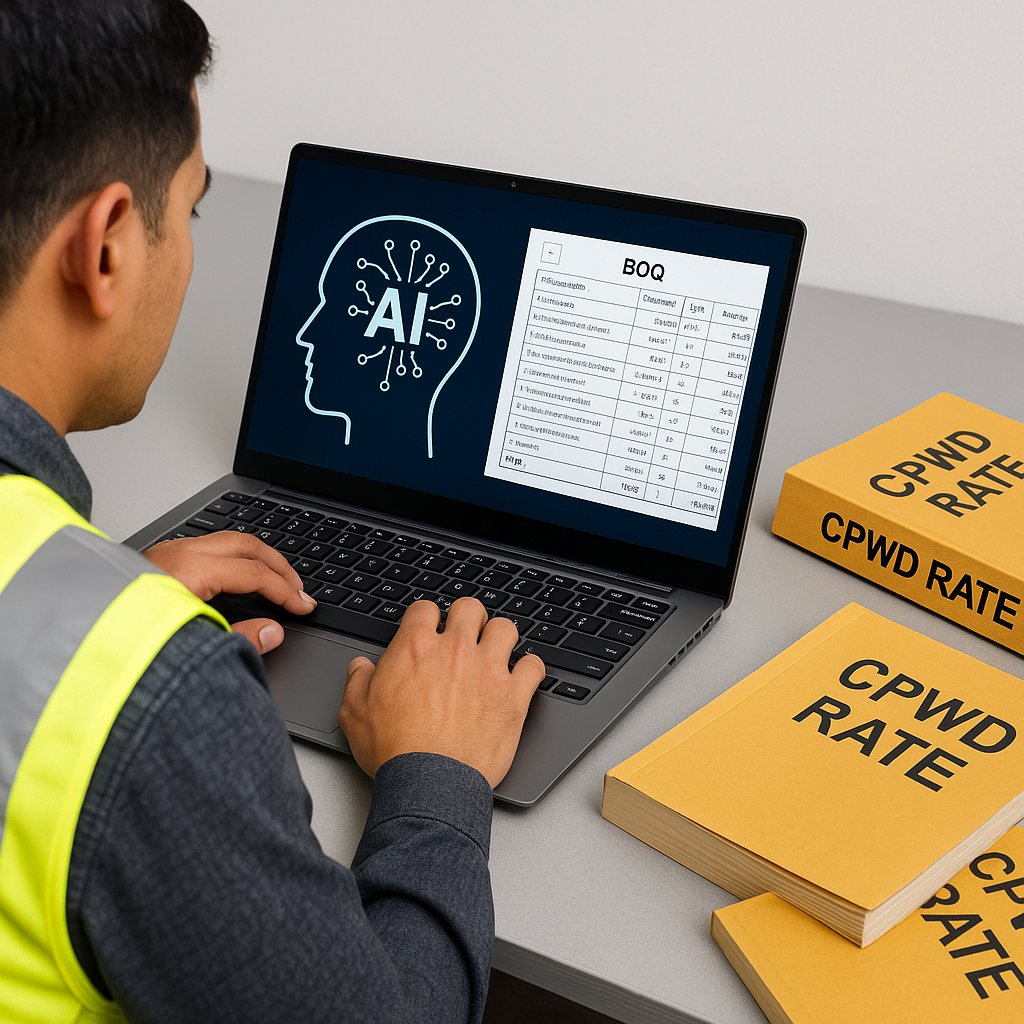
The Pain of Manual CPWD Plinth Area Rate Estimation
If you've ever bid on a CPWD tender, you've probably wrestled with plinth area rates. These rates, part of the Delhi Schedule of Rates (DSR), are a standard way to estimate construction costs for public projects in India. While the concept sounds straightforward, the process itself is excruciatingly slow and prone to errors.
What Makes It So Painful?
The process starts with determining the plinth area of the building and applying rates from the relevant CPWD catalog. However, these catalogs span hundreds of pages and include rates that vary based on factors like region, material type, and inflation adjustments. One small mistake—such as applying an outdated Cost Index—and your estimate can be rejected outright.
Concrete Example: A Regular Day for Estimators
A typical estimator spends 12-16 hours cross-referencing rates, verifying Cost Index adjustments, and ensuring compliance. For example, let’s say you need to bid on a ₹5-crore school project in Uttar Pradesh. You’ll need to:
- Identify the plinth area dimensions.
- Match rates from CPWD’s DSR catalog spanning hundreds of pages.
- Apply Cost Index adjustments specific to Uttar Pradesh.
And that’s assuming you can even find the latest circular updates on the CPWD website, which often feels like a scavenger hunt.
Mistakes are costly—not just in time but in money. Underestimating rates can lead to razor-thin profit margins, while overestimating might price you out of the competition.
The AI Shortcut: Speed and Accuracy
This is where AI-powered tools like EstimateNext come in. These tools drastically reduce the time and effort involved, while ensuring unmatched accuracy. Let’s break this down further:
1. Automated Rate Matching
EstimateNext’s semantic search engine scans 78,000+ CPWD items across 19 catalogs. All you need to do is upload your Bill of Quantities (BOQ), and the tool instantly identifies relevant rates based on the plinth area, material specifications, and region.
Case Study: Bidding on a ₹10-Crore Hospital Project in Bihar
Using manual methods, estimators would typically spend 12-16 hours matching rates and applying adjustments. With EstimateNext, the same task takes under 30 minutes. The tool ensures that even region-specific rates are accurately applied, minimizing human error.
2. Real-Time Cost Index Adjustments
CPWD updates its Cost Index once or twice a year. These updates reflect inflation, labor costs, and market fluctuations. Manually applying these adjustments to hundreds of rates is a nightmare. EstimateNext automates this step, updating all relevant rates within seconds.
Example: Inflation Updates
Imagine CPWD releases a circular raising labor rates by 5.2%. With manual methods, you’d have to recheck every line item in your BOQ, manually calculate adjustments, and ensure compliance. EstimateNext integrates these updates in real-time, saving hours of recalculation.
3. Audit Trails for Compliance
Government tenders demand precision. If your bid is questioned during an audit, you must provide a clear trail of how rates were calculated. EstimateNext creates detailed logs for every adjustment and rate match, giving you a data-backed explanation for every number.
Why This Matters
- Transparency: You can prove compliance with CPWD standards easily.
- Error Reduction: Automated audit trails minimize the risk of missteps that could jeopardize a tender.
Why It Matters: Time, Money, and Margins
Time Saved
Manual plinth area rate calculations can eat up days. With AI tools, you’re not just saving hours—you’re multiplying your capacity to respond to tenders. For instance, a contractor who typically handles 3 bids per month might use EstimateNext to handle 10 bids, drastically improving their business potential.
Better Margins
Mistakes in rate matching often lead to underpricing, which kills your margins. AI tools ensure every rate is compliant and accurate, protecting your bottom line. For example, one contractor reported a 15% improvement in profit margins after switching to EstimateNext.
Compliance Confidence
CPWD audits are strict. Using automated tools minimizes the risk of errors and ensures your bids meet government standards, reducing the likelihood of rejection.
Edge Cases: When Manual Might Still Win
Some projects are so niche that AI tools may struggle to find exact matches. Heritage building restorations, for instance, often require specialized rates that might not exist in standard catalogs. However, even in such cases, AI tools like EstimateNext can handle 90% of the workload and flag low-confidence matches for manual review.
Comparison: Manual vs. AI Tools
| Feature | Manual Process | AI Tools (EstimateNext) |
|---|---|---|
| Time Taken | 12-16 hours per project | Under 30 minutes |
| Error Rate | High | Minimal |
| Cost Index Updates | Manual recalculations | Automated |
| Compliance Audit Trails | Limited or non-existent | Detailed logs |
| Cost | Labor-intensive, expensive | ₹1,999/month |
Ready to Save Time?
Stop wasting days on manual CPWD plinth area calculations. EstimateNext cuts the process to minutes, giving you faster estimates, better margins, and compliance confidence. Get started free →


