Stop Wasting Days on Sub Bid Leveling: AI Fixes It in 30 Minutes
Sub bid leveling is the worst. If you've ever spent hours sorting through subcontractor quotes, trying to figure out who included what, you know exactly what I mean. It's tedious, prone to errors, and usually comes down to gut instincts when time runs out. But here's the thing—AI can fix this. And not in some vague, theoretical way. It's already happening.
Let me walk you through it.
The Problem with Manual Sub Bid Leveling
Most estimators deal with 3-7 subcontractor quotes per trade. Each one is formatted differently—some include exclusions buried three pages deep, others miss key scope items entirely. So, you’re left manually building comparison tables in Excel.
What Does That Look Like in Real Time?
Here’s a breakdown of the typical manual sub bid leveling process:
- Gathering Quotes: You dig through emails, PDFs, and handwritten notes from multiple subcontractors. This can take 1-2 hours per trade.
- Identifying Scope Gaps: You cross-check each quote against the tender documents to identify exclusions or missing scope items. This step eats up 2-3 hours.
- Normalizing Costs: You try to adjust for exclusions, alternate materials, or scope overlap—essentially comparing apples to apples. Expect this to take another 2-4 hours.
- Ranking Bids: After all that, you still rely on your gut to rank subs based on incomplete data.
In total, you’re spending 6-9 hours per trade just on leveling. Multiply that across all trades in a typical project, and you’re looking at 40-60 hours of work for a medium-sized bid. And even after all that effort, there’s still a risk of errors—estimators often make judgment calls based on incomplete information.
Common Pitfalls in Manual Bid Leveling
- Missed Exclusions: Subcontractors bury exclusions deep in their proposals, sometimes in footnotes or separate attachments.
- Scope Overlaps: Two subs might both include the same scope, but you don’t realize it until much later.
- Format Chaos: Every quote is formatted differently, making comparisons tedious and prone to mistakes.
- Subjectivity: Estimators often rely on intuition rather than structured data, increasing the risk of bias or oversight.
How AI Changes the Game
AI-powered sub bid leveling takes the grunt work out of this process. Here’s how it works:
Key Features of AI Sub Bid Leveling Tools:
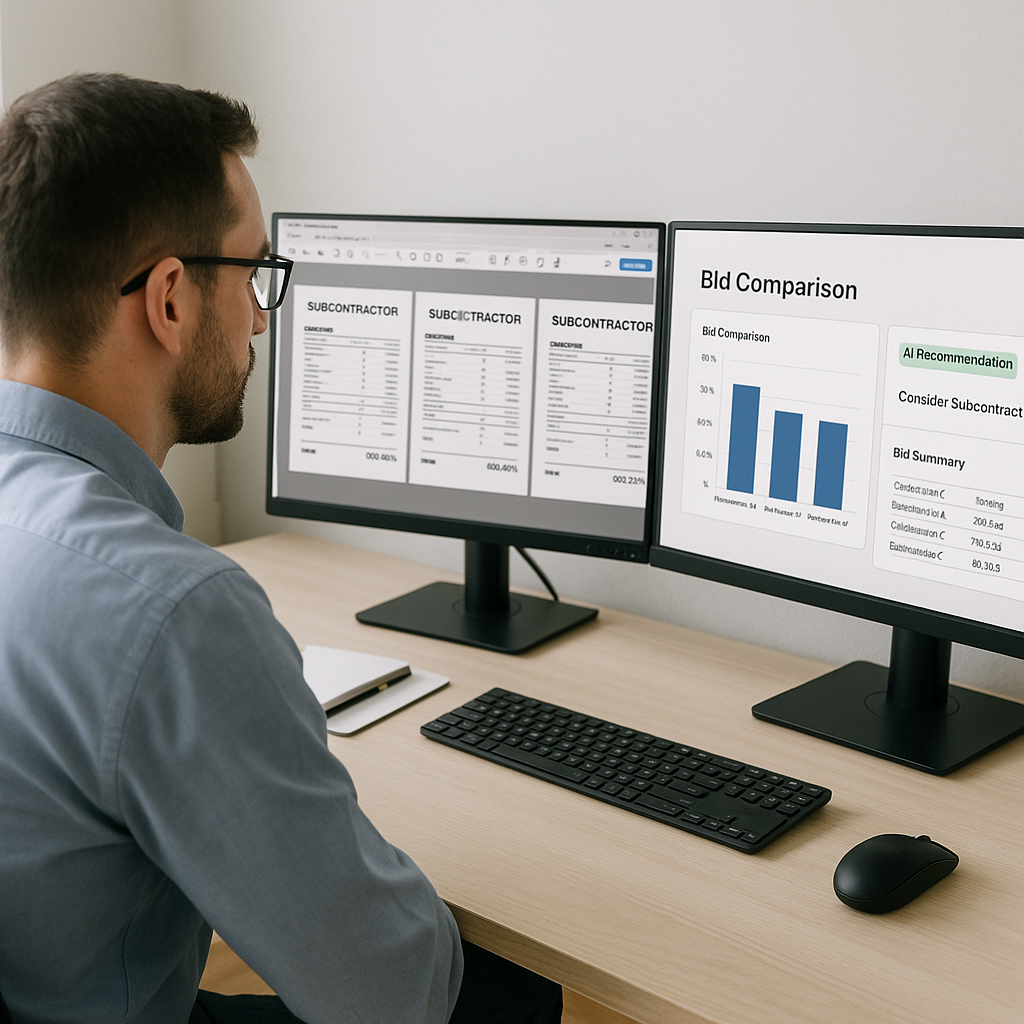
- Quote Ingestion: You upload all your subcontractor quotes, no matter the format (PDF, DOC, Excel). The AI automatically extracts the relevant data.
- AI Scope Matching: The system analyzes each quote against the project scope, flagging missing or extra items. For example, if Sub A excludes fireproofing and Sub B includes it, the platform highlights the difference automatically.
- Cost Normalization: AI adjusts quotes for exclusions or alternates. Got one sub offering cheaper materials? The system calculates the equivalent cost for the specified materials.
- Ranking: Once normalized, the tool ranks subs by cost, scope coverage, and even past performance (if you’ve used them before).
Actionable Steps to Implement AI:
- Start Small: Begin with one trade where leveling is particularly painful—like electrical or HVAC.
- Choose the Right Tool: Platforms like EstimateNext or Togal.AI specialize in bid leveling. Look for one with intuitive interfaces and strong customer support.
- Train Your Team: Most tools offer onboarding sessions or tutorials. Dedicate a couple of hours to learning the basics.
- Pilot a Project: Apply AI leveling to a single project and measure its impact on time savings and accuracy.
Real-World Impact
Let’s get specific. A mid-sized general contractor recently used EstimateNext on a $50M office build. They had quotes from five electrical subs, each with wildly different formats.
- Manual Method: The team estimated it would take 8 hours to level the bids.
- AI Method: Using EstimateNext, they completed the process in 45 minutes.
What Were the Results?
- Time Savings: A 10X productivity boost, freeing up staff for higher-value tasks like optimizing project schedules.
- Error Reduction: The AI flagged a critical $150K exclusion (cable trays) in the lowest bid, avoiding a costly change order down the line.
- Confidence Boost: Structured, complete data allowed the team to make informed decisions quickly.
Other case studies show similar results:
- Small Residential Project: A contractor saved 20 hours by using bid leveling tools for plumbing and landscaping trades.
- Industrial Build: A team avoided a $500K overage by spotting discrepancies in steel fabrication bids early.
Common Objections
1. “AI can’t think like an estimator.”
True, AI doesn’t replace your expertise. It amplifies it. You’re still the one making judgment calls, but now you’re working off structured, complete data instead of cobbling it together yourself.
2. “What about edge cases?”
AI isn’t perfect, but tools like EstimateNext let you review and override anything. If the system misses a nuance, you can adjust it manually. Think of it as a second pair of eyes—one that never gets tired or distracted.
3. “We don’t have time to train on new tools.”
Fair point, but most AI platforms are designed to be user-friendly. According to EstimateNext, most teams are up and running within two weeks. And the time savings on the first project alone usually justifies the effort.
4. “It’s too expensive.”
While AI tools have upfront costs, they often pay for themselves in saved labor hours and avoided change orders. Many platforms offer free trials or flexible pricing models to help you evaluate ROI.
Why This Matters
Sub bid leveling isn’t just a time suck—it’s a risk multiplier. Miss one exclusion, and your budget takes the hit. Overestimate costs, and you lose the job. AI doesn’t eliminate all the risks, but it gives you a fighting chance to spot the big ones early.
And in an industry where every bid feels like a sprint to the finish line, that’s a game-changer.
Comparison Table: Manual vs. AI Sub Bid Leveling
| Criteria | Manual Leveling | AI-Powered Leveling |
|---|---|---|
| Time Required | 6-9 hours per trade | 30-45 minutes per trade |
| Error Risk | High (missed exclusions, overlaps) | Low (structured data review) |
| Cost Normalization | Subjective, manual adjustments | Automated and consistent |
| Ease of Use | Labor-intensive, prone to fatigue | User-friendly platforms |
| Scalability | Difficult for large projects | Easily handles multiple trades |
Ready to Try It?
If you're tired of spending days leveling sub bids, EstimateNext can help. Get started free →


