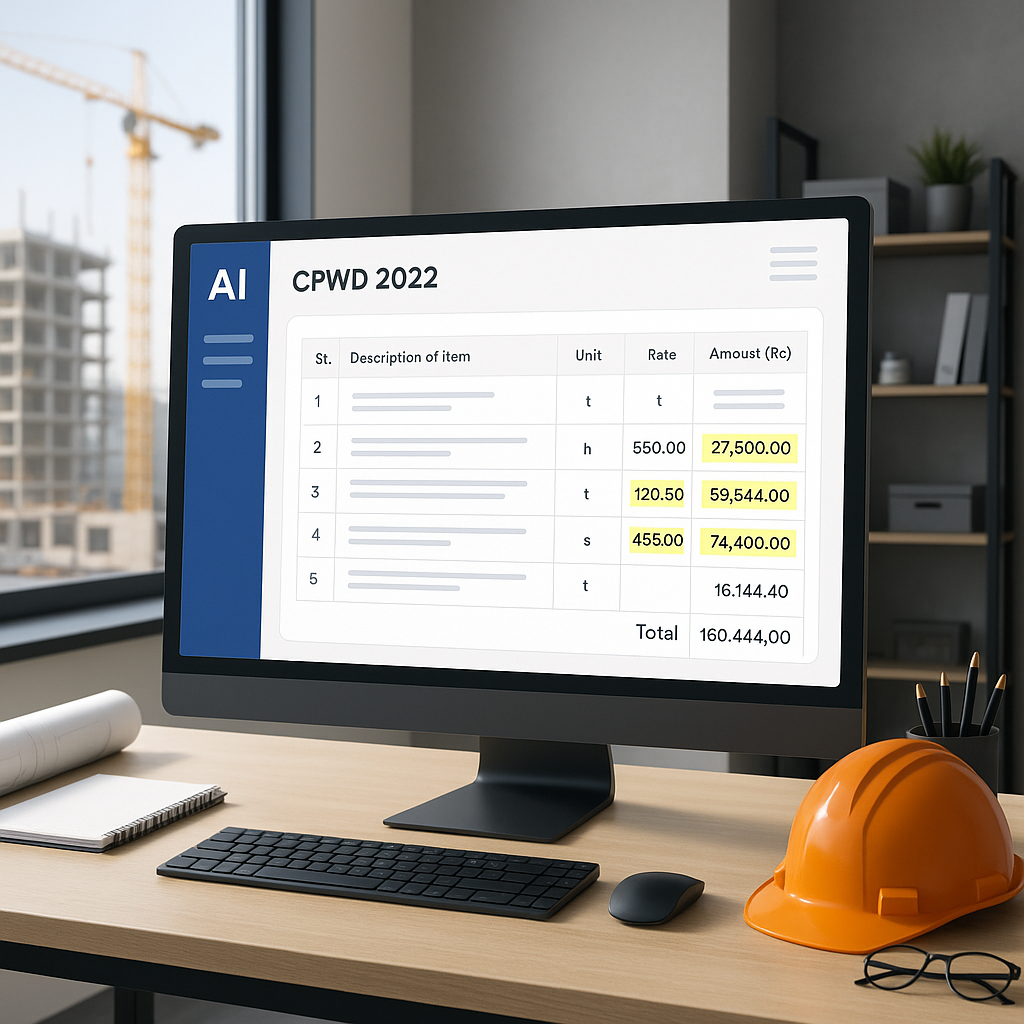
The CPWD Estimation Problem No One Talks About
If you’ve ever bid on a CPWD (Central Public Works Department) project, you know the drill. The tender comes in. You pull out the CPWD 2022 DSR (Delhi Schedule of Rates) PDF, all 2,000+ pages of it. Then begins the manual grind: cross-referencing rates, adjusting for cost index updates, and reworking Excel sheets.
It’s tedious. Worse, it’s risky. A missed rate or outdated adjustment can disqualify your bid or squeeze your margins. But why is this still the norm in 2023? Let’s break it down.
The Manual Estimation Process: A Real-Life Example
Let’s say you’re bidding on a ₹10-crore government project. The tender requires you to submit a BOQ (Bill of Quantities) with the latest CPWD Cost Index applied. Here’s what happens:
Step-by-Step Breakdown:
-
Find the Circular: First, you need to locate the most recent Cost Index circular. If it’s buried on the CPWD website or outdated, good luck finding it. Many contractors spend hours searching for the latest updates, often relying on third-party sources to confirm their accuracy.
-
Manual Adjustments: Next, you manually apply percentage uplifts for labor, materials, and equipment to each line item in your BOQ. For a mid-sized project, this alone can take 12-16 hours. Add complexity—such as regional variations—and the process can stretch into days.
-
Redo Rate Analysis: If any rates don’t match the DSR, you’ll need to justify them with additional calculations, often involving market research, supplier quotes, and historical cost data.
Case Study: A ₹50-Crore Hospital Project
In 2022, a reputed contractor bidding on a ₹50-crore hospital project spent over 30 hours manually refining their BOQ. Despite their diligence, a minor discrepancy in the CPWD Cost Index led to the rejection of their bid. Their estimated loss of potential revenue? ₹8 crores.
This isn’t an isolated case; manual processes are highly prone to errors, even for seasoned professionals.
How AI Tools Fix This
AI-powered platforms like EstimateNext automate this entire process, making CPWD estimation faster, more accurate, and far less stressful. Here’s how:
1. Smart BOQ Parsing
Upload your BOQ in Excel, CSV, or even ODS format. The AI automatically detects merged cells, section headers, and hierarchies. This alone can save hours spent cleaning up files and formatting them manually.
2. Instant Rate Matching
The tool scans 78,000+ SOR items (including CPWD DSR 2022) in seconds. It doesn’t just match exact text. AI understands synonyms and context, so it identifies the right item even if your description uses slightly different terminology.
3. Automated Cost Index Adjustments
One of the most time-consuming tasks—applying the latest CPWD Cost Index adjustments—is handled automatically. The AI integrates the latest circulars, calculators, and regional indices to ensure that your BOQ is compliant and up-to-date.
4. Real-Time Rate Analysis
Want to tweak a rate to reflect market fluctuations? The tool propagates changes across your entire BOQ in real time, complete with an audit trail. No more rebuilding Excel sheets from scratch.
Actionable Benefits of AI Tools
1. Save Time
- Traditional manual estimation: 12-16 hours per tender (depending on project size).
- AI-assisted estimation: 2-4 hours, including reviews and customizations.
2. Improve Accuracy
- Manual calculations are prone to errors, especially for large BOQs.
- AI ensures consistent rate matching and error-free adjustments.
3. Enhance Compliance
- AI ensures your estimates align with CPWD norms and circulars, reducing the risk of bid rejection.
4. Boost Profit Margins
By eliminating guesswork, you can price bids more competitively without risking underpricing or overpricing. For example, a contractor using EstimateNext reported a 5% increase in profit margins due to more accurate rate adjustments.
Common Objections and Their Solutions
“I’m used to Excel. Why switch?”
Excel works for small projects, but it becomes a bottleneck when dealing with larger tenders. AI tools eliminate repetitive tasks like manual rate matching and cost index adjustments, allowing you to focus on strategy.
“What if the AI gets a rate wrong?”
Platforms like EstimateNext allow you to review and override any mismatched rates. Plus, the audit trail feature ensures full transparency, so you can trace every adjustment back to its source.
“How much does it cost?”
Compared to CostX (₹10-15 lakh/year) or ProEst, EstimateNext starts at just ₹3,200/month. For medium-sized contractors, the time savings alone justify the investment.
Comparison Table: Manual vs. AI-Based Estimation
| Feature | Manual Process | AI-Based Process |
|---|---|---|
| Time Required | 12-16 hours | 2-4 hours |
| Error Risk | High | Low |
| Latest Rate Updates | Manual lookup | Automated |
| Compliance Confidence | Moderate | High |
| Cost | Labor-intensive | Affordable (₹3,200/mo) |
Closing Thoughts
If you’re tired of wasting hours flipping through CPWD PDFs and manually adjusting rates, it’s time to rethink your approach. AI-powered platforms like EstimateNext automate rate matching, cost index adjustments, and BOQ updates, letting you focus on pricing smarter—not harder.
Why settle for inefficiency when you can bid faster, smarter, and more confidently? Get started free →


