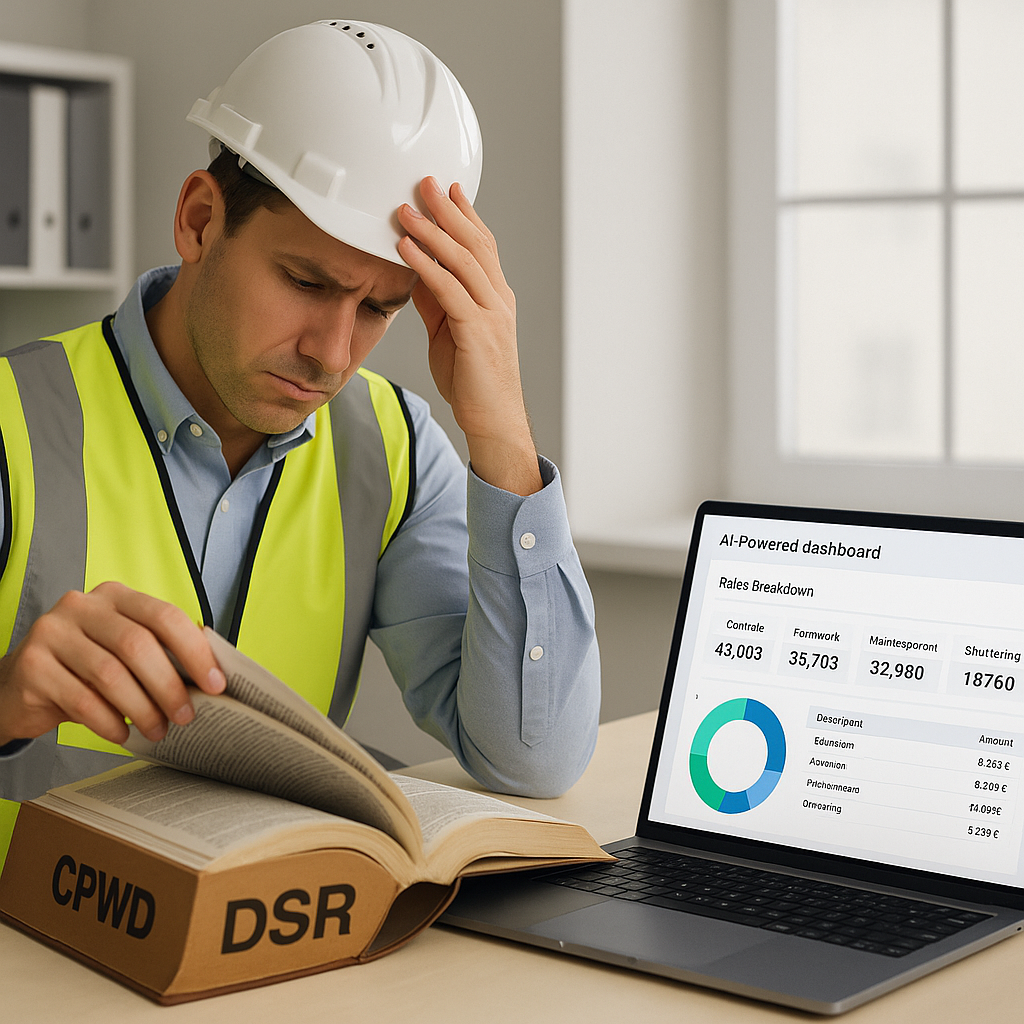
Why Rate Analysis in Civil Works Is a Time Sink
If you've ever worked on a government tender in India, you know rate analysis is a nightmare. Especially if you're using CPWD's DSR (Delhi Schedule of Rates). The process isn't just tedious—it’s error-prone. You spend hours flipping through PDFs, breaking down material, labor, and equipment costs for each item. And if a single rate changes? Back to square one.
Let’s say you’re pricing a ₹150 crore public hospital project in Bihar. The tender specifies CPWD DAR (2023), but half the items don't have published rate breakdowns. Now you're stuck manually calculating material, labor, T&P, contractor profit, and sundries for 500+ BOQ lines. Each line takes you 2-4 hours. Multiply that by 500. You’re looking at 1,500 hours of work for just one tender.
And you can’t skip this step. Clients demand detailed rate breakdowns, especially for sanctions. A lump-sum rate won’t cut it.
The Hidden Cost of Manual Work
Manual rate analysis isn’t just slow—it’s costly. A single overlooked inflation adjustment can blow your margins. Or worse, make your bid uncompetitive. You might think, "Why not stick to Excel or RSMeans?" But those tools weren’t built for CPWD or the nuances of regional Indian tenders. They miss too much.
Take this example: A contractor bidding on a ₹50 crore irrigation project in Andhra Pradesh skipped updating material costs in their rate analysis. Cement prices had risen 8% in the region due to supply-chain issues. That oversight cost them ₹3.5 lakh in lost profit.
In my view, the industry is stuck in the 90s. We’re relying on tools and methods that don’t scale with the complexity of modern projects. It’s like trying to run a marathon in flip-flops.
How AI Cuts Rate Analysis Time by 90%
Here’s the good news: You don’t have to do this manually anymore. AI tools like EstimateNext automate rate analysis for civil works PDFs in seconds.
A Practical Example: CPWD DAR Breakdown
Let’s revisit that Bihar hospital project.
- Upload the BOQ: Drag and drop your Excel sheet into the system. The AI parses merged cells, section headers, and hierarchies automatically.
- Generate Rate Analysis: Click the “Generate Rate Analysis with AI” button. In 5-10 seconds, you get a breakdown for every BOQ line: material, labor, equipment, contractor profit, and sundries. This even accounts for CPWD inflation adjustments.
- Review and Adjust: The system highlights low-confidence matches for manual review. You can override these, and the AI learns from your changes.
Actionable Steps to Try This Today:
- Start small: Use AI for one BOQ with 10-20 items to see how it works.
- Double-check AI outputs for critical items like cement and steel, which tend to have fluctuating prices.
- Use the time saved to refine your bid strategy—focus on pricing more competitively or strengthening your proposal.
No more flipping through PDFs or rebuilding Excel formulas. Just accurate, audit-trail-backed rates in a fraction of the time.
Why This Works
The AI combines two things: a massive database of 78,000+ SOR items and self-learning algorithms. Every time you accept or reject a match, the system improves. It also adjusts for geography (e.g., Bihar vs. Delhi rates) and inflation (e.g., 5.2% for CPWD DAR 2023).
Comparison: Manual vs AI
| Feature | Manual Rate Analysis | AI-Powered Rate Analysis |
|---|---|---|
| Time Taken | 1,500+ hours per tender | ~20 hours (including review) |
| Error Rate | High | Low (with manual review) |
| Geographic Adjustments | Manual effort required | Automated |
| Learning Curve | High | Low |
| Cost | High (labor-intensive) | Affordable (monthly subscription) |
The result? You save 1,400+ hours per project. And your bids are more accurate and competitive.
Real-World Impact
Here’s what this looks like in practice:
- General Contractors: A mid-size GC in Delhi saved ₹5,200 per estimate (40 hours x ₹130/hr) by switching to AI tools. For firms pursuing 5-8 GMP bids a year, that’s a savings of ₹26,000-₹41,600 annually.
- Regional Contractors: A contractor in Himachal Pradesh used AI tools to submit CPWD-compliant bids 30% faster, allowing them to bid on two additional projects in a year.
- MEP Subcontractors: Mechanical, Electrical, and Plumbing (MEP) subcontractors slashed bid turnaround from 3 days to 4 hours, responded to 50% more bids, and increased their win rate by 15%.
Objections and Edge Cases
You might be thinking, "What if my catalog isn’t included?" That’s fair. Not all tools support custom catalogs. But EstimateNext lets you upload your own, and the AI learns over time.
Or maybe you worry about accuracy. AI isn’t perfect, but it flags low-confidence matches so you can review them. And every revision you make feeds back into the system, making it smarter for your next project.
Another common concern is subscription costs. While there’s an upfront cost, the ROI is undeniable. For a ₹100 crore project, shaving 1,400 hours off rate analysis can save ₹18-₹25 lakh in labor and overhead.
Why Speed Matters
In construction, time is money. A slow bid means missed deadlines and lost opportunities. AI-powered rate analysis doesn’t just save time—it gives you a competitive edge. Faster bids mean happier clients and more wins.
Imagine two contractors bidding on the same ₹200 crore metro rail project. Contractor A takes 3 weeks to prepare their bid manually, while Contractor B uses AI to finish in 4 days. Contractor B not only submits first but also has time to refine their bid, making it more accurate and competitive.
Conclusion
Manual rate analysis is a relic of the past. AI tools like EstimateNext are transforming how we handle civil works estimation, especially for CPWD projects. If you’re tired of wasting hours—or losing bids—it’s time to upgrade.


