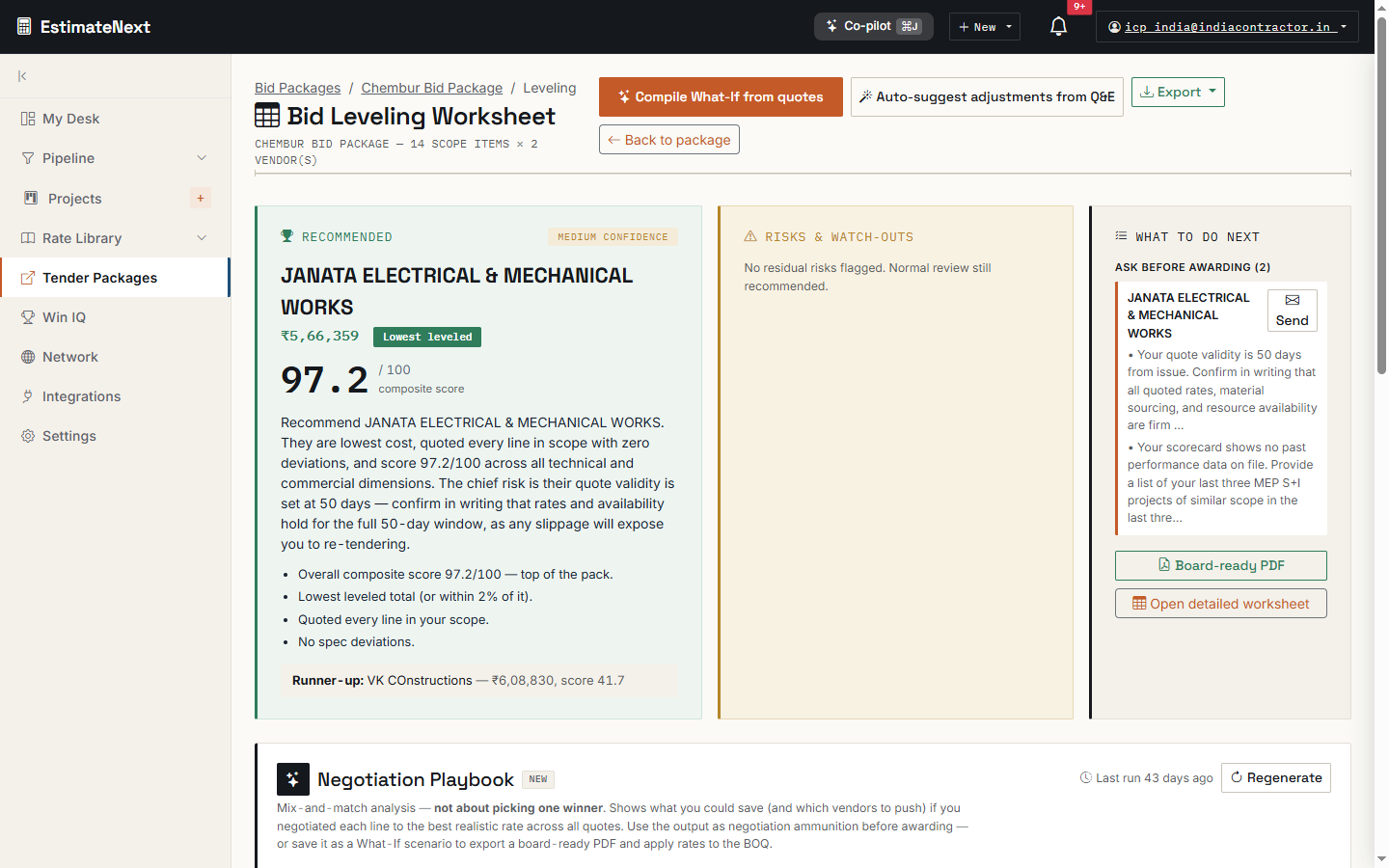
The Sub Bid Levelling Problem
You have received six MEP sub bids for a hospital project. Each one is priced on a different format. Three include commissioning, two exclude it, one includes it but calls it "testing and balancing." Two subs priced the work by floor, three priced by system, and one just gave a lump sum. One includes a 10% contingency, another includes 5%, and two have no visible contingency.
How do you compare these bids? Most GCs do it in a spreadsheet — manually mapping each sub's line items to a common structure, adding back exclusions, deducting inclusions, and trying to arrive at a fair like-for-like comparison.
It takes two to three days. And the comparison is only as good as the person doing it.
What "Like-for-Like" Actually Means
Fair bid comparison requires normalisation across several dimensions:
Scope Coverage
- Which specification items are included, excluded, or qualified?
- Are there scope gaps where no sub has priced an item?
- Are there scope overlaps where multiple subs price the same work?
Pricing Structure
- Are rates unit-based, lump sum, or a mix?
- What is the markup structure (profit, overheads, contingency)?
- Are there qualifications that affect the effective price?
Programme Implications
- What programme duration is each sub assuming?
- Are there acceleration premiums or phasing constraints?
- What mobilisation and demobilisation costs are included?
Commercial Terms
- Payment terms and retention
- Warranty periods
- Insurance and bonding requirements
The Smart Worksheet Approach
A bid levelling smart worksheet transforms this chaos into structure:
-
Define the master scope. Before you look at any sub bid, establish what the complete scope should include. List every specification item, every system, every exclusion that needs to be priced.
-
Map each sub bid to the master scope. For each sub, identify which master scope items they have priced, which they have excluded, which they have qualified, and which they have missed entirely.
-
Normalise to a common format. Convert all pricing to the same structure — unit rates where available, lump sums broken down by trade, markups separated from base costs.
-
Add back exclusions. If sub A excludes commissioning ($80,000 on this project), add it back using either the sub's own rates, another sub's rates, or a budget estimate. This is critical — comparing Sub A at $1.2M excluding commissioning to Sub B at $1.3M including it is not a fair comparison.
-
Compare normalised totals. Now you are looking at six bids for the same scope, in the same format, with the same inclusions.
Finding the True Lowest Bid
The true lowest bid is rarely the one with the smallest number on the cover page. Consider this real scenario:
| Sub | Cover Price | Exclusions Value | Qualifications Impact | Normalised Price |
|---|---|---|---|---|
| A | $1,180,000 | $95,000 | +$12,000 | $1,287,000 |
| B | $1,310,000 | $0 | -$15,000 | $1,295,000 |
| C | $1,250,000 | $45,000 | +$8,000 | $1,303,000 |
| D | $1,200,000 | $120,000 | +$25,000 | $1,345,000 |
| E | $1,340,000 | $0 | $0 | $1,340,000 |
| F | $1,280,000 | $30,000 | +$5,000 | $1,315,000 |
Sub A, which appeared cheapest at $1,180,000, has $95,000 of exclusions and a $12,000 qualification impact. Its normalised price of $1,287,000 is still the lowest — but by only $8,000, not by $130,000 as the cover prices suggest.
Sub D, the second-cheapest cover price at $1,200,000, is actually the most expensive when exclusions are added back. The $120,000 of exclusions completely changes its competitive position.
Without systematic levelling, you might have awarded to Sub A thinking you saved $130,000 over Sub B. In reality, you saved $8,000 — and Sub B's all-inclusive price might be worth the premium for lower contract administration risk.
Time Savings That Matter
On a typical multi-trade project with six to eight packages and four to six subs per package:
- Manual levelling: 2-3 days per package × 8 packages = 16-24 days
- With a smart worksheet: 3-4 hours per package × 8 packages = 3-4 days
That is two to three weeks of procurement team time freed up. More importantly, the quality of comparison is consistent — every package gets the same rigorous normalisation.
Beyond Price: Evaluating Sub Quality
Price is not the only criterion. EstimateNext bid levelling includes qualitative factors:
- Past performance: Has this sub worked on your projects before? How did they perform?
- Financial health: Can they carry the cash flow requirements?
- Methodology: Does their approach align with your programme?
- Key personnel: Are they committing their A-team or their B-team?
These qualitative factors do not change the price comparison, but they inform the award decision. The cheapest sub with a history of claims might cost more than the second-cheapest sub with a clean track record.
Getting Started
Try levelling your next sub bid package using a structured approach. Take the three to four most complex packages on your current project, and see how the normalised comparison differs from the raw cover-price comparison.
Ready to level bids faster? See the smart worksheet in action with a real bid package.
Ready to see EstimateNext in action?
AI-powered preconstruction estimation platform — from BOQ upload to priced bid package in minutes. 78K+ SOR items, 7 specialist trade tools, bid intelligence, and a procurement network.
Get Started Free →

