What Manual Estimation Really Costs
Most construction firms know that manual estimation is slow. What they do not know — because they have never measured it — is exactly how much it costs them. Not just in time, but in lost opportunities, pricing errors, and competitive disadvantage.
Let us do the maths that nobody does.
The Direct Cost: Estimator Time
A mid-size general contractor estimates 40-50 tenders per year. Each estimate, on average, takes 35-40 hours of estimator time. That is:
- 40 tenders × 38 hours = 1,520 estimator-hours per year
- At a fully loaded cost of $85/hour (salary, benefits, overhead, software, office space): $129,200 per year
But this is just the chief estimator. Add the quantity surveyor who does takeoffs (15-20 hours per tender), the procurement coordinator who collects sub quotes (8-10 hours), and the admin support (3-5 hours). The total estimation cost per tender is closer to 65-75 hours, or:
- 40 tenders × 70 hours × $75 average rate = $210,000 per year
That is a quarter of a million dollars spent on estimation. For a firm with $80-100M annual revenue, estimation consumes about 0.2-0.25% of revenue. For a firm with $30-40M revenue, it is closer to 0.5-0.7%.
The Hidden Cost: Lost Tenders Due to Capacity
Here is the cost nobody calculates: how many tenders did you decline because your estimation team was full?
If your team of three estimators can handle 40 tenders per year and you receive 55 viable tender invitations, you declined 15. At a 15% win rate, those 15 tenders represented two or three potential project wins. At an average project value of $8M with a 7% margin, that is:
- 2.5 lost wins × $8M × 7% = $1.4M in lost margin per year
One and a half million dollars in margin that walked out the door because your estimation team could not keep up. That dwarfs the $210,000 direct cost of estimation.
The Accuracy Cost: Pricing Errors
Every estimator makes errors. The industry benchmark for manual estimation accuracy is 92-95% — meaning 5-8% of the estimated value contains errors of some kind.
Not all errors cost money:
- Overestimates on won projects mean you left margin on the table
- Underestimates on won projects eat into margin or create losses
- Errors on lost tenders cost nothing (you did not win the work)
But on won projects, pricing errors have real impact. If your firm wins 6 projects per year worth $50M total, and 3% of the estimated value contains errors that go against you:
- $50M × 3% = $1.5M in annual pricing error exposure
Some of that is absorbed by contingency. Some becomes margin erosion. Some becomes claims and disputes. But the number is real and significant.
The Competitive Cost: Slow Response Time
In many markets, speed of response is a competitive factor. A developer who needs a budget estimate for a board meeting next week will go with the firm that can deliver in three days, not the one that needs three weeks.
Manual estimation is inherently slow because it is sequential:
- Wait for drawings (1-2 days)
- Do takeoff (5-10 days)
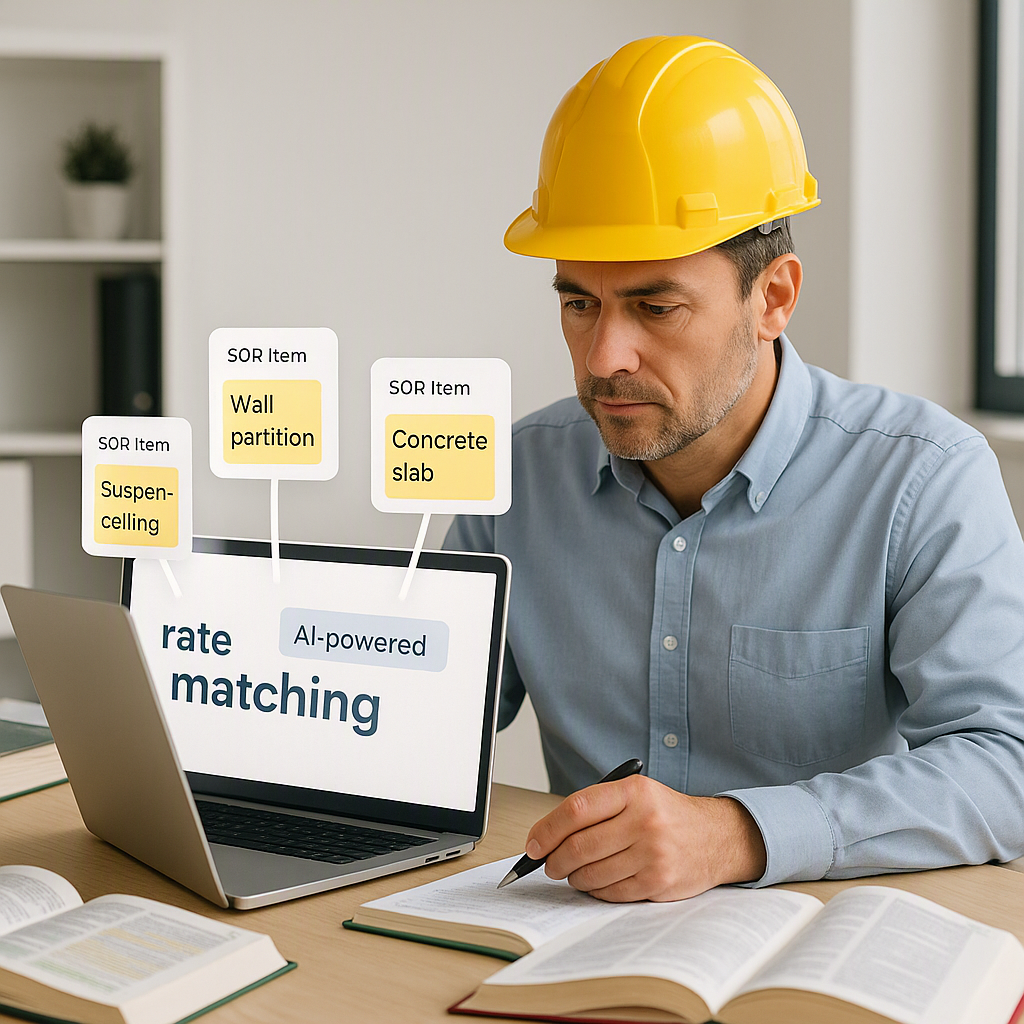
- Match rates (3-5 days)
- Compile estimate (2-3 days)
- Review and submit (1-2 days)
Total: 12-22 working days. In a market where tenders have 3-4 week submission windows, this leaves almost no time for value engineering, client queries, or estimate refinement.
Firms with structured estimation processes compress this to 5-8 days, leaving genuine time for the thinking that wins tenders.
The Rework Cost: Post-Award Surprises
When an estimate is compiled manually from multiple spreadsheets, sub quotes, and rate lookups, post-award surprises are inevitable:
- Scope gaps: Items that were in the tender documents but not in the estimate
- Double-counting: Items priced in both the measured works and the preliminaries
- Unit errors: Square metres where cubic metres were intended
- Escalation misses: Rates from six months ago applied to a project starting in twelve months
Each of these surprises has a cost. Scope gaps become variations (if you are lucky) or losses (if the contract does not allow them). Double-counting becomes free work. Unit errors become claims or losses.
A structured estimation platform catches these errors at the point of creation, not six months into construction.
What the Fix Looks Like
The solution is not working harder or hiring more estimators. It is changing the process:
- Drawing takeoff: From 12 days manual to 3 days automated
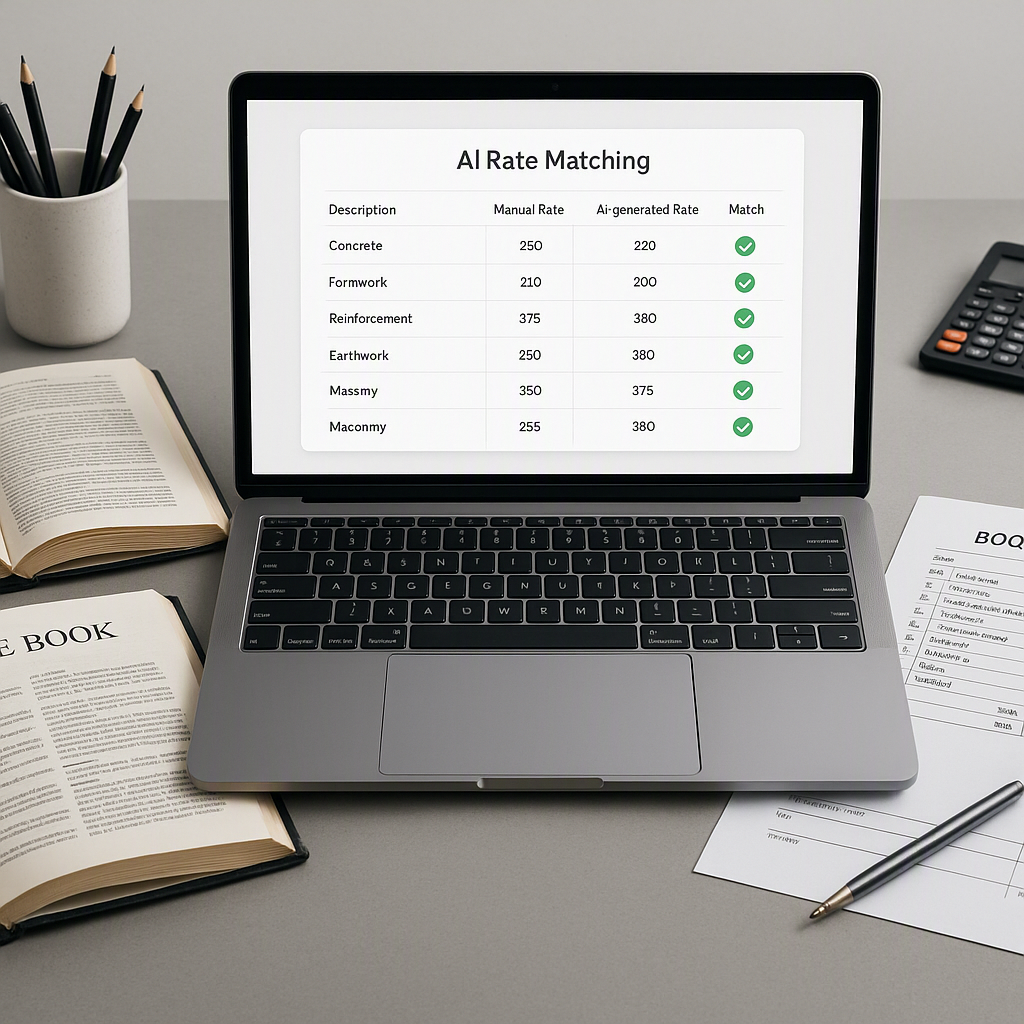
- Rate matching: From 5 days manual to 1 day with intelligent matching
- Sub bid levelling: From 3 days per package to 4 hours per package
- Report generation: From 2 days manual to 2 hours automated
- What-if scenarios: From "we do not have time" to "let us run three options"
The total process compresses from 22-30 days to 5-8 days. But more importantly, the quality improves because:
- Quantities are measured consistently
- Rates are matched systematically
- Errors are caught at entry, not at month six on site
- Scenarios are explored, not avoided
The ROI Calculation
For a firm doing $80M annual revenue with 40 tenders per year:
| Cost Category | Current (Manual) | With Platform | Saving |
|---|---|---|---|
| Direct estimation cost | $210,000 | $105,000 | $105,000 |
| Lost opportunity cost | $1,400,000 | $560,000 | $840,000 |
| Pricing error exposure | $1,500,000 | $450,000 | $1,050,000 |
| Total annual cost | $3,110,000 | $1,115,000 | $1,995,000 |
Even if these numbers are optimistic by half, the ROI on an estimation platform is measured in months, not years.
Five Steps to Start the Transition
- Measure your current state. Track estimation hours, tender volume, win rate, and post-award variances for one quarter.
- Identify your biggest bottleneck. Is it takeoff? Rate matching? Sub levelling? Report generation? Start there.
- Pilot on one project. Do not try to change everything at once. Estimate one real tender on the platform and compare the results.
- Train your team. Estimators need to trust the tool before they will use it. Let them verify results against their manual process.
- Scale gradually. Move from one project to all projects over two to three quarters.
Ready to see what estimation could look like? Start with a demo and bring a real project — we will estimate it together and show you the difference.
Ready to see EstimateNext in action?
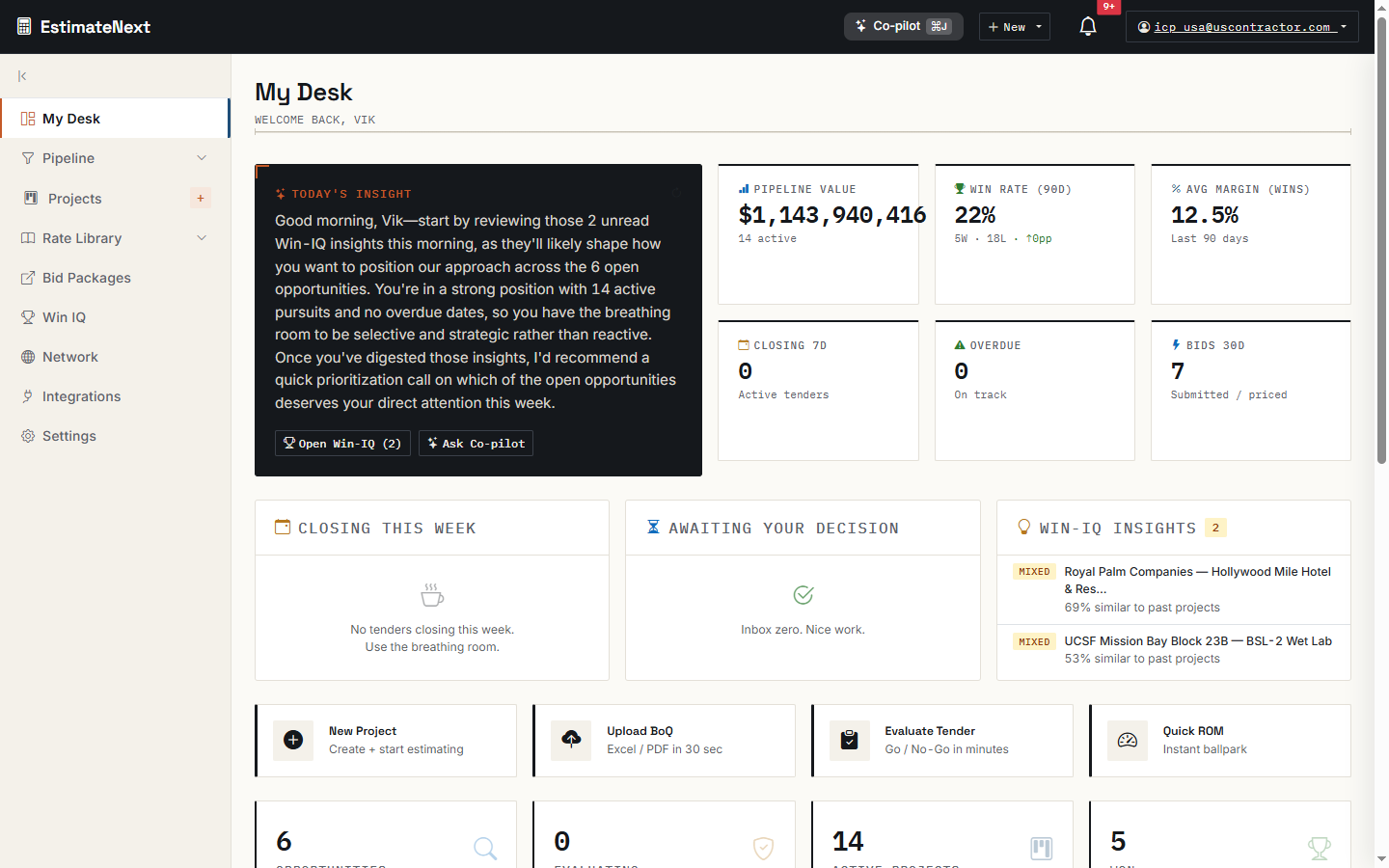
AI-powered preconstruction estimation platform — from BOQ upload to priced bid package in minutes. 78K+ SOR items, 7 specialist trade tools, bid intelligence, and a procurement network.
Get Started Free →