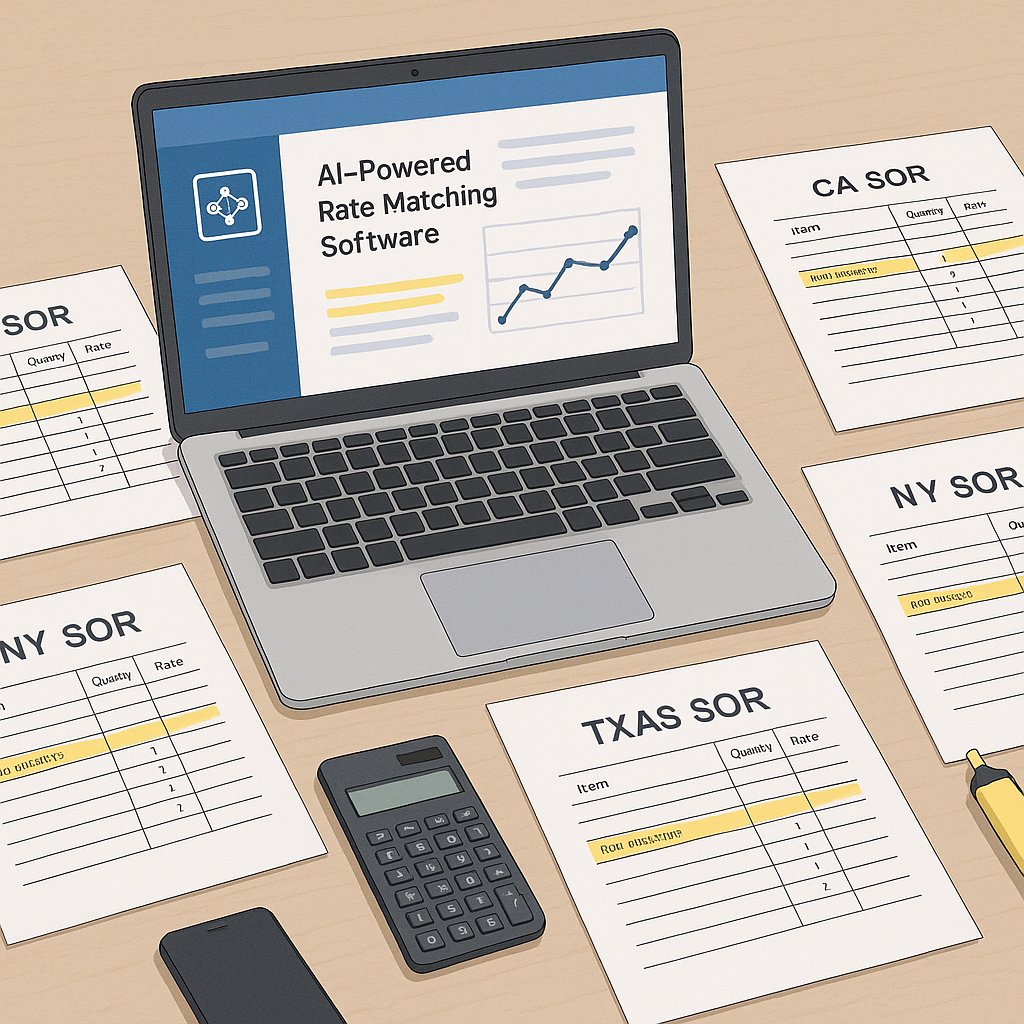
Why State PWD Rate Variations Matter
If you've ever worked on state-level public projects in India, you've likely encountered the frustration of dealing with PWD (Public Works Department) rate variations. Every state publishes its own Schedule of Rates (SOR), and while the format might look consistent on the surface, the devil is in the details. One state might price concrete by cubic meters, while another breaks it down by grade and reinforcement type. If you don't catch these nuances, you're setting yourself up for underbidding—or worse, overbidding.
Take Maharashtra and Bihar as an example. Maharashtra’s SOR is detailed to the point of including GST treatments in its item rates, while Bihar’s SOR requires you to manually apply tax adjustments. These differences are not just administrative headaches; they directly impact your cost analysis.
So, how do you tackle this? Let’s break it down.
Step 1: Start with the Right SOR Version
Every state updates its SOR annually, sometimes even mid-year through circulars. Using an outdated schedule can cost you the bid. Staying updated is crucial. Most PWDs publish their SORs online, but finding the latest version can be challenging. This is where tools like EstimateNext can help by consolidating SOR items across multiple catalogs and ensuring you’re working with the latest data.
Step 2: Account for Regional Cost Index Adjustments
Even within the same SOR, costs vary by location. CPWD rates, for instance, are adjusted by a Cost Index (CI) that accounts for regional factors like labor availability and transportation costs. States like Karnataka apply a similar methodology but often use their own indices, which can differ significantly from the CPWD baseline.
Illustrative example —
- Urban Area: Higher labor and material costs due to demand.
- Rural Area: Lower costs due to local sourcing and cheaper labor.
If your BOQ includes 1,000 m³ of concrete, the rate in an urban area might be significantly higher than in a rural area after applying the CI. Understanding these adjustments is critical for accurate estimation.
Step 3: Don’t Ignore Material and Labor Splits
State SORs often differ in how they break down rates into material, labor, and equipment components. For example:
- Tamil Nadu SOR: Includes detailed splits for labor and equipment, useful for subcontracting negotiations.
- Uttar Pradesh SOR: Provides consolidated rates without splits, requiring you to estimate labor costs separately.
Illustrative example — Pricing a road project in one state might show a higher labor component compared to another state. Without adjusting for these differences, you could easily underprice labor-intensive tasks, leading to project delays and disputes.
Tools like EstimateNext simplify this by offering full rate breakdowns for material, labor, and equipment. You can even apply inflation uplifts to individual components, ensuring your estimates reflect real-world costs.
Common Mistakes to Avoid
-
Blindly Trusting PDFs: Many estimators rely on static SOR PDFs. But these documents often lack context, like whether rates already include GST. Always cross-check.
-
Ignoring Circular Updates: States frequently issue rate revisions via circulars, especially for high-volatility items like cement and steel. Missing these can make your bid non-compliant.
-
Overgeneralizing Rates: Just because CPWD rates are widely used doesn’t mean they apply everywhere. Always verify whether a state project accepts CPWD rates or mandates its own SOR.
Final Thoughts
Understanding state PWD rate variations isn’t optional if you’re bidding on public projects. From staying updated on SOR revisions to accounting for cost indices, every detail counts. The good news? You don’t have to do it manually.
EstimateNext simplifies the process with AI-powered rate matching, cost breakdowns, and compliance checks. Ready to streamline your estimation process? Get started free →


