Stop Flipping Through Rate Books — AI Fixes the Grind
If you’ve ever spent hours flipping through a 2,000-page rate book, you know the pain of manual rate matching. It’s tedious, error-prone, and, frankly, a waste of time. And yet, most preconstruction teams are still doing it. Why? Because until recently, there wasn’t a better way.
But now there is. AI-powered preconstruction estimation tools like EstimateNext are changing the game. With semantic search capabilities that can scan 78,000+ Schedule of Rates (SOR) items in seconds, the days of manually hunting for the right rate are over. It’s fast, accurate, and scalable—whether you’re pricing a $1 million renovation or a $1 billion infrastructure project.
The Problem with Manual Rate Matching
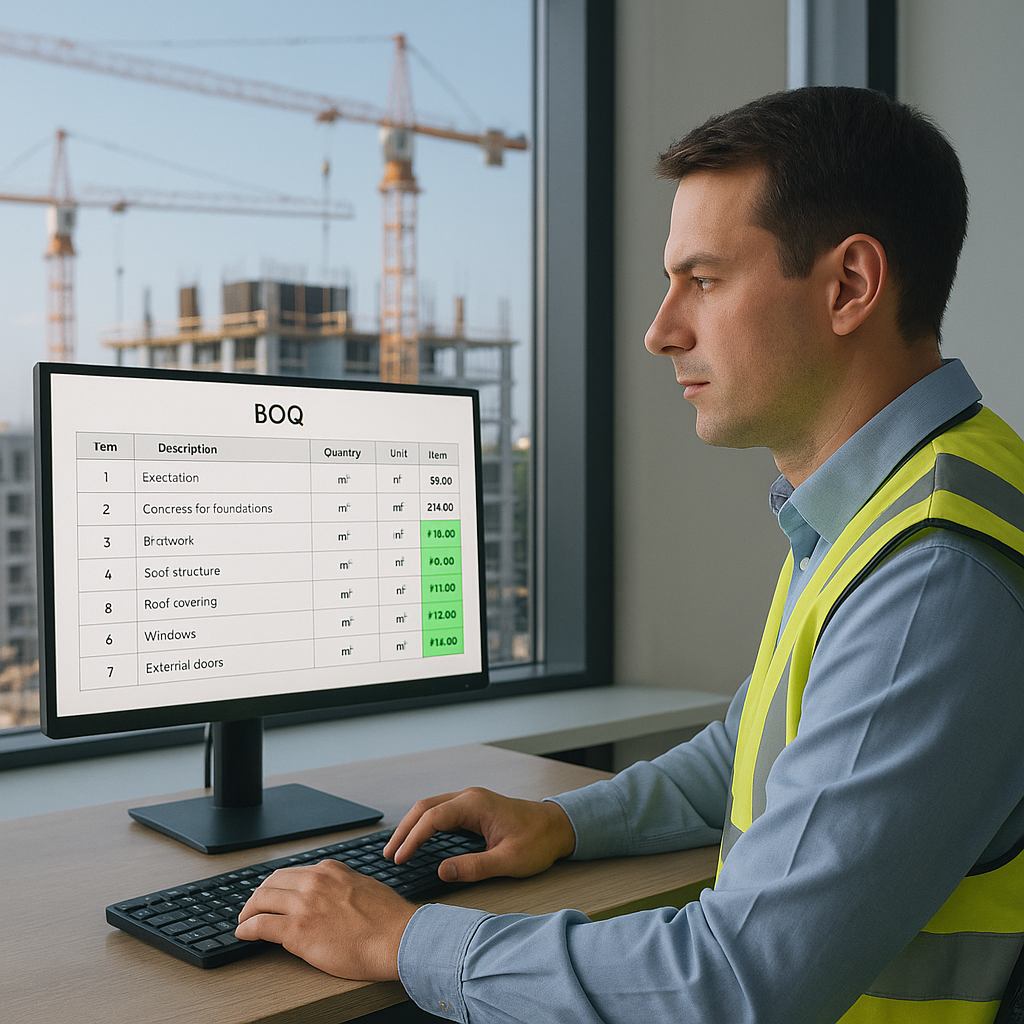
Let’s be real. Manually matching rates is a nightmare. Here’s a common scenario: your estimator gets handed the BOQ (Bill of Quantities) for a new project. It’s got hundreds of line items. For each item, they need to open up a rate book (say, RSMeans for U.S. GCs or CPWD DSR for Indian contractors), scan through hundreds of pages, and manually match the descriptions and quantities.
This process eats up hours—sometimes days—depending on the complexity of the BOQ. Worse, mistakes are almost guaranteed. Typos, misalignments, or overlooked items can cost thousands if not caught early. That’s why many estimators end up double- or triple-checking their work, adding even more time.
And let’s not forget the frustration. I’ve seen experienced estimators almost throw their rate books across the room after hours of dealing with ambiguous descriptions or outdated rates. Manual rate matching isn’t just inefficient—it’s demoralizing.
Real-World Example: A Drainage Contractor’s Struggle
Take the case of a mid-sized drainage contractor working on a $2 million municipal project. Their BOQ included over 300 line items. It took their team three full days to manually find and verify rates, only to discover later that they’d missed two critical line items, leading to a $50,000 underestimation. Mistakes like this are common and costly.
How AI Rate Matching Works
Here’s where AI comes in. Instead of flipping through pages, AI-powered tools like EstimateNext use semantic search to instantly find the best match for any line item. You upload your BOQ, and the system scans its database of 78,000+ SOR items across 135 catalogs. It even accounts for regional standards like CPWD DSR, CSI MasterFormat, or NRM2, depending on your market.
For example, let’s say you’re pricing a high-rise project and need to find the labor rate for installing pre-stressed concrete girders. With traditional methods, you’d spend hours manually flipping through rate books. With AI, you type in the item description or upload your BOQ, and the system returns the closest matches in seconds.
Actionable Steps:
- Upload Your BOQ: Most tools accept Excel or CSV formats, making it simple to get started.
- Customize Your Rates: If your rates are unique, upload your catalogs for a tailored experience.
- Refine Matches: Use feedback tools to improve the AI’s accuracy over time.
Real-Time Comparison: Manual vs. AI Rate Matching
| Feature | Manual Process | AI-Powered Tools |
|---|---|---|
| Time Required | 12-30 hours | Seconds to minutes |
| Error Rate | High (10-20%) | Low (<2%) |
| Scalability | Limited | High |
| Team Morale | Low (frustrating) | High (focus on strategy) |
What if your rates are custom or project-specific? No problem. You can upload your own rate catalogs, and the AI integrates them seamlessly for future use. The system even improves with feedback, getting smarter and more accurate with every project you complete.
Real ROI: Time Saved, Accuracy Gained
Here’s the math: manual rate matching takes an average of 12 hours per estimate. AI-powered tools cut that to seconds. For a general contractor (GC) with 5-8 GMP pursuits per year, that’s 60-96 hours saved annually. At an average estimator rate of $130/hour, that’s $7,800-$12,480 saved—just on rate matching alone. And that doesn’t even account for the improved accuracy, which can prevent costly errors down the line.
ROI Case Study: MEP Subcontractor
For MEP subcontractors who handle 30-60 bid packages a year, the savings are even more dramatic. By cutting a 3-day rate-matching process down to 4 hours, you’re not just saving time—you’re freeing up capacity to respond to more bids. That could mean 4-8 additional wins per year at $200K average revenue per project. Do the math: that’s $800K-$1.6M in incremental revenue.
Hidden Benefits:
- Faster Client Approvals: With more accurate estimates, clients are less likely to question your rates.
- Reduced Burnout: Estimators can focus on high-value tasks, improving job satisfaction and retention.
- Competitive Edge: Faster turnaround times mean you can bid on more projects, increasing your chances of winning.
The Obvious Objection: “But AI Can’t Think Like an Estimator”
I hear this a lot. “Sure, AI is fast, but it doesn’t understand the nuances of construction.” That’s true—to a point. AI isn’t here to replace your expertise; it’s here to amplify it. You’re still the one making judgment calls, negotiating with subs, and deciding on markup. The AI just handles the grunt work—like rate matching, takeoffs, and what-if recalculations.
Think of it this way: would you rather have your senior estimators spending their time poring over rate books, or using their expertise to refine the bid strategy? AI gives you back those hours, so your team can focus on the work that really matters.
Call to Action
If you’re tired of wasting hours on manual rate matching, EstimateNext can help. Upload your BOQ and get a priced bid package in minutes. Start Free →


