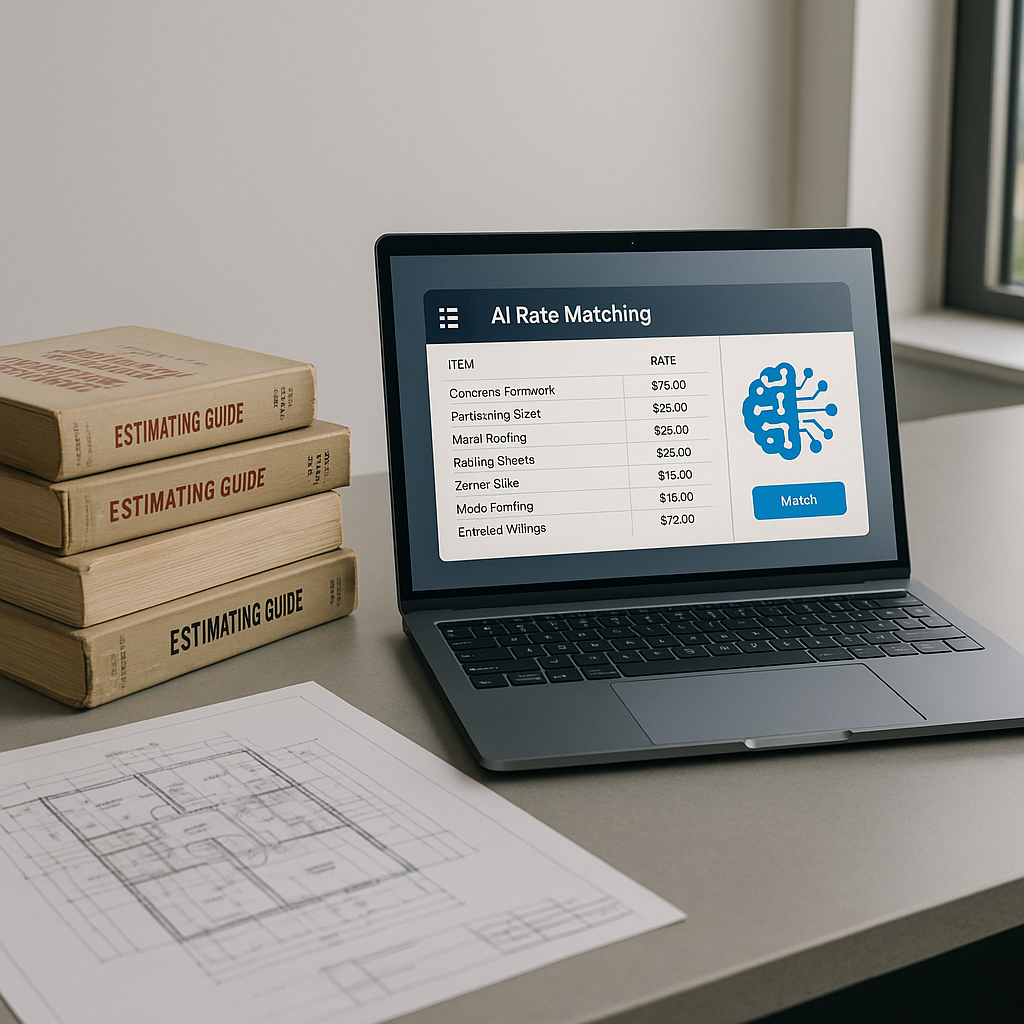
The Brutal Reality of Rate Matching
If you’ve ever priced a construction project, you know the pain. Rate matching is slow, manual, and full of potential errors. Flipping through a 2,000-page CPWD DSR or RSMeans catalog to find the right labor and material rates feels like being stuck in the 1990s. No wonder estimators spend an average of 12 hours per estimate just on rate lookup.
What’s worse? Even after all that effort, mistakes happen. A missed line item or outdated rate can snowball into profit loss. It’s not just frustrating—it’s costly.
The Scale of the Problem
Let’s put this into perspective. A 2022 survey of 500 estimators found that 65% reported losing contracts due to errors in rate matching. Even minor mistakes—like using a labor rate from last year’s catalog—can result in underpricing that eats into profit margins or overpricing that loses you bids.
Take the case of a regional contractor in Texas who underestimated equipment rates for a highway extension project. The error cost them $125,000 in profit due to unexpected equipment rental fees. These issues aren’t isolated; they’re baked into manual processes that rely on human effort and outdated workflows.
Enter AI-Powered Rate Matching
AI tools like EstimateNext change the game. Semantic search across 78,000+ SOR items finds matches instantly. Need the labor rate for installing pre-stressed concrete girders? Type it in, and you’ve got it. No flipping through PDFs. No second-guessing your catalog.
Let’s get specific. A mid-sized general contractor working on a $1B rail project used EstimateNext to match rates for concrete columns, beams, and rail decks. What used to take 12 hours was done in seconds. The result? More time to focus on real value—negotiating subcontractor bids and refining project margins.
Actionable Steps to Implement AI Rate Matching
- Start Small: Begin by using AI tools for a specific category, such as concrete or HVAC rates. This allows your team to get comfortable with the technology.
- Upload Custom Catalogs: If your projects use proprietary materials, ensure your AI tool supports custom catalogs. This ensures accurate matches for unique items.
- Train Your Team: Most AI platforms require minimal training, but dedicating 2-3 hours to onboarding ensures smoother adoption.
- Monitor and Adjust: Use the AI’s feedback loop to correct errors and refine the system. Over time, this improves accuracy.
Why Speed Isn’t the Only Benefit
Accuracy. That’s the real kicker. AI-powered rate matching doesn’t just save you time. It reduces errors by up to 99% when paired with human oversight. The system learns from corrections and gets smarter with each project. By the third bid, most users report significant improvements.
Here’s a real-world example: a subcontractor pricing an HVAC bid saved $3,400 in labor costs by catching an outdated rate flagged by the AI. Manual methods never would’ve caught it.
Comparison: Manual vs AI Rate Matching
| Feature | Manual Methods | AI-Powered Rate Matching |
|---|---|---|
| Speed | 12+ hours per estimate | Seconds per estimate |
| Error Rate | High (up to 15%) | Low (less than 1%) |
| Customization | Limited | Supports custom catalogs |
| Learning Curve | None | 1-2 weeks |
| ROI | Neutral | 40X-100X |
Actionable Steps to Improve Accuracy
- Combine AI With Manual Oversight: AI tools are powerful, but pairing them with expert review ensures even edge cases are handled.
- Use Confidence Scoring: Many AI tools provide confidence scores for matches. Focus on high-confidence items and manually review low-confidence ones.
- Regular Updates: Ensure your catalogs are up-to-date. AI can’t fix outdated inputs.
What About Custom Rates?
You might be thinking, “My projects use proprietary materials. Can AI handle that?” Absolutely. Platforms like EstimateNext let you upload custom catalogs. The AI integrates them seamlessly and suggests matches for future projects.
This isn’t just theoretical. A fit-out specialist in Dubai used custom FF&E rates to price a Cat-B office renovation in under 4 hours. The AI matched unique finishes like imported Italian marble and high-end fixtures.
How to Leverage Custom Rate Matching
- Document Proprietary Materials: Maintain a digital catalog of unique materials and labor rates for your projects.
- Integrate With AI: Upload these custom catalogs into your AI tool for seamless rate matching.
- Validate Matches: Use AI-generated matches as a starting point and verify accuracy manually.
The ROI Math
Let’s break it down.
- GC Directors: Save 40 hours per estimate x $130/hr = $5,200 saved per bid. That’s a 52X ROI vs a $99/mo subscription.
- MEP Subcontractors: Respond to 50% more bids, winning 4-8 additional contracts/year at $200K avg. That’s $800K-$1.6M incremental revenue.
- India Contractors: 200+ hours saved/year pricing CPWD tenders at INR 1,999/mo. It’s 100X cheaper than CostX.
Real-Life Case Studies
- General Contractor (US): A GC in California saved $32,000 in labor costs on a hospital expansion by catching outdated rates for skilled trades.
- HVAC Subcontractor (India): Using AI, an HVAC subcontractor priced 60% more tenders in a year, winning 8 additional contracts worth INR 12 crore.
- Fit-Out Contractor (Dubai): Reduced bidding time for luxury renovations by 75%, achieving 20% higher accuracy in estimates.
Skeptical? Let’s Address That
You might object: “AI can’t think like an estimator.” True. AI doesn’t replace your expertise; it amplifies it. You’re still the one making judgment calls, negotiating with subs, and deciding on markup. The AI just handles the grunt work—rate matching, takeoffs, and recalculations.
And for those worried about reliability: AI isn’t perfect, but it includes confidence scoring and manual override features. You’re always in control.
Why AI Won’t Replace Human Estimators
- Judgment Calls: AI handles data; you handle decision-making.
- Subcontractor Relationships: Negotiating with subcontractors requires human expertise.
- Markup Strategy: AI doesn’t know your margin goals—it’s a tool, not a strategist.
Get Started
Rate matching doesn’t have to be a headache. If you’re tired of wasting hours flipping through rate books—or losing money to outdated rates—AI can help. Get started free →


