The Problem: Manual Takeoffs Are Killing Your Margins
Let’s start with a hard truth: manual drawing takeoffs waste an obscene amount of time. On average, it takes two estimators working full days to complete a single bid — 40 hours gone before you’ve priced a thing. And let’s not pretend these hours are cheap. If your estimator costs $130/hour, you’re burning $5,200 every time you chase a project.
The worst part? Much of that time isn’t even spent on high-value tasks. It’s tracing drawings, double-checking quantities, and redoing work after architect revisions. These bottlenecks don’t just frustrate your team; they kill your ability to bid competitively.
Take a real-world example: A regional drywall contractor recently shared their pain. On a mixed-use project with over 300,000 square feet of drywall, their estimators spent 60 hours manually counting and cross-referencing door openings, linear feet of walls, and square footage areas. By the time they submitted their bid, they were already behind competitors using automated tools — and they lost the project.
The Fix: Vision AI Cuts Takeoffs to 10 Minutes
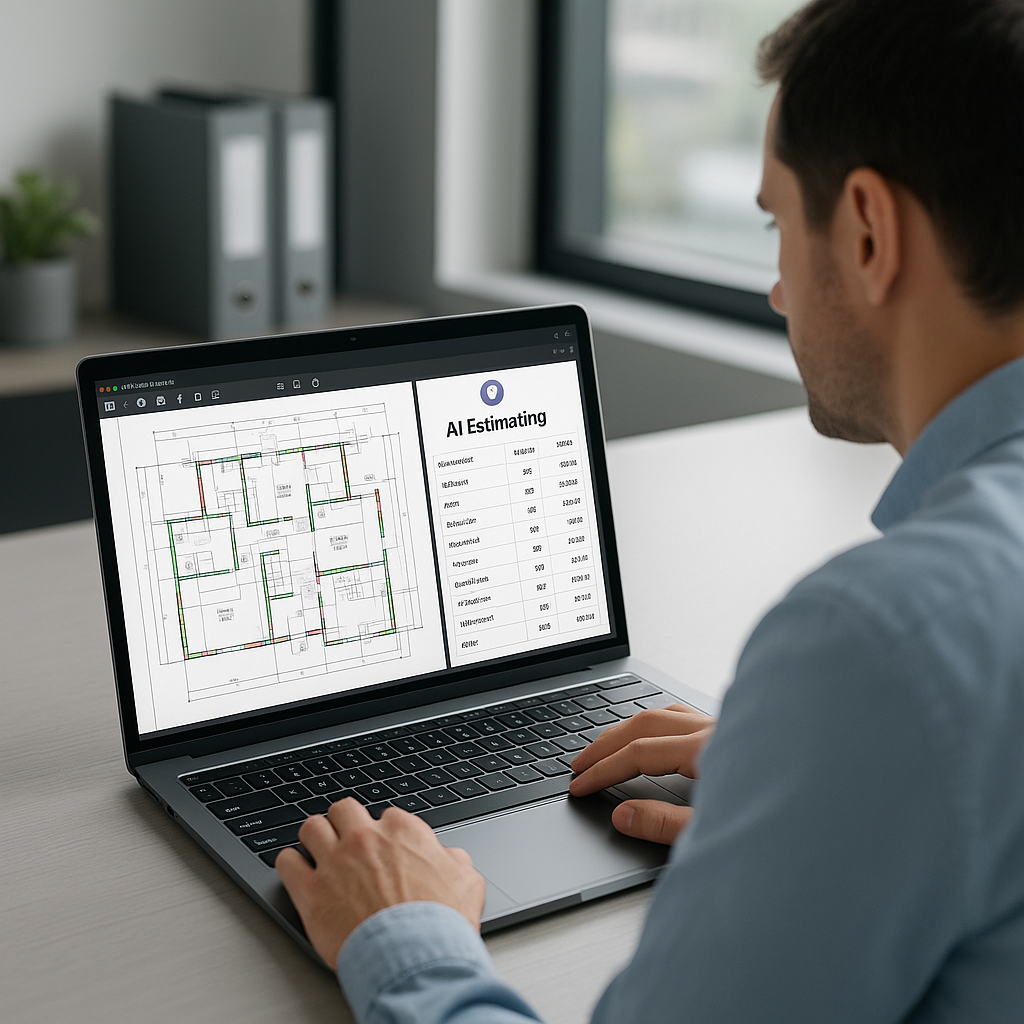
This is where AI-powered tools like EstimateNext flip the script. Their Vision AI extracts quantities directly from PDF drawings in just 10 minutes — no tracing, no guesswork. You upload the file, calibrate the scale, and let the software do the heavy lifting.
Here’s a real-world example: A mid-sized general contractor saved 120 hours on a high-rise bid by automating takeoffs with Vision AI. That’s two full weeks of labor they didn’t have to pay for, all while meeting tight bid deadlines. The team described it as “like hiring a full-time estimator without the overhead.”
What Vision AI Can Do
Vision AI doesn’t just speed up takeoffs — it makes them smarter. Here’s what it can handle:
- Room Areas: Instantly calculates square footage from floor plans. Whether it’s flooring, tiling, or carpet, you get accurate measurements in seconds.
- Wall Lengths: Extracts linear dimensions for drywall, paint, or cladding. This eliminates common errors caused by manual tracing.
- Door and Window Counts: Identifies openings for hardware schedules, saving hours of manual counting.
- Revision Comparison: Highlights changes between drawing sets, so you can avoid redoing entire takeoffs when architects make updates.
Case Study: Flooring Contractor Gains a Competitive Edge
A flooring subcontractor bidding on a large hospital project used Vision AI to automate their takeoffs. They saved 18 hours of manual work, identified scope discrepancies early, and submitted their bid three days ahead of the deadline. The result? They won the project — not just because of their competitive pricing but also because their quick turnaround impressed the general contractor.
You Might Be Thinking: “AI Can’t Think Like an Estimator”
I hear this all the time. Sure, AI doesn’t have the nuanced judgment of a seasoned estimator. It won’t catch discrepancies in scope or flag risky low-margin items. But that’s not the point. AI is a tool — it handles grunt work so your team can focus on what matters.
Imagine freeing up those 36 hours per bid. You could:
- Bid on more projects: Instead of spending weeks on one bid, you could price out two or three.
- Negotiate better with subs: With more time, you can analyze subcontractor proposals and find cost-saving opportunities.
- Analyze risks: Use your expertise to identify potential problem areas, rather than wasting time on repetitive tasks.
Example: Doubling Productivity Without Adding Staff
A small electrical contractor with two estimators adopted AI-powered takeoff tools. Before using AI, they averaged six bids per month. After implementing Vision AI, they doubled their bid volume to 12 projects per month — without hiring additional staff. This led to a 30% increase in revenue over 12 months.
The ROI: Brutal Math That Pays Off
Let’s break it down:
- Time Saved: 40 hours per bid reduced to 10 minutes.
- Labor Costs Avoided: $5,200 per estimate (based on $130/hour).
- Annual Impact: If your team prices 8 bids per year, that’s $41,600 saved — or 52X ROI on a $100/month tool.
What Does This Mean for Subcontractors?
For MEP subs, faster takeoffs mean responding to more quotes. More quotes equal more wins, and more wins mean serious revenue gains. One HVAC subcontractor reported 50% more bids submitted after adopting AI tools. Even at a conservative 20% win rate, that’s 4-8 extra projects per year.
Let’s say each project adds $100,000 in revenue. That’s an additional $400,000 to $800,000 annually — all because they automated takeoffs.
Comparison Table: Manual vs. AI Takeoffs
| Metric | Manual Takeoffs | AI-Powered Takeoffs |
|---|---|---|
| Average Time Per Bid | 40 hours | 10 minutes |
| Labor Cost Per Bid | $5,200 | $21.67 (based on $130/hr) |
| Accuracy | Prone to human error | High, with confidence scoring |
| Scalability | Limited by staff capacity | Unlimited bids per month |
Edge Cases: What If Your Drawings Are Messy?
Let’s not pretend every drawing set is perfect. PDFs with low-resolution scans or inconsistent line weights can trip up even the smartest AI. That’s why Vision AI includes confidence scoring and manual override tools. If the software flags an area as “low confidence,” you can remeasure it directly within the platform.
This hybrid approach — AI first, human review second — ensures accuracy without sacrificing speed.
The Takeaway
Manual takeoffs are an expensive bottleneck you don’t need. AI-powered tools like EstimateNext cut that time from 40 hours to 10 minutes, save thousands per bid, and free up your team for higher-value tasks. If you’re still tracing walls by hand, you’re leaving money on the table.


