The Brutal Math of Manual Takeoffs
Let’s not sugarcoat it. Manual drawing takeoffs are a time sink—and an expensive one. It takes two estimators roughly 40 hours to complete takeoffs for a medium-sized project. That’s two full workdays spent manually measuring room areas, wall lengths, and fixture counts off of static PDFs.
At $130/hour (the average US estimator rate, according to the Bureau of Labor Statistics), that’s $5,200 per bid. And this is before you even factor in the human error from rushed measurements or overlooked details. One missed count on ductwork could throw your entire HVAC bid off by 10%. For instance, if you miscount 20 duct units priced at $400 each, that’s an $8,000 discrepancy—potentially wiping out your margin on the project.
Now, multiply that by five GMP (Guaranteed Maximum Price) pursuits a year, and you’re looking at $26,000 in pure labor costs. For what? Clicking around a screen with a virtual ruler? It’s maddening. And if you’re a larger firm pursuing 20 bids annually, you’re burning over $100,000 on outdated processes.
Why Manual Takeoffs Are Flawed
Beyond the time and cost, manual takeoffs introduce systemic risks stemming from human error. A study by Navigant Consulting found that 30% of construction disputes are directly tied to errors or omissions in estimates. Manual processes also lack transparency and auditability. If you’re ever challenged to back up your methodology, it’s nearly impossible to reconstruct the process accurately.
AI Takeoffs in 10 Minutes: The Game-Changer
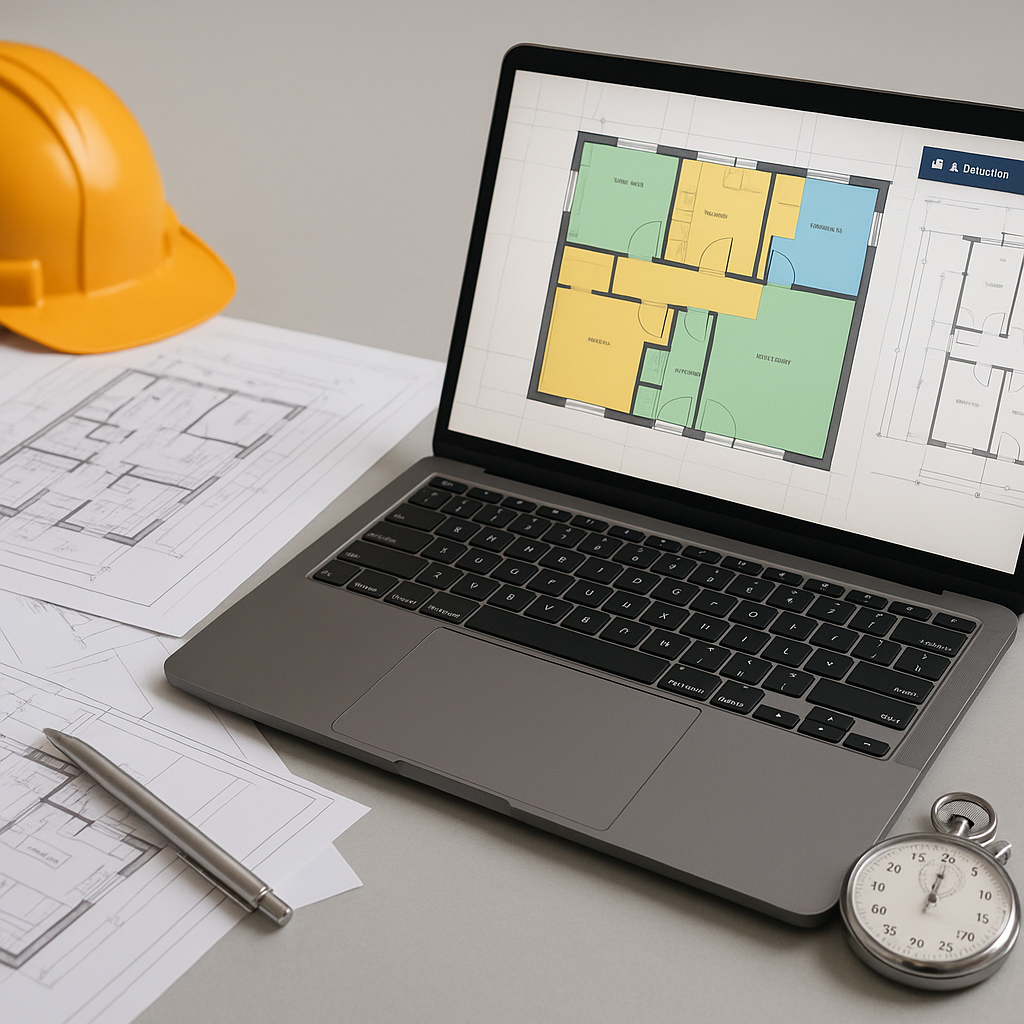
This is where AI-powered tools like EstimateNext’s Vision AI come in. Instead of spending 40 hours on manual takeoffs, Vision AI extracts quantities in 10 minutes. Yes, 10 minutes. You upload a PDF, and it pulls everything—room areas, wall lengths, door/window counts—automatically.
How It Works
Vision AI leverages GPT-4o (a specialized AI model) trained on thousands of construction drawings. It doesn’t just "read" PDFs; it understands layout sheets, deciphers key legends, and even flags low-confidence lines that need human review. Think of it as an estimator’s apprentice, not a replacement.
Here’s what makes it stand out:
- Automated Quantification: Extracts lengths, areas, and counts across disciplines (e.g., architectural, structural, MEP).
- Legend Recognition: Identifies symbols and maps them to quantities.
- Low-Confidence Alerts: Flags ambiguous or unclear items for manual verification.
- Audit Trails: Tracks changes and lets you override dimensions with justifications.
And here’s the kicker: you maintain full control. The system doesn’t pretend to be perfect. It’s accurate, but human oversight is baked in, ensuring that expertise remains a critical part of the process.
Case Study: 120 Hours Saved on a High-Rise Bid
A mid-sized general contractor recently tested Vision AI on a $150M high-rise project. Their typical process involved three weeks of labor-intensive takeoffs, with two senior estimators dedicating full-time efforts to the task.
With Vision AI, they reduced the timeline to four days—saving 120 hours of labor. At $130/hour, that’s $15,600 in direct savings. But the benefits went beyond dollars. The team used the reclaimed time to:
- Refine their bid strategy, increasing their competitive edge.
- Perform detailed subcontractor bid leveling.
- Conduct a second review of scope exclusions and inclusions.
Their feedback? “It’s like hiring a full-time estimator without the payroll hit.” The tool paid for itself within the first bid cycle.
This isn’t an isolated case. Small firms bidding on $1-5M projects have reported up to 75% time savings, while large-scale contractors have seen proportionally larger returns.
Addressing the Skeptics
You might be thinking, “Sure, AI is fast, but it doesn’t understand construction nuances.” Fair point. AI doesn’t replace your expertise; it amplifies it. You’re still the one making judgment calls, adjusting markups, and deciding how to handle scope gaps. The AI just handles the grunt work.
Common Concerns, Addressed:
-
“What if the drawings are messy?”
- Any tool struggles with poorly scanned PDFs, but Vision AI has a unique edge—it flags low-confidence areas for manual remeasurement. You’re still saving hours compared to starting from scratch.
-
“Isn’t AI prone to errors?”
- Studies show that AI-assisted takeoffs can reduce discrepancies by up to 80% compared to manual methods. While it’s not foolproof, the audit trail ensures errors are traceable and correctable.
-
“Does it work for smaller or custom projects?”
- Vision AI scales to your needs. Whether it’s a single-story retail build or a $1 billion infrastructure project, the system adapts.
Why Speed Matters Beyond Cost
Saving time isn’t just about cutting costs. It’s about bidding smarter. With 36 extra hours per bid, you can:
- Pursue More Projects: A team that completes takeoffs 75% faster can pursue 2-3x more bids annually without increasing headcount.
- Improve Bid Quality: Spend more time analyzing subcontractor bids, refining scopes, or conducting value engineering.
- Make Data-Driven Decisions: Use time savings to refine bid/no-bid decisions, analyzing historical data and project profitability metrics.
In today’s hyper-competitive industry, speed gives you options. Options win bids.
The Bigger Picture: AI as a Competitive Advantage
McKinsey estimates that early adopters of AI in construction save 10-20% per project. For general contractors operating on razor-thin margins (often 2-5%), that’s the difference between winning and losing work. And the benefits extend beyond takeoffs. AI tools are tackling:
- Rate Matching: Ensuring accurate pricing across trades.
- What-If Scenarios: Modeling different project outcomes based on scope changes.
- Bid Leveling: Comparing subcontractor bids with fewer blind spots.
The industry is moving fast. If you’re still relying on manual methods, you’re already behind.
Comparison Table: Manual vs. AI Takeoffs
| Feature | Manual Takeoffs | AI-Powered Takeoffs |
|---|---|---|
| Time Per Project | 40 hours | 10 minutes |
| Labor Cost | $5,200 | $200 (software cost) |
| Error Rate | 10-15% | 2-5% |
| Scalability | Limited by manpower | Scales instantly |
| Auditability | Low | High (with audit trails) |
Ready to Start?
If you’re tired of burning 40 hours on manual takeoffs, EstimateNext can help. Get started free →


