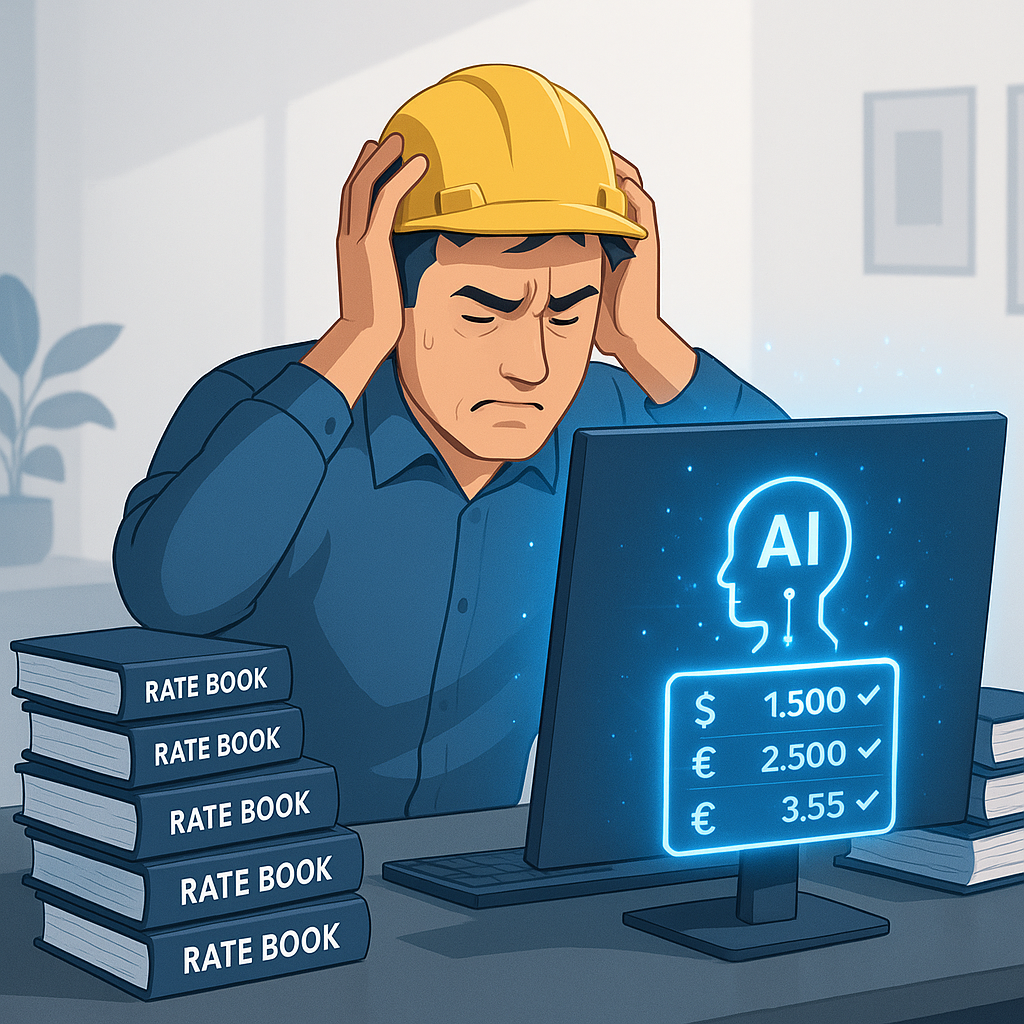
The Hidden Time Sink in Construction Estimation
Estimators don’t talk about it much, but flipping through rate books is a productivity killer. Whether you’re working with RSMeans, CPWD DSR catalogs, or your own custom rate sheets, you know the drill: endless scrolling, manual lookups, and hoping you didn’t miss something crucial. This seemingly small inefficiency adds up quickly and can cost you more than just time—it can cost you bids.
Let me paint a picture. A mid-sized GC (general contractor) team tackling a $1 billion rail project spent 12 hours just matching rates for items like pre-stressed concrete girders and rail ties. EstimateNext’s blog highlights this exact scenario, showing how much time AI-powered tools save. Imagine typing “labor rate for installing rail girders” and getting the match instantly. That’s precisely what semantic search does. Instead of wasting hours flipping through pages, you get the data you need in seconds.
Why Manual Rate Matching Costs You Bids
Here’s the brutal math. If your team spends 12 hours per estimate on rate matching, that’s 60 hours a week if you’re chasing five bids. Multiply that by an average estimator cost of $130/hour, and you’re burning $7,800 weekly just to look up rates. Over the course of a year, that’s a staggering $405,600 in labor costs spent on a task that could—and should—be automated.
But the real cost isn’t just financial—it’s opportunity. Every hour spent manually matching rates is an hour you’re not refining your bid strategy, negotiating with subcontractors, or evaluating tender documents. Worse, if your competitors are using AI tools to streamline their pricing process, they’re gaining a clear advantage. With more time to focus on high-value activities like margin optimization, value engineering, and better bid/no-bid decisions, they’re positioning themselves as smarter, faster, and more competitive bidders.
Case in Point: Losing Competitive Edge
For example, consider two contractors bidding on the same $20 million office building project. Contractor A uses manual rate matching and spends 20 hours on itemized lookups. Contractor B uses AI to complete the same task in just 2 hours. Contractor B now has 18 extra hours to refine their bid package, negotiate with suppliers for better pricing, or explore alternative construction methods. Who do you think has the better chance of winning the bid? Exactly.
How AI Fixes the Problem
AI-powered rate matching tools like EstimateNext take all the grunt work out of rate lookups. Here’s how they work:
1. Semantic Search Across Catalogs
Instead of manually flipping through catalogs, you type what you need, like "installation rate for HVAC ducts." The system returns matches in seconds from its database of 78,000+ rates, including industry standards like RSMeans and CPWD DSR catalogs. This eliminates hours of manual searching and reduces human error.
2. Custom Rates? No Problem
Got project-specific or regional rates? No problem. AI tools allow you to upload custom rate sheets, which are then integrated into the system for future use. By the third project, most users report significant accuracy improvements as the AI learns your preferences and adjusts its recommendations accordingly.
3. Audit Trail for Transparency
One of the biggest concerns with AI tools is transparency. How did the system arrive at a specific rate? AI tools like EstimateNext address this by providing a detailed audit trail for every rate matched. Each result comes with a breakdown of material, labor, and equipment costs, so you know exactly where the numbers come from.
4. Integration with Other Tools
Many AI rate-matching platforms integrate seamlessly with your existing preconstruction software. Whether you’re using Procore, Bluebeam, or Autodesk, the integration ensures that your workflow remains smooth and uninterrupted.
Real-World Examples
AI in construction estimation isn’t just theoretical—it’s delivering tangible results for contractors worldwide. Let’s look at a few real-world examples:
A Major Contractor’s Rail Bridge Project
On a large rail bridge project, a major national general contractor’s team needed to pull rates for rail ties and structural steel from state DOT-approved catalogs. Manually, this process would have taken days, as engineers cross-referenced rates from multiple sources. By using AI-powered rate matching, this task was completed in under 30 minutes. The time savings allowed the team to focus on refining other parts of their proposal, ultimately leading to a more competitive bid.
Mid-Sized GC Saves 36 Hours
A mid-sized general contractor bidding on a high-rise project saved 36 hours by automating rate matching and takeoffs. That’s nearly a full workweek freed up. The extra time was used to improve their bid presentation and negotiate better pricing with suppliers, which directly contributed to winning the project.
Small Contractor Competes with Big Players
A small contractor in Chicago struggled to match rates as quickly as larger competitors with dedicated preconstruction teams. By adopting AI tools, they leveled the playing field. Automating rate matching gave them the speed and accuracy they needed to compete effectively—even on multi-million-dollar projects.
The Obvious Objection: “But AI Isn’t Perfect”
You might be thinking, “Sure, AI is fast, but it won’t understand the nuances of my projects.” And you’re right—to a degree. AI isn’t here to replace your judgment; it’s here to handle the repetitive, time-consuming tasks that don’t require your expertise. You’re still the one deciding on markup percentages, negotiating with subs, and making the final calls on bid strategy. AI just ensures you’re starting with accurate, reliable data faster.
Addressing Common Concerns
- “What if the AI suggests incorrect rates?” The system learns from your feedback. If a rate doesn’t look right, you can flag it, and the AI will adjust its recommendations over time.
- “What about regional variations?” Advanced AI tools account for regional cost differences by pulling data from localized rate sheets or allowing you to upload your own.
Comparison Table: Manual vs. AI Rate Matching
| Feature | Manual Process | AI-Powered Process |
|---|---|---|
| Time to Match Rates | 10–12 hours per estimate | Under 30 minutes |
| Accuracy | Prone to human error | Consistently high with feedback |
| Handling Custom Rates | Manual entry required each time | Seamless integration |
| Cost | $130/hour per estimator | $39/month subscription |
| Opportunity Cost | High – Limited time for strategy | Low – Focus on high-value tasks |
The Bottom Line
Every estimator knows what it feels like to lose time to manual processes. AI-powered rate matching isn’t just faster; it’s smarter. It frees your team to focus on strategy, not spreadsheet drudgery. By automating repetitive tasks, you gain the competitive edge needed to win more bids and grow your business.
If you’re tired of wasting hours on rate lookups, EstimateNext can help. Get started free →.


