Infrastructure Demand Is Exploding — But Budgets Aren’t
The U.S. infrastructure backlog is staggering. According to the American Society of Civil Engineers, we need $2.59 trillion just to bring our infrastructure up to par by 2029. That’s roads, bridges, water systems — the whole nine yards. But here’s the kicker: public funding covers only about half of that. The rest? It’s up to private contractors, developers, and innovative financing models like public-private partnerships (PPPs).
This budget gap isn’t just a government problem. It trickles down to general contractors (GCs) bidding on these projects. Margins shrink, risk skyrockets, and the competition gets brutal. A senior executive at one of the largest infrastructure contractors recently highlighted this exact issue, pointing out how infrastructure demand in the U.S. is far outpacing what budgets can realistically handle. The key message? Efficiency is no longer optional — it’s survival.
But where do you even start fixing this?
The Bid Crunch: Why Traditional Estimation Fails
When margins are tight, every dollar in your bid matters. Overestimate, and you lose the job. Underestimate, and you bleed cash once construction starts. Most GCs rely on a patchwork of Excel spreadsheets, RSMeans PDFs, and manual drawing takeoffs. It’s slow, error-prone, and frankly outdated.
Take manual quantity takeoffs, for example. For a $500M rail project, estimating teams often spend 40+ hours just measuring track lengths, station footprints, and utility lines from PDF drawings. That’s a week of work — per project — before you even touch rate analysis or bid packaging. One wrong number in that process can throw your entire bid off.
Here’s the thing: time isn’t just money in preconstruction. It’s opportunity. The longer you take to submit a bid, the fewer projects you can pursue. And if you’re spending all your time on busywork, you’re not focusing on strategy, risk, or value engineering — the areas that actually win bids.
Actionable Steps to Improve Traditional Estimation
- Audit Your Estimation Workflow: Break down the time spent on each stage of your estimation process. Identify bottlenecks like manual takeoffs or outdated rate lookups.
- Invest in Training: Ensure your team is well-versed in modern tools and techniques. Even something as simple as mastering pivot tables in Excel can speed up workflows.
- Pilot a Digital Tool: Start small by testing an AI-powered tool on one project. Measure the time and accuracy improvements before scaling across your team.
The AI Game-Changer: Faster, Smarter Estimation
This is where AI-powered tools like EstimateNext come in. Let’s talk specifics. Their Vision AI feature slashes takeoff time from 40 hours to 10 minutes. Yes, minutes. Here’s how:
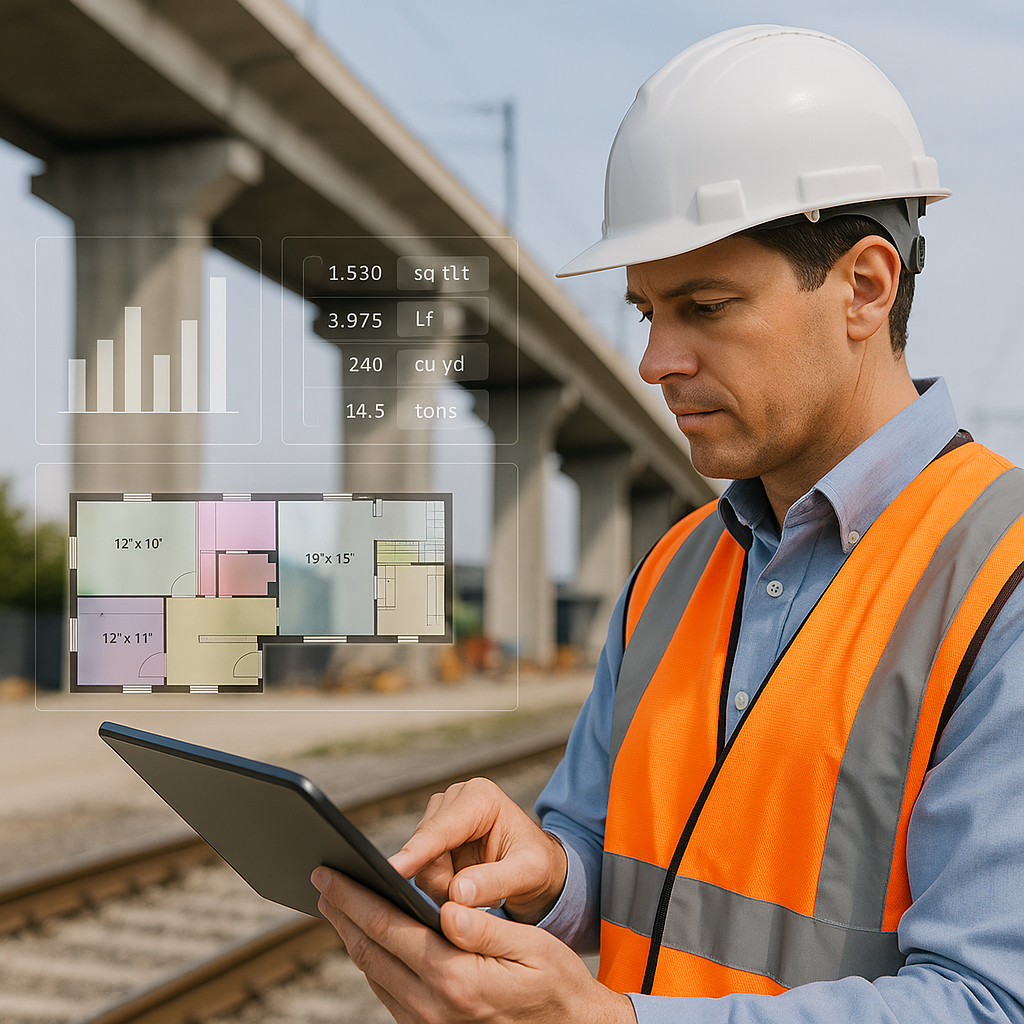
- Automatic Quantity Takeoffs: Upload your PDF drawings, and the AI extracts quantities instantly — room areas, wall lengths, door/window counts, you name it. No more manual tracing.
- Error Reduction: Low-confidence lines are flagged for review, so you can focus on validating critical quantities instead of remeasuring everything.
- Revisions Made Easy: Upload updated drawings, and it highlights what’s changed. No more guesswork.
Take a large civil contractor, for example. They used AI tools to estimate cut/fill earthwork volumes for a roughly $500M regional floodwater project. Instead of weeks of manual calculations, they had accurate numbers in days — freeing their team to focus on optimizing pavement slab thickness for flood-prone areas. Now imagine scaling that kind of efficiency across 5-8 GMP pursuits a year.
Case Study: A Mid-Sized GC’s AI Adoption
A mid-sized general contractor in Texas used EstimateNext on a $20M municipal wastewater treatment plant project. By automating takeoffs, they reduced preconstruction time by 60% and improved bid accuracy by 15%. This allowed them to confidently bid on two additional projects that quarter, one of which they won. Over a year, they estimated an ROI of 8x their investment in the tool.
Rate Matching: Stop Losing Money on Outdated Catalogs
Another massive inefficiency? Rate lookup. Most estimators still flip through 2,000-page catalogs like RSMeans or CPWD’s DSR. It’s slow, and worse, it’s static. These books don’t reflect real-time market shifts in material or labor costs.
EstimateNext solves this with semantic search across 78,000+ rate items. Need the cost of a 12” ductile iron pipe? Type it in, and you’ll get rates broken down by material, labor, and equipment — with audit trails to show how each rate was calculated. Plus, it adjusts for inflation, so you’re not stuck relying on 2021 pricing in a 2024 bid.
Comparison Table: Traditional Rate Lookup vs. AI-Powered Rate Matching
| Feature | Traditional Methods | AI-Powered Tools |
|---|---|---|
| Time to Find a Rate | 10–30 minutes per item | <1 minute |
| Real-Time Market Updates | No | Yes |
| Audit Trails for Accuracy | No | Yes |
| Inflation Adjustments | Manual | Automated |
| Ease of Use | Low | High |
Why does this matter? Because mismatched rates lead to either overpricing (and losing bids) or underpricing (and losing money). With AI, you can price your BOQ confidently in minutes instead of hours.
The Real Problem: Bid/No-Bid Decisions
Here’s an underrated issue: most bid/no-bid decisions are gut calls. A 30-minute meeting, some back-and-forth, and that’s it. No structured criteria, no hard data. And when you’re chasing billion-dollar projects, that’s a risky way to operate.
EstimateNext’s Go/No-Go Evaluator changes the game. It uses AI to analyze tender documents against a 26-criterion rubric — things like project size, location, risk profile, and historical win rates. Instead of guessing, you get a data-backed recommendation. This kind of structured approach not only saves time but also ensures you’re pursuing the right projects.
Example Criteria for Go/No-Go Evaluations
- Profit Margin Potential: Does the estimated profit margin align with your company’s goals?
- Risk Level: Are there high-risk factors like regulatory hurdles or unproven geotechnical conditions?
- Resource Availability: Do you have the labor and equipment capacity to deliver on time?
What This Means for GCs
That executive wasn’t exaggerating about infrastructure demand outpacing budgets. It’s real, and it’s forcing GCs to rethink how they bid. Efficiency isn’t just a nice-to-have anymore — it’s the only way to survive in this market.
AI tools like EstimateNext offer a tangible way forward. By cutting takeoff times, improving rate accuracy, and bringing structure to bid decisions, they help GCs do more with less. And when budgets are tight, that’s the kind of edge you need to win.
If you’re dealing with tight budgets and competitive bids, EstimateNext can help. Get started free →


