The Hidden Cost of Manual Bid Leveling
Let’s start with a reality check: leveling subcontractor bids is a nightmare. You’ve got 7 bids for the same scope of work, each formatted differently, with varying exclusions, inclusions, and pricing structures. What’s next? Hours of combing through PDFs, Excel sheets, and emails. It’s not just time-consuming — it’s risky. A missed item or an incorrect normalization can blow up your margins.
What Manual Bid Leveling Actually Looks Like
Imagine you’re working on a $50M commercial project, and you need to select subcontractors for HVAC, electrical, and plumbing. For each scope of work, you receive multiple bids — let’s say seven for HVAC alone. Here’s what you might encounter:
- Bid Format Chaos: One subcontractor submits their bid in Excel, another in PDF, and a third in a hand-scanned document. Each format requires different tools and manual effort to interpret.
- Inconsistent Scope Details: While one subcontractor includes duct cleaning in their bid, another includes after-installation testing. Yet another excludes both. Without normalization, you’re comparing apples to oranges.
- Hidden Exclusions: Some bids bury exclusions in fine print, like “does not include permits” or “pricing subject to material escalation.” Miss these, and you could face costly surprises later.
Why It Doesn’t Scale
On a typical $50M project, bid leveling might eat up 6 hours per scope. Multiply that across trades like framing, drywall, MEP systems, and finishes, and you’re looking at 50–60 hours wasted on manual bid leveling per project. Now let’s say your firm pursues 8 GMP (Guaranteed Maximum Price) projects per year. That’s over 400 hours of high-value labor flushed down the drain.
And don’t forget the cost of human error. Ever miss a scope exclusion buried in the fine print of a bid? Or forget to adjust for a subcontractor’s unique pricing terms? It happens. And when it does, the fallout isn’t pretty: change orders, disputes, and blown margins.
How AI is Redefining Bid Leveling
This is where AI-powered tools like EstimateNext come in. Instead of slogging through bids manually, AI can normalize and rank subcontractor proposals in a fraction of the time. It’s not magic — it’s smart automation.
How AI Tools Work
Here’s a simple breakdown of how AI-powered bid leveling tools like EstimateNext streamline the process:
-
Upload Subcontractor Bids: Load all your bids, regardless of format — PDFs, Excel files, even scanned documents. The AI reads and parses the data.
-
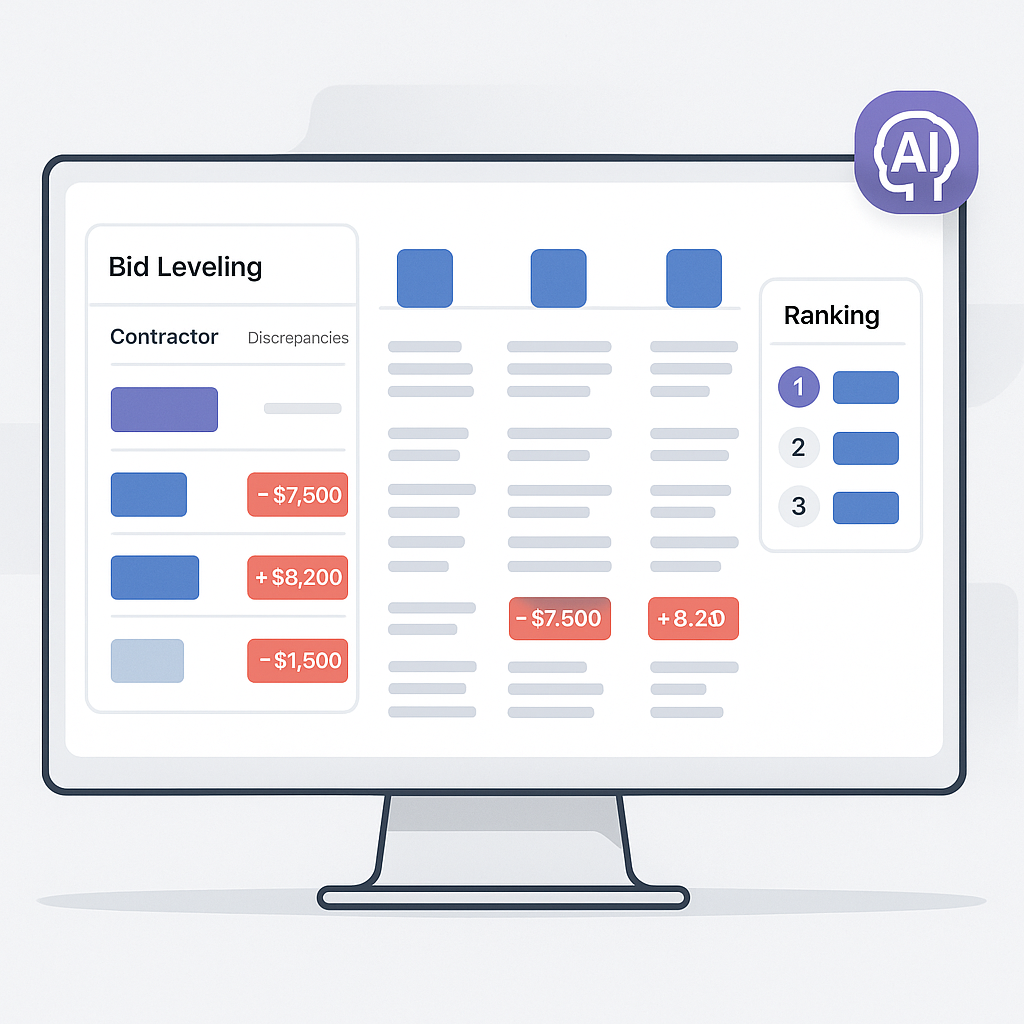
Scope Normalization: The tool identifies discrepancies in scope, exclusions, and pricing. For example, if one HVAC sub includes duct cleaning and the others don’t, the AI flags it.
-
Ranking and Insights: Once normalized, the AI ranks bids based on cost, scope completeness, and other criteria you set. You get a clear L1, L2, L3 ranking in minutes, not hours.
Real-World Example: A $20M Commercial Build
A mid-sized general contractor (GC) recently used EstimateNext to level bids for a $20M commercial build that included 12 separate scopes of work. The GC typically spent 15 hours per scope analyzing bids, but with AI, they reduced that to just 1 hour per scope. In total, they saved over 168 hours of labor. More importantly, the estimator team used the freed-up time to negotiate better terms with their shortlisted subcontractors, ultimately saving the project $300,000.
The Skeptic’s Objection: Can AI Really Replace Human Judgment?
You might be thinking, “Sure, AI can speed things up, but it doesn’t understand the nuances of our projects.” And you’re right. AI isn’t a replacement for your expertise — it’s a tool to amplify it.
What AI Can and Can’t Do
AI can process massive amounts of data quickly and identify discrepancies that are easy to overlook. But it doesn’t make the final call. It simply presents the data in a way that’s easy to digest, so you can make informed decisions faster. Think of it as having an assistant who does the grunt work while you focus on strategy.
For example, AI might flag that one subcontractor’s bid includes a lower cost for materials because they’re using a cheaper supplier. It’s up to you to decide whether that supplier meets your quality standards.
Why This Matters Now
The construction industry is under pressure like never before. With labor shortages and tighter competition, preconstruction teams are being asked to do more with less. Wasting hundreds of hours on manual processes isn’t just inefficient — it’s unsustainable.
Industry Stats to Consider
- Labor Shortages: The Associated Builders and Contractors (ABC) estimates that the construction industry needs an additional 546,000 workers to meet current demand.
- Cost Savings from AI: McKinsey estimates that early adopters of AI in construction see cost savings of 10-20% per project. For a $50M project, that’s $5M–$10M in savings.
- Time Savings: AI tools like EstimateNext can cut the time spent on bid analysis from 6 hours to 30 minutes per scope — a 12X efficiency boost.
Comparison Table: Manual Bid Leveling vs. AI-Powered Bid Leveling
| Feature | Manual Bid Leveling | AI-Powered Bid Leveling |
|---|---|---|
| Time Required | 6 hours per scope | 30 minutes per scope |
| Error Potential | High (human error) | Low (AI-based accuracy) |
| Scalability | Poor | Excellent |
| Format Compatibility | Limited | Supports PDFs, Excel, scans |
| Decision Support | Manual interpretation | Automated insights and rankings |
What’s Next?
If you’re still leveling bids manually, it’s time to rethink your process. AI tools like EstimateNext can cut the time spent on bid analysis from 6 hours to 30 minutes. That’s a 12X efficiency boost — and a lot fewer headaches.
Get started with EstimateNext free →
Call to Action
If you’re tired of wasting hours on manual bid leveling, EstimateNext can help. Get started free →


