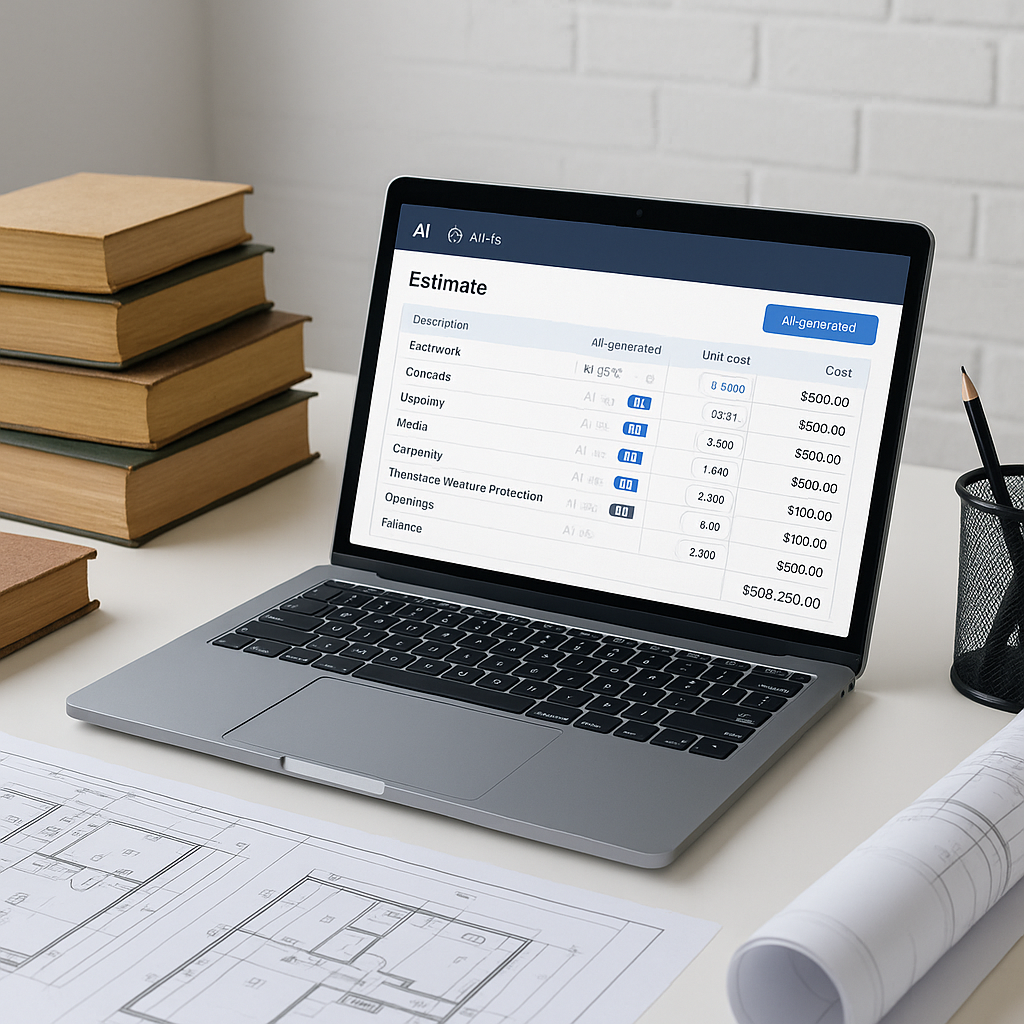
# Why Manual Rate Lookups Are Costing GCs $15,000 a Year

Imagine this: You’re leading a preconstruction team for a $50M commercial project. The clock is ticking on your bid submission deadline, and two of your estimators are flipping through a 2,000-page RSMeans book trying to find rates that match your BOQ. It’s tedious. It’s slow. And worst of all, it’s expensive.

Let’s do some quick math. Say your estimators spend 12 hours per estimate just on rate lookups. If your team handles five GMP pursuits a year, that’s 60 hours wasted annually. At an average estimator hourly rate of $130, you’re paying $7,800 just for that grunt work.

Now, let’s factor in the cost of errors. A missed rate or a miscalculation can easily lead to underbidding—or overbidding. Either way, it’s money lost. McKinsey estimates that early adopters of AI in construction save 10-20% per project. For a $50M project, even a conservative 1% miscalculation could mean a $500,000 swing in your profitability. Can your team afford that kind of risk?

### The AI Fix: Rate Matching in Seconds

This is where AI-powered estimation tools like [EstimateNext](https://estimatenext.ai/) step in. Their semantic search engine can sift through 78,000+ standardized rate items and match them to your BOQ in seconds. Yes, seconds—not hours.

For example, let’s say your team is pricing a parking garage project. You need the labor rate for rebar installation. Instead of flipping through RSMeans or CPWD DSR, you simply type “rebar installation labor” into the system. The AI pulls up the exact rate, broken down into material, labor, and equipment costs, complete with an audit trail. It even suggests appropriate inflation adjustments based on past projects and regional cost indices.

#### Case Study: Small GC Saves Big
One mid-sized GC using EstimateNext reported saving 12 hours per estimate just on rate matching. Multiply that by five GMP pursuits, and you’re saving 60 hours annually—time that can be reallocated to refining bids or negotiating with subs. And the cost? Starting at $99 per month. That’s $1,188 a year for a tool that eliminates $7,800 in manual labor costs. The ROI is a no-brainer.

#### Actionable Steps to Get Started with AI Tools
1. **Audit Your Current Workflow**: Track how much time your estimators spend on manual rate lookups over the course of a few projects. This will establish a baseline for comparison.
2. **Pilot an AI Tool**: Start with one project to test how AI-powered rate matching improves your workflow. Many platforms, including EstimateNext, offer free trials or low-cost entry plans.
3. **Train Your Team**: Most AI tools are intuitive, but a short training session will get your team up to speed faster. Focus on key features like semantic search and custom rate uploads.
4. **Measure ROI**: After your pilot project, calculate the time saved and reduced error rates. Compare this to the cost of the tool to validate its value.

### What About Custom Rates?

You’re probably thinking, “That’s great for standard rates, but my projects often involve custom finishes and materials.” Fair point. The good news? AI tools today aren’t just limited to preloaded catalogs. With platforms like EstimateNext, you can upload your own rate books or create project-specific custom rates. The system learns from your inputs, improving accuracy with each use.

#### Real-Life Example: High-End Fit-Out Contractor
For instance, a fit-out contractor specializing in high-end office spaces added their proprietary FF&E (furniture, fixtures, and equipment) catalog to EstimateNext. Now, their estimators can find and apply custom rates for bespoke items like imported Italian marble or custom millwork in seconds. No more hunting through spreadsheets or PDFs.

#### Additional Benefits of Custom Rate Management
- **Consistency Across Projects**: Centralized custom rate libraries ensure consistency, even as team members change.
- **Reduced Errors**: Manual data entry from spreadsheets is error-prone. AI reduces these risks significantly.
- **Faster Onboarding**: New estimators can quickly access your custom rate libraries and hit the ground running.

### The Obvious Objection: “AI Can’t Replace Human Expertise”

This is a common pushback I hear. And it’s true—AI isn’t a replacement for human expertise. It’s a force multiplier. Instead of spending hours on repetitive tasks like rate lookups, your estimators can focus on higher-value activities: refining cost factors, analyzing bid competitiveness, or negotiating with subs.

Think of AI as your junior estimator that doesn’t sleep, doesn’t make typos, and gets smarter every time you use it. In fact, most platforms, including EstimateNext, allow manual overrides. If the AI gets a match wrong—or if you need to tweak a rate—you can adjust it with full transparency.

#### Comparison Table: Manual Rate Lookups vs. AI-Powered Rate Matching
| Feature                     | Manual Lookups            | AI-Powered Tools         |
|-----------------------------|---------------------------|--------------------------|
| Time per Estimate          | 10-12 hours              | < 1 hour                 |
| Error Rate                 | High (human errors)       | Low (99%+ accuracy)      |
| Scalability                | Limited                  | High                     |
| Cost                       | $7,800/year per estimator| $1,188/year per license  |
| Custom Rate Integration    | Manual                   | Automated                |

### Real-World Impact: A Case Study

A mid-sized general contractor bidding on a $108M municipal water project used AI-powered rate matching for the first time. Their team saved 56 hours on rate lookups alone, freeing up their senior estimators to focus on bid strategy. The result? They submitted a more competitive bid and won the project. According to their preconstruction director, “It’s like hiring an extra estimator without the payroll.”

### Why This Matters Now

The construction industry is under pressure. Skilled labor shortages, inflation, and tighter margins mean you can’t afford inefficiencies. Tools like EstimateNext aren’t just nice-to-haves—they’re becoming essential to staying competitive. By automating low-value tasks like rate matching, you’re not just saving time; you’re reducing errors, improving bid accuracy, and freeing up your team to focus on what really matters.

### Ready to Ditch the Rate Books?

If your team is still flipping through PDFs or Excel sheets for every estimate, it’s time to rethink your workflow. AI-powered tools like EstimateNext can save you time, reduce errors, and ultimately improve your bottom line. [Get started free →](https://estimatenext.ai/)

### FAQ

**Q: How accurate are AI-powered rate matches?**
A: Most platforms, including EstimateNext, boast 99% accuracy. Plus, you can manually review and adjust matches as needed.

**Q: Can these tools handle custom rates or catalogs?**
A: Yes. Many AI tools allow you to upload custom rate books or define project-specific rates.

**Q: What’s the ROI of switching to AI for rate matching?**
A: For GCs, the time savings alone can generate a 52X return on investment. Add in reduced errors, and the financial benefits are even more significant.

**Q: Is it hard to train staff on AI estimation tools?**
A: Not at all. Most platforms are designed for ease of use, with intuitive interfaces. Training typically takes under two weeks.

**Q: Does it integrate with other software like Procore or Excel?**
A: Yes. Many tools, including EstimateNext, offer API integrations with popular construction software for seamless workflows.