Why Manual Takeoffs Are Costing You $20K Per Bid (And How AI Fixes It)
40 hours. That’s how long manual takeoffs take for most estimators. Two days of squinting at drawings, manually measuring, re-checking, and inevitably redoing some of the work when the architect sends over late revisions. It’s not a fun job, and let’s be honest—time spent on manual takeoffs doesn’t add any real value to your bid.
Now, consider this: at an average hourly rate of $130 for a senior estimator, those 40 hours cost your firm $5,200. And if you're doing 4 GMP pursuits a year, that’s $20,800 gone—just on takeoffs. Not to mention the opportunity cost of what your team could’ve been doing instead: refining bid strategies, negotiating with subs, or even chasing more projects.
AI-powered tools are changing the game. What used to take 40 hours can now be done in 10 minutes. Yes, you read that right. Let me break down how this works, why it matters, and how you can start saving time and money today.
The Brutal Math of Manual Takeoffs
Let’s start with the obvious: manual takeoffs are slow. Painfully slow. Why? Because the process hasn’t evolved much in decades. You print out the drawings (or open a PDF if you’re fancy), calibrate the scale, then painstakingly measure every dimension, wall, window, and door. Rinse and repeat for every revision.
Example: The Domino Effect of Late Revisions
Imagine you’re bidding on a $20M commercial project. You’ve spent 30 hours completing your takeoff, double-checking every measurement. Then, 24 hours before the bid deadline, the architect sends revised drawings. You now have to scramble to locate the changes, update your calculations, and ensure that your pricing aligns with the new specs. Mistakes are almost inevitable in this high-pressure scenario, and they can cost you dearly—either in underbidding or in losing the project entirely.
Mistakes are easy to make, too. Miss a line or a dimension? Guess what—you’ll either underbid and eat the cost or lose the bid altogether because your numbers look off.
In a typical year, a regional GC might pursue 4-8 GMP projects. That’s 160-320 hours spent on takeoffs alone. Multiply that by your hourly rates, and you’re staring at tens of thousands of dollars in labor costs.
But it’s not just the money. It’s also the stress. Architects love sending revisions at the 11th hour, and suddenly your team is scrambling to re-check measurements instead of focusing on the bid strategy. It’s exhausting and inefficient.
Data: The True Cost of Manual Takeoffs
- Time per project: ~40 hours
- Hourly rate for senior estimators: $130/hour
- Annual takeoff cost (4 bids): $20,800
- Error correction costs: $5K-$10K per project (due to underbidding or rework)
How AI Cuts Takeoff Time to 10 Minutes
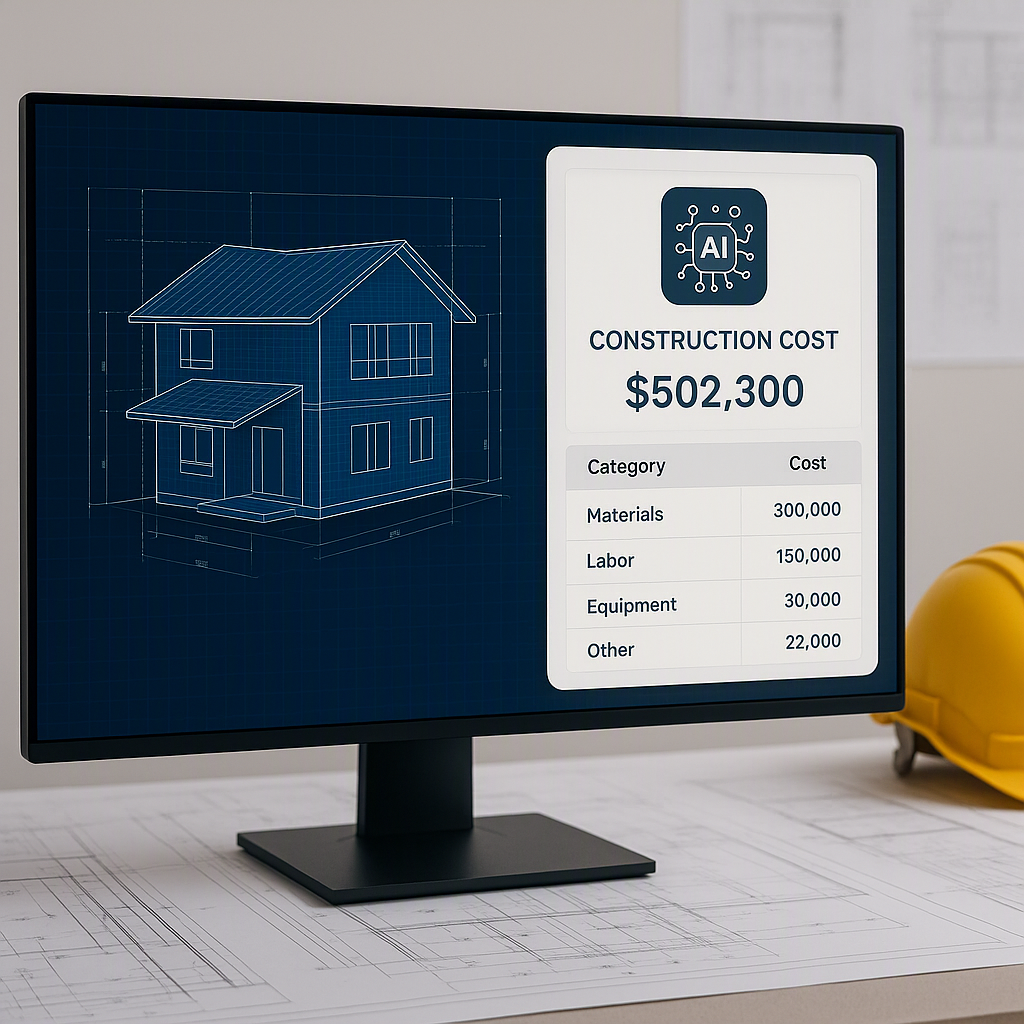
This is where AI tools like EstimateNext come in. Instead of manually measuring everything, you upload the PDF drawings, and the AI automatically extracts quantities for floors, walls, doors, windows—you name it. The process is fast, accurate, and repeatable.
Real-World Example: High-Rise Project Efficiency
Here’s a real example: A mid-sized GC bidding on a $50M high-rise project used EstimateNext’s Vision AI to automate their takeoffs. What used to take 40 hours was done in 10 minutes. That’s a 240x speed improvement. Moreover, they identified discrepancies in the architect’s revisions within minutes, saving an additional 8 hours of manual cross-checking.
And because the tool provides confidence scores and allows manual overrides, they could quickly focus on double-checking the handful of items flagged by the AI, rather than redoing the entire takeoff. This hybrid approach saved both time and reduced stress on the team.
The Revision Advantage
AI tools handle revisions like a pro. Upload a new set of plans, and the system highlights what’s changed. No more hunting through layers and trying to spot the differences manually. This is a game-changer for anyone tired of last-minute chaos.
Actionable Steps to Implement AI Takeoff Tools:
- Choose the Right Tool: Look for platforms like EstimateNext that integrate easily with your existing workflows and support common file formats (PDF, CAD, etc.).
- Set Aside Time for Training: Most tools require minimal onboarding, but allocate 2-3 hours for your team to learn the basics.
- Start with a Test Project: Use the AI tool on a smaller bid to familiarize yourself with its features before deploying it on larger, time-sensitive projects.
- Use Revision Tracking: Take advantage of revision comparison tools to eliminate the stress of last-minute plan changes.
The Obvious Objection: “AI Can’t Think Like an Estimator”
You might be thinking, “Sure, AI is fast, but it doesn’t understand the nuances of construction.” And you’re right—to an extent. AI doesn’t replace your expertise. It amplifies it.
Analogy: A Calculator for Estimators
Think of it like this: A calculator doesn’t do math for you; it just speeds up the process and eliminates errors. Similarly, AI handles the grunt work so you can focus on the strategic stuff. The AI extracts the quantities, but you’re still the one setting the markups, negotiating with subs, and making judgment calls. It’s not about replacing humans; it’s about freeing them up to do higher-value work.
Built for Real-World Accuracy
To address accuracy concerns, tools like EstimateNext include features like confidence scoring and manual override, so you’re always in control. Plus, the system gets smarter with every project, learning from your feedback to improve over time. In fact, studies show that AI-enhanced takeoffs can reduce errors by up to 80%, according to a 2022 report by Dodge Data & Analytics.
What’s the ROI?
Let’s talk dollars and cents. As I mentioned earlier, manual takeoffs cost about $5,200 per project. If you’re doing 4 bids a year, that’s $20,800 in labor costs. Now, compare that to an AI tool like EstimateNext, which costs $99/month for a GC subscription. That’s just $1,188 per year.
ROI Breakdown
| Metric | Manual Takeoffs | AI-Powered Takeoffs |
|---|---|---|
| Time per project | 40 hours | 10 minutes |
| Labor cost per bid | $5,200 | ~$100 |
| Annual cost (4 bids) | $20,800 | $1,188 |
Even if you only saved half of your takeoff time, you’d still be saving thousands of dollars per project. But realistically, you’ll save much more than that—especially on larger, more complex bids where manual takeoffs are even more time-consuming.
And then there’s the hidden ROI. Faster takeoffs mean faster bid submissions, which means you can pursue more projects. Responding to just one or two extra bids per year could mean millions in additional revenue for your firm.