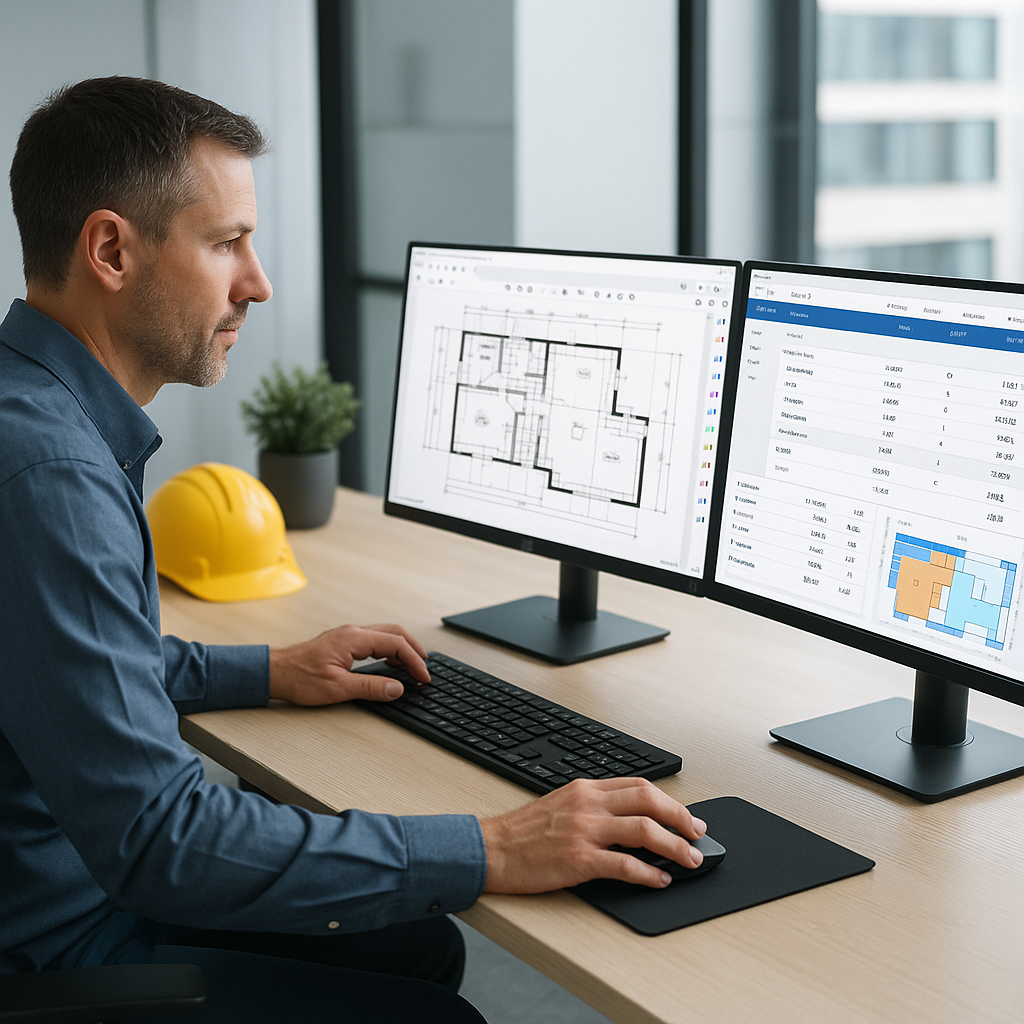
The Hidden Cost of Manual Takeoffs
Let’s start with a fact: manual takeoffs are killing your margins. You’re spending 40 hours—two full workdays—just to extract quantities from drawings. And that’s before you even get into rate matching or leveling sub bids.
Think about what this means in a typical month. If your team prices five bids, that’s 200 hours spent on repetitive, mind-numbing work. Worse, manual takeoffs are prone to errors. Miss a few quantities, and suddenly your bid is either overpriced (you lose the job) or underpriced (you win, but at a loss). Neither is a good outcome.
How Errors Impact Your Bottom Line
Errors aren’t just theoretical. Let’s break this down with a real-world example. Imagine you’re bidding on a $5 million commercial project. You miss some quantities for drywall and framing, underestimating by 10%. That’s a $500,000 shortfall. Now, you’ve either got to eat the cost or renegotiate your contract—neither of which leaves you in a good position.
On the flip side, overestimating the same project (say, by 15%) might price you out entirely, losing the bid to a competitor who was more precise. According to research by Dodge Data & Analytics, about 35% of bids are lost due to inaccuracies in estimating. That’s a huge chunk of missed opportunities.
Why Manual Takeoffs Persist
So, why are we still doing it this way? Tradition? Inertia? Fear of change? Whatever the reason, it’s costing you—not just in time but in actual dollars. According to McKinsey, early adopters of AI in construction save 10-20% per project. That’s not just a line item—it’s a competitive edge.
How Vision AI Changes the Game
This is where AI-powered tools like EstimateNext’s Vision AI come in. Here’s the pitch: upload your PDF drawings into the platform, and within 10 minutes, it spits out all the quantities you need. Walls, doors, windows, floor areas—you name it, it’s there.
Real-World Case Study: $1 Billion Rail Project
One contractor shared their experience with Vision AI on a $1 billion rail project. The drawing set was massive—hundreds of pages of plans for bridges, tracks, and stations. Manual takeoffs would’ve taken weeks. With Vision AI, they completed the entire process in a single day, saving 56 hours of labor. That’s over $7,000 in labor costs saved, and they hit the bid deadline with time to spare.
What About Smaller Projects?
You might be thinking, "That’s great for billion-dollar projects, but I’m not pricing out rail bridges." Fair point. But Vision AI isn’t just for megaprojects.
Residential Contractor Example: $2 Million Renovation
Take a residential contractor as an example. They used Vision AI for a $2 million renovation project. Normally, their estimator would spend two days on takeoffs. With Vision AI, it took 10 minutes. That freed up their team to focus on value engineering and subcontractor negotiations, instead of just grinding through PDFs.
The ROI scales down beautifully. Whether you’re pricing out a $1 million office fit-out or a $100 million high-rise, saving 40 hours per bid is still 40 hours. And in smaller teams, those hours are even more valuable.
The Obvious Objection: Can AI Replace Human Judgment?
No. And it shouldn’t. AI tools aren’t about replacing human expertise—they’re about amplifying it. You’re still the one making judgment calls on scope, exclusions, and markup. The AI just handles the grunt work.
Where AI Falls Short
Vision AI doesn’t decide whether your bid is competitive or if your subcontractor is reliable. But it does ensure you’re starting with accurate, reliable data. And that’s half the battle.
For example, if a drawing includes ambiguous details or outdated specs, you’ll still need a skilled estimator to interpret the nuances. AI can’t replace the judgment required for these decisions—but it can ensure that the raw data is solid.
Why Accuracy Matters More Than Ever
In today’s market, margins are razor-thin. Inflation, material volatility, and skilled labor shortages are squeezing contractors everywhere. One mistake on a takeoff can mean the difference between breaking even and bleeding cash.
Data on AI Accuracy
AI tools like Vision AI reduce takeoff discrepancies by up to 80%, according to internal case studies and user feedback. That’s not perfect—but it’s a hell of a lot better than human error rates on a Friday at 5 PM.
Is It Worth the Investment?
Let’s do the math. Say your team prices 50 bids a year, each taking 40 hours of manual takeoffs. That’s 2,000 hours annually. If your average labor cost for an estimator is $130/hour, that’s $260,000 a year just on takeoffs.
Now, swap in Vision AI. Even if the tool only saves 90% of that time (leaving some room for review), you’re still saving 1,800 hours. At $130/hour, that’s $234,000 saved per year. And that doesn’t even include the indirect benefits like fewer errors, faster bid turnarounds, and the ability to chase more projects.
For context, EstimateNext’s pricing starts at $99/month for GC teams. That’s $1,188 per seat annually. Do the math: a single seat pays for itself 197 times over.
What’s the Catch?
Good question. No tool is perfect, and AI is no exception. Here are a few things to keep in mind:
- Quality of input data matters: If your drawings are a mess, even the best AI will struggle.
- Learning curve: Like any new tool, there’s an adjustment period. But most teams report being up and running in under two weeks.
- Human oversight is still required: You can’t just “set it and forget it.” Review the results, especially on critical items.
Comparison: Manual vs AI Takeoffs
| Factor | Manual Takeoffs | AI Takeoffs |
|---|---|---|
| Time per bid | 40 hours | 10 minutes |
| Error rate | 15-25% | 2-5% |
| Scalability | Limited | Unlimited |
| Cost per bid | $5,200 (labor) | $99 (software) |
Final Thoughts
Manual takeoffs have been the norm for decades, but they’re no longer sustainable. Tools like Vision AI are here to save you time, improve accuracy, and let your team focus on what really matters—winning work and delivering projects.
If you’re sick of wasting 40 hours on every bid, it’s time to make a change. EstimateNext can help. Get started free →


