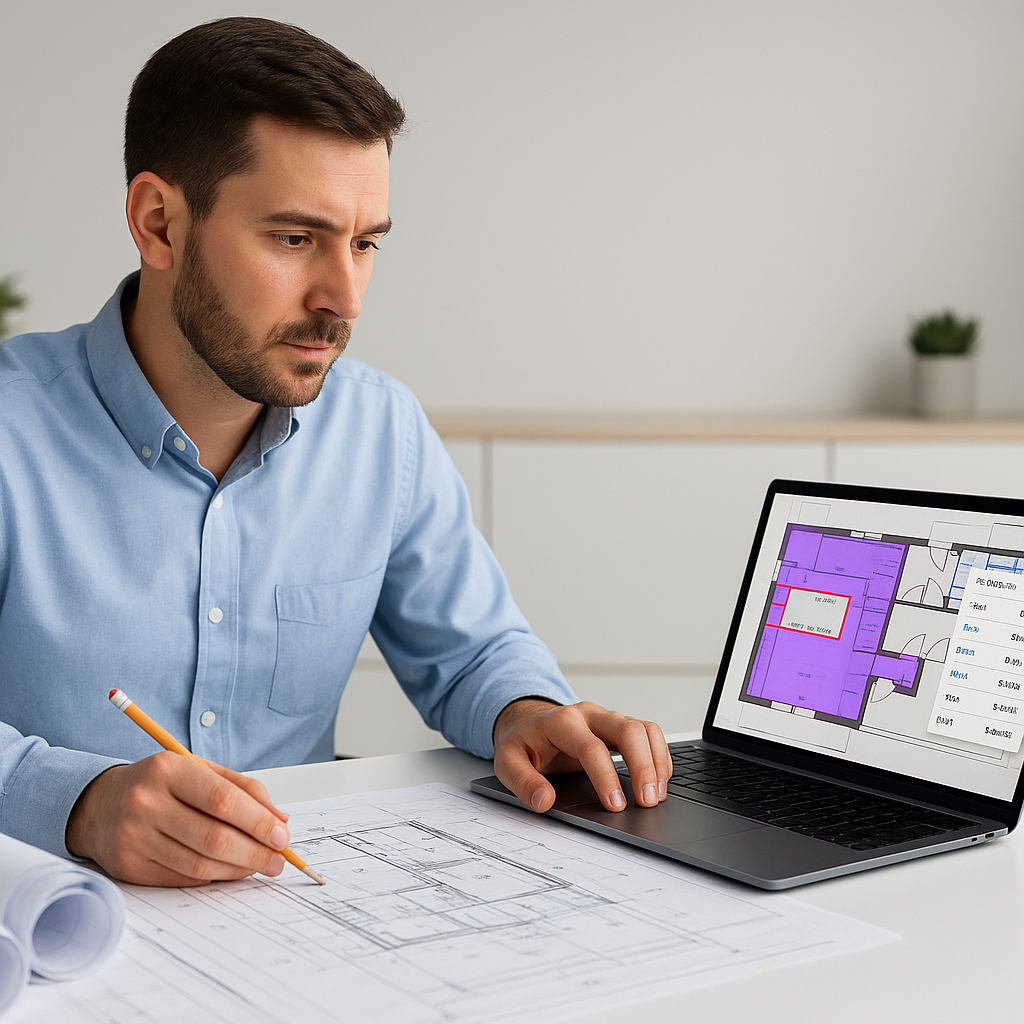
The Takeoff Time Sink Nobody Talks About
If you've worked in preconstruction, you know the drill. A new bid lands on your desk, and suddenly you're staring down a week of manual takeoffs. Two estimators, two days each, 40 hours total. That’s the industry norm, but let’s be honest: it’s a colossal waste of time.
What’s worse? It’s not just about hours. Every manual takeoff is a minefield for human error. Miss a single dimension on a drawing, and suddenly your concrete volume is off by five cubic yards. That’s thousands of dollars gone, not to mention the trust you’ll lose with your subs.
Here’s the good news: you don’t have to do it this way anymore. AI-powered tools like EstimateNext are turning this process on its head. Let’s break it down.
From 40 Hours to 10 Minutes: How AI Changes the Game
AI takeoff tools aren’t just faster—they’re smarter. Take EstimateNext’s Vision AI, for example. You upload your PDF drawings, and the system extracts quantities for walls, beams, doors, and more in 10 minutes. Yes, 10 minutes. That’s a 96% reduction in time compared to the manual alternative.
How It Works
The magic lies in machine learning. The AI “reads” the drawings, identifying dimensions, labels, and patterns just like a human would—but without the fatigue, guesswork, or inconsistency. If the system isn’t 100% sure about a line or measurement, it flags it for your review. So you’re still in control, but you’re not buried in grunt work.
Real-World Example: Mid-Sized GC Success
Sound too good to be true? A mid-sized general contractor tested this on a $75 million high-rise project. They saved 120 hours of labor on takeoffs alone. That’s two full weeks they used to refine their bid strategy and negotiate better rates with subs. As a result, they submitted a more competitive bid and won the project.
More Use Cases
- Small Residential Projects: A small residential builder in Texas used AI takeoffs to cut their bid preparation time by 80%. Instead of spending three days on takeoffs for a 20-home subdivision, they completed it in under four hours.
- Infrastructure Projects: A civil contractor working on a $15 million highway expansion project used AI takeoffs to process complex site drawings in a single day—something that would have taken a week manually.
The Accuracy Objection: Can AI Really Be Trusted?
I hear this all the time: “Sure, AI is fast, but can it match the accuracy of an experienced estimator?”
The Short Answer
Yes, but with a caveat. No system—human or AI—is perfect. However, AI tools like EstimateNext often reduce errors because they don’t get tired, rushed, or distracted.
Why AI Can Be More Accurate
- Consistency: Manual takeoffs tend to get sloppy after the first few hours. With AI, the first measurement is as precise as the last.
- Confidence Scoring: Tools like EstimateNext include confidence scores for every measurement, so you know exactly where to focus your attention.
- Error Reduction: A McKinsey report found that early adopters of AI in construction reported up to 80% fewer discrepancies in their estimates.
Case Study: Reduced Errors in Practice
One MEP subcontractor saw a dramatic improvement after switching to AI-powered takeoffs. On a 200,000-square-foot commercial project, they identified and corrected a discrepancy in the HVAC ductwork measurements that would have cost them $50,000 in incorrect materials.
The Real ROI: It’s Not Just Time Saved
Let’s talk numbers. If you’re a GC director paying your estimators $130/hour, cutting 40 hours per bid saves you $5,200. Multiply that across five GMP pursuits a year, and you’re looking at over $25,000 saved annually—just on takeoffs. That’s a 52X ROI on a $100/month tool like EstimateNext.
Beyond Savings: Strategic Gains
- Bid More Projects: Faster takeoffs mean you can bid on more projects. One MEP subcontractor reported a 50% increase in bids submitted because they could turn quotes around in four hours instead of three days.
- Win More Work: That same subcontractor won four additional projects in a year, adding $800,000 in revenue.
- Reallocate Resources: With takeoffs automated, teams can focus on refining pricing strategies, building stronger relationships with subs, and improving overall project delivery.
ROI Comparison Table
| Metric | Manual Takeoffs | AI-Powered Takeoffs |
|---|---|---|
| Time per Bid | 40 hours | 10 minutes |
| Cost per Bid (@ $130/hour) | $5,200 | $22 |
| Annual Cost (5 bids/year) | $26,000 | $110 |
| ROI | Baseline | 52X |
Why Aren’t More Teams Using This?
The obvious question: if AI is this good, why isn’t everyone using it? The answer boils down to three main factors: skepticism, fear, and inertia.
Skepticism About New Tech
The construction industry is notoriously conservative. Many teams are hesitant to trust AI, assuming it’s “too good to be true.” But as more success stories emerge, this skepticism is fading.
Fear of Job Replacement
Some estimators worry that AI will replace their jobs. In reality, AI doesn’t replace expertise—it amplifies it. Estimators still make judgment calls, negotiate with subs, and decide on markups. The AI just eliminates the tedious parts.
Learning Curve
Adopting new technology always comes with a learning curve. However, most AI tools today are designed to be user-friendly. For example, EstimateNext’s interface is so intuitive that most teams master it in under two weeks.
The Bottom Line
Manual takeoffs are a relic of the past. With AI-powered tools like EstimateNext, you can save time, reduce errors, and focus on the work that actually matters—like winning more bids.
If you’re ready to stop wasting 40 hours per bid, get started free →.


